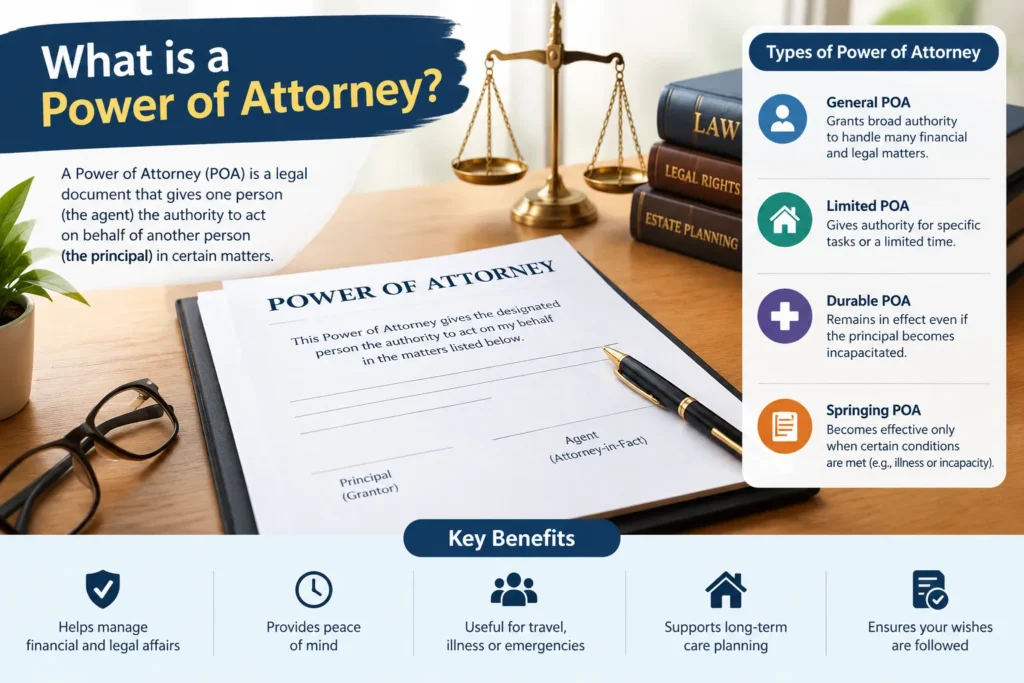

A power of attorney (POA) is a legal document that allows one person to authorize another person to act on their behalf in specified matters. It can be used to manage finances, handle property transactions, pay bills, or make certain healthcare decisions when permitted by law. The exact authority depends on the document’s wording and the rules of the country or state where it is used.
The person granting the authority is called the principal, while the appointed representative is known as the agent or attorney-in-fact. In some countries, different terms are used for these roles. A power of attorney can be useful for people who travel frequently, own property in another location, need help managing financial responsibilities, or want to prepare for possible future incapacity.
In 2026, power-of-attorney arrangements remain an important part of legal and financial planning in countries such as the United States, the United Kingdom, Canada, Australia, and New Zealand. Although these countries share the general principle of appointing someone to act on another person’s behalf, their legal requirements are not identical.
Quick Facts About Power of Attorney
| Detail | Information |
| Full term | Power of attorney |
| Abbreviation | POA |
| Person granting authority | Principal |
| Appointed representative | Agent or attorney-in-fact |
| Main uses | Financial, property, business, and other permitted decisions |
| Common US terminology | Durable and nondurable POA |
| Common UK terminology in England and Wales | Lasting power of attorney |
| Common Australian terminology | General and enduring power of attorney |
| Common New Zealand terminology | Enduring power of attorney |
| Signing requirements | Depend on jurisdiction and document type |
| Can it be revoked? | Generally, subject to applicable law and capacity |
| Does it normally continue after death? | No |
What Is a Power of Attorney?
A power of attorney gives a chosen person legal authority to handle specific responsibilities for someone else. For example, a property owner who cannot attend a transaction personally may authorize an agent to complete certain paperwork on their behalf.
The document can also support longer-term planning. Someone who wants to prepare for a possible future illness may establish an appropriate power of attorney while they still have the legal capacity to make that decision. Depending on the document, the appointed person may later be able to manage financial affairs or make other permitted decisions.
A power of attorney does not automatically transfer ownership of the principal’s assets. It grants authority to act within the limits of the document. The agent must follow the applicable legal duties and should not treat the principal’s money or property as their own.
Who Needs a Power of Attorney?
A power of attorney can be useful for adults who want a trusted person to handle particular responsibilities when they cannot do so personally. It is not limited to older people or those with an existing medical condition.
A person living abroad might use a POA to authorize someone to manage a property transaction in their home country. A business owner might need a representative to complete a specified administrative task while travelling. Someone planning for future incapacity might arrange a durable or enduring document where local law permits it.
The right arrangement depends on personal circumstances. Some people need authority for a single transaction, while others prefer a document designed to support ongoing financial management.
Main Types of Power of Attorney
The terminology differs by jurisdiction, but several common arrangements appear in power-of-attorney systems.
General Power of Attorney
A general power of attorney grants broad authority over the matters described in the document. Depending on the applicable law, an agent may be authorized to manage multiple financial or administrative responsibilities.
This type may be appropriate when someone needs help with a range of affairs for a defined period. However, broader authority requires careful consideration because the agent may be able to carry out significant transactions on the principal’s behalf.
A general POA is not necessarily durable. In jurisdictions where ordinary authority ends upon incapacity, it may not provide the protection required for long-term planning.
Limited or Special Power of Attorney
A limited power of attorney restricts the agent’s authority to specific tasks. A principal might use one to authorize the signing of a particular contract, completion of a property transaction, or management of a defined business matter.
The document should explain the task clearly and specify any relevant limits or ending conditions. This helps reduce the risk of the agent acting outside the principal’s intentions.
Limited powers can be particularly useful when broad authority is unnecessary. However, the wording must still meet the requirements of the jurisdiction and the organization that will receive the document.
Durable or Enduring Power of Attorney
A durable or enduring power of attorney is designed to continue operating in circumstances where an ordinary POA might end, including certain situations involving loss of decision-making capacity.
The terminology varies by country and state. In the United States, durable power of attorney is widely used, while enduring power of attorney is common in Australia and other jurisdictions.
These documents can form part of long-term planning. Their effectiveness depends on proper execution, the scope of the authority granted, and the relevant legal requirements.
Springing Power of Attorney
A springing power of attorney becomes effective only when a specified condition is met. For example, the document may state that the agent’s authority begins after a required determination of incapacity.
This arrangement can give the principal greater control over when another person may begin acting. However, the triggering condition must be clearly defined and workable under the applicable law.
Not every jurisdiction treats springing powers in the same way. Before using this arrangement, confirm that it is permitted and that the document explains how the condition will be established.
Healthcare Power of Attorney
A healthcare power of attorney allows an appointed person to make specified medical or personal welfare decisions when the relevant legal conditions are met.
The authority may relate to treatment, care arrangements, or other permitted healthcare matters. It is separate from financial authority, even if the same person is appointed to both roles.
The terminology and scope differ between jurisdictions. Some countries use separate advance directives or welfare appointment documents instead of the US-style healthcare POA.
What Can an Agent Do?
An agent’s responsibilities depend on the authority granted. A financial POA may allow the agent to pay bills, manage specified accounts, communicate with financial institutions, or handle certain property transactions.
In other arrangements, the agent may be permitted to manage investments, collect income, or complete defined business activities. Some transactions require specific wording or additional authorization.
A healthcare representative may have different responsibilities, subject to the relevant document and law. A financial power of attorney should not automatically be treated as permission to make healthcare decisions.
Agents also have responsibilities. They must act within their authority and comply with applicable duties, which may include keeping accurate records, protecting the principal’s assets, and avoiding unauthorized personal benefit.
How to Get a Power of Attorney
The process varies by country, but the following steps provide a useful starting point.
Step 1: Identify the Purpose
Decide which responsibilities need to be covered. You may require assistance with finances, property, business matters, healthcare, or one specific transaction.
Identifying the purpose first helps you choose a suitable document and avoid granting more authority than necessary.
Step 2: Choose a Trusted Person
Select someone who is responsible, understands the duties involved, and is willing to act in your interests. Consider the person’s financial judgment, availability, and ability to follow instructions.
You may also be able to appoint a successor or additional agent, depending on local law and the document’s terms.
Step 3: Define the Authority
Explain which actions the agent may perform and any restrictions that apply. If the document covers a specific transaction, identify it clearly.
For long-term planning, consider when the authority should begin and whether it should continue if you later lose decision-making capacity.
Step 4: Use the Correct Legal Form
Use a form that meets the requirements of the relevant jurisdiction. Official government forms may be available for certain types of appointments, but a complex transaction may require professional drafting.
An online template should not be assumed to be valid in every state or country.
Step 5: Complete the Formalities
Depending on the document, signing may require witnesses, notarization, certification, registration, or other legal steps. These requirements should be confirmed before signing.
Step 6: Store the Document Securely
Keep the completed document somewhere safe and accessible. Share it with the agent and relevant institutions when appropriate.
If the document is changed or revoked later, notify the people and organizations that need to know.
Power of Attorney in the United States
In the United States, powers of attorney are commonly used for financial planning, property management, and preparing for possible incapacity. The person granting authority is generally called the principal, and the appointed representative is called the agent or attorney-in-fact.
State law determines many of the requirements, including signing formalities, durability, and revocation. A document that meets one state’s rules should not automatically be assumed to satisfy every other state’s requirements.
A durable financial POA can be especially useful for advance planning because it may allow an agent to continue managing permitted affairs after the principal becomes incapacitated. Without an appropriate arrangement, a family member may need to seek court authority to manage certain matters.
People preparing a US POA should check their state’s current requirements and consider legal advice when the arrangement involves substantial assets, property, or complex instructions.
Power of Attorney in the United Kingdom
The United Kingdom does not have one identical power-of-attorney process for every part of the country. England and Wales use lasting powers of attorney, while Scotland and Northern Ireland have different legal arrangements.
In England and Wales, there are two main types of lasting power of attorney: one covering property and financial affairs, and another covering health and welfare. An eligible adult can appoint one or more attorneys, and the document must be registered before it can be used.
A property and financial affairs LPA can cover matters such as paying bills and managing accounts. A health and welfare LPA concerns permitted personal care and healthcare decisions and can generally be used only when the donor lacks the capacity to make the relevant decision.
As of October 2026, the published application fee for registering an LPA in England and Wales is £92, although reductions or exemptions may be available. Registration commonly takes around eight to ten weeks if the application contains no errors.
People in Scotland or Northern Ireland should use the procedures that apply to their own jurisdiction rather than relying on England and Wales forms.
Power of Attorney in Canada
Canada’s power-of-attorney arrangements are governed primarily by provincial and territorial law. Financial documents may be described as general, enduring, or continuing powers of attorney, depending on the jurisdiction.
A financial POA can authorize an appointed person to manage specified accounts, pay bills, or handle property-related matters. An enduring or continuing arrangement may remain effective after the principal becomes mentally incapable, provided the document meets local legal requirements.
Healthcare and personal-care decisions may require a separate document or appointment. The terminology and permitted powers differ across provinces and territories.
Anyone preparing a POA in Canada should check the current rules for the province or territory involved. A document created in one province may not automatically satisfy every requirement in another.
Power of Attorney in Australia
Australia uses powers of attorney for financial and property matters, with different rules across states and territories. General powers and enduring powers serve different purposes.
A general POA may authorize an agent to handle specified financial tasks, but it may not continue after the principal loses decision-making capacity. An enduring power of attorney is designed to continue in circumstances permitted by the relevant jurisdiction.
The document may cover financial or property decisions, while personal and medical decisions can involve separate appointments under local law. Requirements for witnessing, execution, and revocation also differ.
Before signing, Australians should consult the official guidance for the state or territory where the document will be used.
Power of Attorney in New Zealand
New Zealand uses enduring powers of attorney (EPAs) for advance planning. There are two main types: one relating to property and another covering personal care and welfare.
A property EPA can authorize a representative to manage specified financial or property matters. A personal care and welfare EPA covers permitted personal decisions under the applicable legal framework.
The rules governing when an EPA can be used depend on its type and terms. The document must be prepared correctly, and the appointed attorney must follow the legal duties that apply to the role.
People preparing an EPA should confirm the current requirements and ensure that the chosen representative understands the responsibilities involved.
Power of Attorney in Ireland
Ireland has its own legal framework for enduring powers of attorney and supported decision-making arrangements. Its procedures should not be assumed to match those of the United Kingdom.
An enduring power of attorney can form part of planning for a future period when a person may be unable to make certain decisions independently. The scope of the authority and the applicable procedures depend on the current Irish legal framework.
People considering this arrangement should seek guidance from an appropriately qualified Irish legal professional and verify any registration or other formal requirements.
Power of Attorney in South Africa
South Africa recognizes powers of attorney for specified legal, financial, and property-related matters. The document’s scope depends on its wording and the applicable law.
One important consideration is what happens if the principal loses the legal capacity required to manage their affairs. A conventional power of attorney should not automatically be assumed to provide the same continuing authority as an enduring arrangement in another jurisdiction.
People who need advance planning for incapacity should obtain South African legal advice about the available options, their limitations, and any additional arrangements that may be necessary.
Can a Power of Attorney Be Used Internationally?
A power of attorney prepared in one country is not automatically accepted in another. Recognition depends on the destination country’s law, the type of transaction, the wording of the document, and the requirements of the organization receiving it.
For example, someone living in the United States who owns property in Pakistan may need a document that satisfies the requirements of the relevant Pakistani authority or institution. Similar issues can arise when overseas property, bank accounts, or business interests are involved.
Depending on the circumstances, additional steps may include translation, notarization, authentication, apostille, consular procedures, or local registration. These requirements are not universal.
Before preparing an international power of attorney, confirm the receiving country’s requirements and seek advice from a qualified professional familiar with both jurisdictions.
Power of Attorney Costs
The cost of creating a POA depends on the country, document type, complexity, and method of preparation. Some jurisdictions provide official forms, while others may require additional professional assistance for particular arrangements.
Possible expenses include legal fees, notarization, witnessing, registration, translation, and document authentication. International transactions can involve additional costs when documents must be prepared for use abroad.
There is no single price that applies to every power of attorney worldwide. Before relying on a cost estimate, identify the relevant jurisdiction and check the current official fees and professional charges.
Risks and Safety Measures
A POA gives another person authority over important matters, so choosing the right agent is essential. Potential problems include unauthorized spending, conflicts of interest, misuse of personal information, or transactions outside the scope of the document.
The principal can reduce these risks by limiting the agent’s authority, choosing someone trustworthy, documenting instructions, and considering appropriate oversight. Depending on the arrangement, it may be useful to require the agent to keep records or provide reports to another trusted person.
An agent should not use the principal’s assets for personal benefit unless the document and applicable law expressly permit the action. If abuse is suspected, prompt legal advice may help determine the available remedies.
Can a Power of Attorney Be Cancelled?
A principal who retains the required legal capacity can generally revoke a POA, subject to the applicable law and document terms.
The revocation should be communicated appropriately to the agent and relevant institutions. If the original document was supplied to a bank, government agency, or property authority, those parties may need formal notice before their records can be updated.
Simply destroying a copy may not be enough to notify everyone who has relied on the document. A lawyer can help determine the appropriate procedure where the arrangement is complex or disputed.
A POA generally ends when the principal dies. The administration of the estate then follows the applicable inheritance and estate procedures rather than the ordinary authority granted under the POA.
Final Thoughts
A power of attorney is a valuable legal planning tool that allows someone to appoint a trusted representative to handle specified responsibilities. It can simplify financial administration, support property transactions, and help people prepare for situations in which they may need assistance with decision-making.
However, the document must match the principal’s needs and comply with the relevant legal requirements. A US durable power of attorney, an English and Welsh lasting power of attorney, a Canadian enduring POA, and an Australian enduring power of attorney are not interchangeable legal documents.
Before signing, consider the authority being granted, the person appointed, the safeguards needed, and the rules of the jurisdiction where the document will be used. Careful preparation can reduce confusion and help protect the principal’s interests.
Frequently Asked Questions
What is a power of attorney in simple words?
A power of attorney is a legal document that authorizes someone else to act on your behalf for specified matters.
What are the main types of power of attorney?
Common types include general, limited, durable, enduring, springing, and healthcare powers of attorney. The available options depend on the jurisdiction.
Does a power of attorney work in every country?
No. A document may require additional authentication, translation, or legal formalities before it can be accepted in another country.
How much does a power of attorney cost in 2026?
The cost depends on the jurisdiction, type of document, legal assistance required, and any witnessing, notarization, or registration fees.
Can a power of attorney be used after incapacity?
A properly prepared durable or enduring POA may continue after incapacity where permitted by law. Ordinary powers may end when the principal loses the required capacity.
Can I cancel a power of attorney?
Generally, a principal who has the necessary legal capacity can revoke a POA, subject to local law and the document’s requirements.
Does a power of attorney continue after death?
Ordinary POA authority generally ends when the principal dies. Estate matters are then handled under the applicable legal procedures.
Continue Exploring Our Latest Article: CNLawBlog: A Complete Guide to Its Features and Legal Resources


