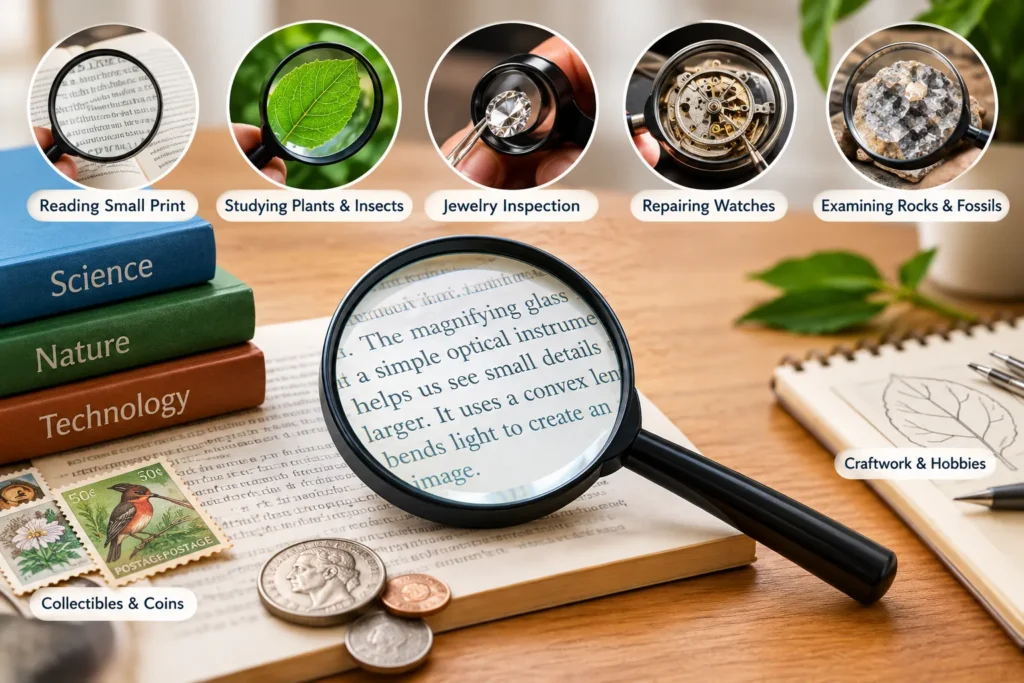

A magnifying glass is an optical tool used to make small objects, tiny letters, and fine details appear larger and easier to examine. It usually contains a convex lens that bends light to create an enlarged image when an object is placed at the correct distance. People use magnifying glasses for reading small print, studying plants and insects, inspecting jewelry, repairing watches, examining rocks, and completing detailed craftwork.
Although a magnifying glass is a simple instrument, it has many practical uses in everyday life, education, science, and professional work. Understanding how it works and when to use it can help readers choose the right magnifier for a particular task.
What Is a Magnifying Glass?
A magnifying glass is a handheld optical instrument that helps people see details that are difficult to distinguish with normal vision. Traditional models consist of a lens fitted inside a frame, often with a handle. Modern versions may include built-in lighting, adjustable stands, or additional lenses for specialized work.
Most ordinary magnifying glasses use a convex lens, which curves outward and is generally thicker in the middle than at the edges. This lens changes the direction of light entering the eye, allowing a nearby object to appear larger than it does without the magnifier. Magnifying glasses are available in different sizes and strengths. A small handheld model can be convenient for reading labels, while a larger illuminated magnifier may be more suitable for prolonged inspection or detailed work.
What Is a Magnifying Glass Used For?
The main purpose of a magnifying glass is to make small details easier to see. Its usefulness depends on the object being examined, the lens strength, and the level of detail required.
1. Reading Small Print
One common use is reading text that appears too small to view comfortably. A magnifying glass can help people inspect product labels, medicine packaging, instruction manuals, maps, and the fine print found on documents.
It can also help readers examine small letters on collectible cards, stamps, and printed materials. A suitable magnifier makes the text appear larger without requiring the user to enlarge a digital document or print another copy.
People who regularly struggle with reading should consider whether a suitable optical aid or a professional vision assessment would better meet their needs.
2. Studying Plants and Insects
Students, gardeners, and nature enthusiasts use magnifying glasses to examine details on living things. A leaf may reveal visible veins, small surface structures, or signs of insect damage that are difficult to notice from a normal viewing distance.
The tool is also useful for observing the external features of insects, including wings, legs, antennae, and body patterns. These observations can support classroom activities, gardening, and basic nature studies.
A magnifying glass does not reveal every microscopic structure. However, it provides a simple way to investigate objects without the complexity of laboratory equipment.
3. Inspecting Jewelry and Gemstones
Jewelers use magnification to examine gemstone surfaces, small scratches, metal settings, and the details of decorative work. A specialized jeweler’s loupe is often preferred because it is compact and designed for close inspection.
Collectors may also use magnifiers to examine gemstones, coins, watches, and other valuable items. The enlarged view can help reveal visible characteristics that might otherwise be overlooked.
However, magnification alone cannot confirm that a gemstone is genuine or establish its complete value. Professional identification may require additional instruments and testing methods.
4. Repairing Watches and Small Components
Watchmakers and repair technicians often work with parts that are too small to inspect comfortably with the naked eye. Magnifying lenses can help them view gears, screws, connections, and other fine mechanical details.
The same principle applies to hobbyists who build miniature models or repair small household objects. An appropriate magnifier can improve visibility while working on intricate tasks.
For electronics repair, the best choice depends on the component size and working distance. Some technicians use illuminated magnifiers or specialized inspection microscopes when a basic handheld lens does not provide enough detail.
5. Examining Rocks, Minerals, and Fossils
Geologists and rock collectors use magnifying glasses to inspect visible features of natural specimens. They can examine mineral grains, crystal shapes, fossil surfaces, and the texture of rocks.
These observations can provide useful clues when comparing specimens or identifying visible characteristics. For example, a magnifier may reveal differences in grain size or help someone inspect the surface of a fossil.
A handheld lens is not sufficient to identify every mineral or fossil with certainty. Some materials require laboratory analysis, hardness testing, or more powerful optical equipment.
6. Supporting Education and Science Experiments
Magnifying glasses are useful educational tools because they allow students to explore the relationship between light, lenses, and image formation. Teachers can use them during activities involving leaves, fabric, seeds, paper, soil, and other everyday materials.
Students can compare an object’s appearance with and without a magnifier and record the differences they observe. These simple exercises introduce ideas about observation, optical instruments, and the importance of examining evidence carefully.
Educational resources also use magnifying glasses to demonstrate how convex lenses bend light and produce enlarged images.
7. Inspecting Fabric and Craftwork
People who sew, knit, embroider, or restore textiles may use magnification to examine stitches, threads, and small defects. It can help them identify loose fibers, damaged seams, and fine details in decorative patterns.
Artists and model makers may also benefit from a magnifying glass when working on miniatures or other projects that require precision. An illuminated model can be especially useful when the work involves small parts or low-contrast details.
The best magnifier depends on the task. A wide lens may provide a larger viewing area, while a smaller high-power lens may be more suitable for inspecting one specific feature.
8. Examining Paper, Coins, and Collectibles
Collectors often inspect coins, stamps, banknotes, and historical documents using magnification. It can help reveal printing details, surface marks, patterns, and signs of wear.
For coin collectors, a magnifier may assist with examining dates, lettering, mint marks, and small design features. Stamp collectors can use one to inspect printed patterns, perforations, and visible damage.
These observations can support a preliminary assessment, but they do not automatically establish authenticity. Counterfeit detection and professional valuation may require additional expertise and specialized tools.
9. Helping With Detailed Personal Tasks
A magnifying glass can also assist with everyday activities that require close visual inspection. Examples include reading small appliance labels, threading a needle, examining tiny fasteners, or locating a small mark on an object.
Some people prefer handheld magnifiers, while others find stand-mounted or illuminated versions easier to use. The right design depends on the task, comfort, lighting, and how long the tool will be used.
For people with ongoing difficulty seeing ordinary text or objects, a low-vision specialist can recommend appropriate magnification options.
How Does a Magnifying Glass Work?
A typical magnifying glass uses a convex lens to refract, or bend, light. When the object is positioned closer to the lens than its focal length, the lens produces an image that appears enlarged and upright. This is called a virtual image because the light rays reaching the eye appear to come from the image, rather than actually meeting at that location. The eye receives the light passing through the lens and forms an image on the retina. Because the lens allows the object to be viewed at a more favorable angle, its details appear larger than they would when viewed directly from the same close distance.
The distance between the object and the lens matters. Moving the lens or object can change the focus and clarity, so users may need to adjust their positions until the image becomes sharp.
What Are the Different Types of Magnifying Glasses?
Magnifiers come in several designs, each suited to different tasks.
Handheld Magnifying Glass
A handheld magnifier usually has a lens mounted in a frame with a handle. It is easy to carry and useful for occasional reading, examining small objects, or completing simple inspection tasks.
Illuminated Magnifier
An illuminated magnifier combines a lens with a built-in light source. The additional light helps make details easier to distinguish when the surroundings are dim or the object has a dark surface.
Stand Magnifier
A stand magnifier rests on or above the object being examined. It can be useful when both hands are needed for sewing, model making, repairs, or other detailed work.
Jeweler’s Loupe
A jeweler’s loupe is a compact magnifier designed for close inspection. It is commonly used to examine gemstones, watches, and small collectible objects.
Sheet Magnifier
A sheet magnifier is a thin, broad magnifying lens that can cover a larger area of printed text. It may be useful for reading books, maps, newspapers, or documents.
What Determines the Magnifying Power?
The magnifying power of a lens depends on its optical properties and how it is used. One important property is the focal length, which describes the distance associated with the lens’s focusing behavior.
For a simple magnifier, a shorter focal length generally allows greater angular magnification under comparable viewing conditions. However, greater magnification does not automatically mean that the image will be clearer or more useful.
Lens quality, lighting, viewing distance, and the user’s eyesight also affect the experience. A very powerful lens may show a smaller area at once, making it less convenient for reading full lines of text.
When choosing a magnifier, consider the size of the object, the level of detail required, and the working distance that feels comfortable.
Can a Magnifying Glass Start a Fire?
Yes. A suitable convex lens can concentrate direct sunlight into a small area. Under the right conditions, this concentrated energy can heat a combustible material enough to cause ignition.
The outcome depends on factors such as sunlight intensity, lens characteristics, the position of the focal spot, and the material being heated. Not every magnifying glass or lighting condition will produce ignition.
Safety is essential: Never leave a magnifying glass in direct sunlight where it can focus light onto paper, fabric, dry vegetation, or other flammable materials. Do not look directly at the Sun through a magnifying glass, because concentrated sunlight can seriously damage the eyes.
Magnifying Glass vs. Microscope
A magnifying glass and a microscope both help people examine small objects, but they are designed for different levels of detail.
A magnifying glass is a simple optical instrument that usually contains one convex lens. It is convenient for close inspection of visible features, reading small text, and examining everyday objects.
A compound microscope uses an objective lens and an eyepiece, or an equivalent optical system, to provide substantially greater magnification and resolution for suitable specimens. It is more appropriate for observing details such as cells and other structures that a handheld magnifier cannot resolve.
The choice depends on the task. A magnifier is often sufficient for a quick inspection, while a microscope is preferable when the object contains details too small to distinguish with a simple lens.
How to Use a Magnifying Glass Correctly
Using a magnifying glass effectively requires a little adjustment.
First, place the object in a well-lit area. Hold the magnifier between your eye and the object, then move the lens or the object slowly until the details become clear.
Next, keep the lens steady while examining the feature you want to see. If the image looks blurry, adjust the distance rather than assuming that a stronger magnifier is necessary.
For prolonged work, choose a comfortable position and adequate lighting. If you are inspecting small components, make sure the magnifier does not interfere with the tools or movements needed to complete the task.
Always handle glass lenses carefully and store the instrument where it will not be damaged.
Benefits and Limitations of a Magnifying Glass
Benefits
A magnifying glass is simple to operate, portable, and useful for many everyday tasks. It does not usually require batteries or a power supply unless it includes built-in lighting.
It can also support learning by allowing students to observe details in familiar objects. For hobbies and professional inspection, it provides a convenient way to examine small features without setting up a larger optical instrument.
Limitations
A magnifying glass cannot reveal every detail of an object. Its resolving ability is limited, and its performance depends on lens quality, focus, lighting, and the user’s eyesight.
High magnification can also reduce the visible area, making it harder to follow a long line of text or inspect a large surface. For very small structures, a microscope or specialized optical equipment may be more suitable.
Frequently Asked Questions
What is the main purpose of a magnifying glass?
Its main purpose is to make small objects and fine details appear larger so they are easier to inspect. Common uses include reading small print, studying natural specimens, and examining jewelry.
Which type of lens is used in a magnifying glass?
A conventional magnifying glass uses a convex lens. When an object is placed within the lens’s focal length, it produces an enlarged, upright virtual image.
Can a magnifying glass be used for scientific work?
Yes. Students, naturalists, and researchers use magnifiers to inspect visible features of plants, insects, minerals, fossils, and other specimens. More detailed investigations may require a microscope.
Does a magnifying glass make an object physically larger?
No. It changes how the object appears to the observer. The actual size of the object remains unchanged.
Is a magnifying glass the same as a microscope?
No. A simple magnifying glass usually uses one lens, while a compound microscope uses multiple optical elements to examine much smaller details.
Why can a magnifying glass burn paper?
A convex lens can concentrate direct sunlight into a small spot, increasing the temperature of a combustible surface. This can cause ignition under suitable conditions, so magnifying glasses should be kept away from uncontrolled sunlight.
Final Wordings
A magnifying glass is a practical optical tool for examining small details in reading materials, natural specimens, jewelry, collectibles, crafts, and mechanical components. Its simple design makes it useful in homes, classrooms, workshops, and professional settings.
Choosing the right magnifier depends on the object being examined, the amount of detail needed, and the conditions in which it will be used. For routine close inspection, a handheld lens may be sufficient; for extremely fine structures, a microscope or specialized instrument may provide better results.
Understanding these differences helps people use magnification effectively while recognizing its limitations and following basic optical safety precautions.
Continue Exploring Our Latest Article: Nemin.io in 2026: Exploring Free Marketing Tools and Business Resources