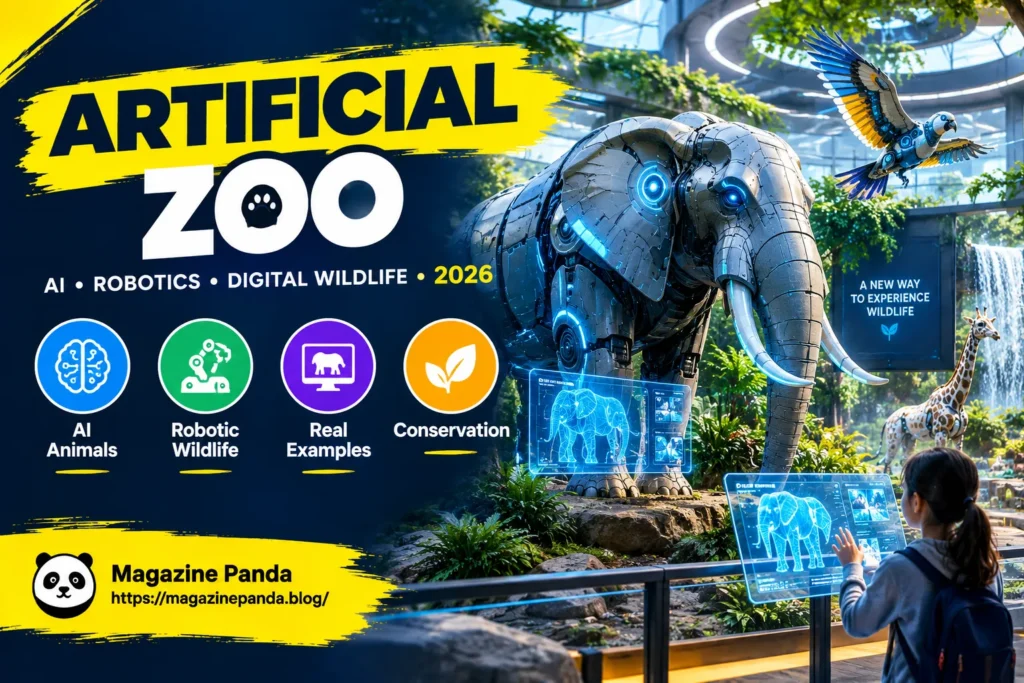

An artificial zoo is a modern wildlife attraction that uses technology to recreate the experience of observing animals without necessarily keeping living creatures inside enclosures. It can combine holographic projections, virtual reality, augmented reality, artificial intelligence, computer-generated environments, and robotic animals to create interactive wildlife experiences.
The concept offers a different way to explore nature, particularly for people who want to learn about wildlife through digital entertainment. Visitors may encounter a virtual elephant walking across a digital savannah, watch a holographic whale swimming through an underwater environment, or observe mechanical animals demonstrating how different species move.
Artificial zoos are becoming an interesting part of the entertainment and educational industries. In 2026, international projects are introducing new holographic experiences, interactive robotic displays, and technology-based wildlife attractions. Although these environments cannot completely replace traditional wildlife conservation facilities, they offer another way to introduce people to animal diversity, natural habitats, and environmental education.
What Is an Artificial Zoo?
An artificial zoo is a technology-based environment designed to represent animals and their natural surroundings through artificial systems. Instead of relying entirely on living wildlife, these attractions use digital images, mechanical models, projections, and interactive displays.
The term does not describe one specific technology or officially recognized type of zoological institution. Different companies and exhibition organizers use similar ideas to create experiences that combine education, entertainment, and digital innovation.
For example, a holographic attraction might show visitors a life-sized digital giraffe walking through a simulated African landscape. A robotic exhibition may use mechanical components to demonstrate how a chameleon’s tongue catches insects. Some artificial wildlife attractions focus on entertainment, while others are developed for museums, science education, or environmental awareness.
How Does an Artificial Zoo Work?
The technology behind an artificial zoo depends on the type of experience being offered. Some attractions use specialized projection equipment, while others depend on computer-generated environments or physical robotic models.
In a holographic environment, projectors and optical systems create images that appear to occupy three-dimensional space. Certain systems use specially tracked glasses to help visitors experience different perspectives as they move around the exhibition.
Virtual reality works differently. Visitors wear a headset that displays a computer-generated environment, allowing them to explore simulated wildlife habitats from an immersive viewpoint.
Robotic exhibitions use motors, sensors, electronic controls, and mechanical structures to reproduce selected animal movements. Programmers can control how these models respond to their surroundings or interact with visitors.
These technologies can also be combined. An attraction might use physical scenery, digital projections, sound effects, and interactive sensors to create one connected experience.
Main Types of Artificial Zoos
Artificial wildlife attractions come in several forms. Each type offers a different way to introduce visitors to animals and their environments.
Holographic Zoo
A holographic zoo uses specialized visual technology to display realistic-looking animal representations. Visitors can observe digital creatures in different environments without requiring physical animal enclosures.
Some systems use tracked glasses and laser-based projection technology to create a sense of depth and movement. Large animals, underwater creatures, and prehistoric species can be displayed at impressive scales.
Virtual Reality Zoo
A virtual reality zoo allows visitors to explore digital wildlife environments through a headset. They can experience simulated forests, oceans, deserts, and other habitats from a first-person perspective.
Educational applications may include underwater exploration, virtual safaris, and demonstrations of animal behaviour. The experience depends on the quality of the software, headset, and virtual environment.
Augmented Reality Zoo
Augmented reality combines digital content with the physical surroundings. Visitors can use compatible smartphones, tablets, or special devices to see artificial animals appearing within real-world environments.
For example, a visitor might point a device toward an exhibition floor and see a digital tiger displayed on the screen. This format can also provide information about animal anatomy, habitats, and feeding behaviour.
Robotic Animal Zoo
A robotic animal exhibition uses physical mechanical models to represent living creatures. These models may reproduce selected movements through motors, gears, sensors, and electronic systems.
Robotic animals are particularly useful for explaining engineering and biomechanics. Visitors can observe how mechanical components imitate functions such as walking, swimming, jumping, and catching prey.
Interactive Digital Zoo
An interactive digital zoo uses touchscreens, motion sensors, educational software, and animated characters. Visitors can participate in activities instead of simply watching a presentation.
These environments can include wildlife quizzes, virtual feeding demonstrations, habitat-building games, and animal identification activities.
Technologies Used in Artificial Zoos
Modern artificial wildlife attractions depend on several technologies working together.
Artificial intelligence: AI can support interactive educational assistants, animal identification demonstrations, and responsive digital characters. It can also help exhibition developers organize and personalize educational content.
Holographic projection: Specialized projection and optical systems create visual representations that appear to have depth. Some attractions use tracked glasses to produce different views depending on the visitor’s position.
Virtual reality: VR headsets provide immersive computer-generated surroundings that allow people to explore simulated ecosystems.
Augmented reality: AR places digital objects over views of the real environment, making wildlife demonstrations more interactive.
Robotics: Mechanical structures and electronic controls reproduce selected animal movements, helping explain the relationship between biology and engineering.
Motion tracking: Cameras and sensors detect visitor movements and allow digital displays to respond to their position or actions.
The combination of these technologies makes it possible to create experiences that are more interactive than traditional information displays.
Real Artificial Zoo Examples Around the World
Several existing projects demonstrate how technology-based wildlife attractions are developing internationally.
Hologram Zoo by Axiom Holographics
Axiom Holographics is an Australian technology company associated with the development of Hologram Zoo attractions.
Its experiences use specialized holographic systems to present animals, environments, and themed adventures. Visitors can explore representations of different continents, encounter marine creatures, and experience prehistoric environments.
The company reported in October 2026 that its Hologram Zoo network was approaching 20 operating locations across countries including Australia, the United States, Canada, New Zealand, France, Switzerland, Poland, Bulgaria, Mexico, and Mongolia.
The company also announced a new South America experience featuring tropical environments, the Andes Mountains, condors, and poison frogs.
Hologram Zoo Vancouver
Hologram Zoo Vancouver opened in June 2026 at 50 Smithe Street in Vancouver, Canada.
The attraction features holographic wildlife environments, dinosaur experiences, and interactive entertainment. According to its opening announcement, visitors can explore different environments through a session lasting approximately 30 to 40 minutes.
The project also announced that a portion of ticket revenue would support wildlife or conservation charities selected through its visitor programme.
It demonstrates how holographic wildlife attractions are entering major tourism and entertainment markets.
Zoocade in Austin
Zoocade is another technology-based wildlife experience associated with Axiom Holographics.
An AVIXA article published in March 2025 described an attraction in Austin, Texas, featuring approximately 15 to 20 holographic animals. Visitors move through a specially designed environment and encounter digital wildlife representing different parts of the world.
The experience combines projectors, 3D artwork, software, and special glasses. It illustrates how augmented reality and holographic-style entertainment can create animal-free attractions for families and visitors.
The Robot Zoo at Science World
Science World in Vancouver, Canada, features The Robot Zoo, an exhibition that uses large mechanical animal models to demonstrate the engineering principles behind biological movement.
Its eight robotic animals represent different creatures and their physical abilities. Visitors can explore how animals swim, jump, hunt, and adapt through mechanical demonstrations.
The exhibition runs from October 9, 2026, through April 4, 2027. It also includes interactive activities that help explain movement, reaction speed, and animal anatomy.
Unlike a holographic zoo, this attraction focuses on physical robotic models and the relationship between nature and engineering.
GAIA Zoo of the Future
GAIA introduced its Zoo of the Future exhibition in Brussels, Belgium, using augmented and virtual reality to present wildlife in digital environments.
Its December 2025 announcement reported nearly 20,000 visitors and confirmed an extension through May 31, 2026. The exhibition included digital representations of animals such as elephants, tigers, seals, albatrosses, and blue whales.
The project also included educational content about wildlife conservation and the challenges associated with keeping wild animals in captivity.
Its announced exhibition period has ended, but it remains an important example of a fully virtual wildlife attraction.
Artificial Zoo Developments in 2026
The year 2026 has brought several developments that show how this industry is expanding.
One notable development is the growth of international holographic attractions. Axiom Holographics reported new locations in Vancouver and Paris, alongside its expanding network of independently operated venues.
The company’s content library also grew during the year. Its May 2026 aquarium experience introduced digital representations of whales, dolphins, orcas, turtles, octopuses, and other marine creatures.
Another development is the announcement of Holozoo Florida in Miami. A report highlighted by the American Alliance of Museums in October 2026 described plans for a holographic wildlife attraction in a Coconut Grove building. Its promoter, Tan Umut Koker, has discussed an ambitious target of 1.5 million annual visitors and possible future locations in Orlando and New York.
These visitor figures are projections rather than confirmed attendance. The Miami project should also be distinguished from established attractions that have already opened.
Robotics is developing alongside holographic entertainment. Science World’s Robot Zoo, which opened its 2026 exhibition period in October, provides an example of how mechanical animal models can be used to teach scientific principles.
Benefits of Artificial Zoos
No Live Animals Required
One important advantage is that fully digital attractions can present wildlife without keeping the represented species in captivity.
This approach can appeal to visitors who prefer animal-free entertainment. It also allows exhibition organizers to introduce species that would be difficult or inappropriate to house in a conventional attraction.
Better Access to Rare Wildlife
Digital technology can represent endangered, elusive, or extinct species. Visitors can learn about animals that are difficult to observe in their natural environments.
For example, an exhibition can recreate an underwater experience featuring marine creatures that most visitors would never encounter directly.
Interactive Education
Artificial zoos can turn wildlife learning into an active experience. Visitors can explore animal anatomy, compare species, participate in quizzes, and investigate how different creatures survive.
These activities may help children understand biological concepts through visual demonstrations rather than relying only on written descriptions.
Flexible Exhibition Content
Digital attractions can introduce new species and environments through software and content updates. Organizers may be able to change exhibition themes without constructing entirely new physical habitats.
This flexibility can help museums and entertainment venues introduce seasonal experiences and updated educational material.
Access for Different Audiences
Virtual wildlife environments can bring certain experiences to people who cannot easily visit distant natural habitats.
Schools, museums, and educational organizations may also use digital wildlife experiences to introduce students to biodiversity and environmental topics.
Accessibility still depends on the design of the equipment, venue, and visitor experience.
Artificial Zoo vs. Traditional Zoo
Although both formats introduce visitors to wildlife, their methods and purposes are different.
| Feature | Artificial zoo | Traditional zoo |
| Main attraction | Digital or mechanical representations | Living animals |
| Animal interaction | Simulated | Observation of living creatures |
| Main technology | Holograms, VR, AR, robotics | Technology may support animal care |
| Habitat | Digitally recreated or themed | Physical managed habitats |
| Veterinary services | Not needed for fully artificial animals | Required for animal health |
| Conservation activities | Depend on separate programmes | May include breeding and research |
| Animal behaviour | Programmed or simulated | Biological and naturally variable |
| Visitor experience | Technology-focused | Wildlife observation and interpretation |
Neither format should automatically be considered a complete replacement for the other. Traditional zoological institutions can contribute to animal healthcare, conservation breeding, research, and species management in ways that digital attractions cannot reproduce.
Artificial Zoo and Animal Welfare
Animal welfare is an important part of discussions about artificial wildlife attractions.
Some people prefer digital exhibitions because they can experience animal representations without supporting attractions that keep wild creatures for entertainment.
However, the ethical discussion also involves the educational message. A robotic elephant or holographic tiger can introduce an animal’s appearance, but it cannot demonstrate every aspect of its natural behaviour.
A review published in Biological Conservation in September 2025 examined the potential role of robotic animals in zoos. It discussed opportunities and limitations involving animal welfare, education, and research.
The review highlights an important point: using artificial animals does not automatically create a meaningful conservation programme. Educational accuracy and genuine environmental awareness remain important.
Limitations of Artificial Zoos
Despite their potential, artificial wildlife attractions have several challenges.
High installation costs: Advanced projection equipment, VR systems, specialized displays, and robotic models can require substantial investment.
Technical maintenance: Hardware failures, software problems, and equipment upgrades can affect the visitor experience.
Limited biological realism: A programmed animal cannot fully reproduce the unpredictable behaviour and biological complexity of a living creature.
Accessibility challenges: Some virtual reality systems may cause discomfort for visitors who experience motion sickness. Equipment also needs to accommodate different physical and sensory requirements.
Educational accuracy: Digital representations must be carefully researched. Incorrect movements, habitats, or animal characteristics can create misunderstandings.
Visitor preferences: Some people enjoy technological experiences, while others prefer observing real wildlife and natural animal behaviour.
Successful attractions need to balance entertainment, accessibility, scientific information, and visitor expectations.
Are Artificial Zoos Good for Children?
Artificial zoos can be useful educational environments for children when the content is age-appropriate and scientifically accurate.
Young visitors can learn about different animal species, habitats, food chains, and physical adaptations through interactive demonstrations.
Robotic exhibitions can also introduce basic engineering concepts by showing how mechanical systems imitate biological movement. Virtual environments may help students understand ecosystems that are difficult to study directly.
Parents and teachers should choose experiences that encourage learning rather than focusing entirely on visual entertainment.
Future of Artificial Zoos
The future of artificial zoos may involve increasingly realistic digital wildlife, responsive educational systems, and more sophisticated physical installations.
AI-powered educational characters could answer questions about animal habitats and behaviour. Improved tracking systems may allow visitors to interact with digital creatures more naturally.
Holographic attractions could also introduce larger environments and more detailed underwater or prehistoric experiences. At the same time, robotic exhibitions may become useful for teaching biomechanics, engineering, and scientific principles. Museums and educational institutions may explore these systems as additional tools for introducing environmental subjects.
However, the long-term value of artificial zoos will depend on more than impressive technology. Accurate information, meaningful educational experiences, accessibility, and responsible environmental messaging will determine whether they become lasting educational attractions.
Frequently Asked Questions
What is an artificial zoo?
An artificial zoo is a technology-based attraction that represents wildlife through holograms, robotics, virtual reality, augmented reality, or digital animations instead of relying entirely on living animals.
Are artificial zoos real?
Yes. Technology-based wildlife attractions already operate in different countries. Hologram Zoo and robotic animal exhibitions are examples of real projects.
What is the difference between a holographic zoo and a virtual zoo?
A holographic zoo uses specialized visual systems to display digital animals within a physical exhibition environment. A virtual zoo generally uses computer-generated environments that visitors explore through screens or VR equipment.
Do artificial zoos keep real animals?
Fully artificial attractions do not need living animals for their main exhibits. However, some conventional zoos and museums may combine digital displays with real animal exhibits.
Where can visitors experience an artificial zoo?
Examples include Hologram Zoo locations operated by Axiom Holographics, Zoocade in Austin, and technology-based animal exhibitions at institutions such as Science World in Vancouver.
Can artificial zoos help wildlife conservation?
They can introduce visitors to endangered species, habitat destruction, and environmental challenges. Actual conservation benefits depend on the quality of educational programmes and whether the attraction supports meaningful conservation activities.
Are robotic animals the same as holographic animals?
No. Robotic animals are physical mechanical models that use motors and electronic systems. Holographic animals are digital visual representations created through specialized display technology.
What technologies are used in artificial zoos?
Common technologies include artificial intelligence, virtual reality, augmented reality, holographic projection, robotics, motion tracking, and computer-generated graphics.
Final Wordings
Artificial zoos represent an interesting development in wildlife entertainment and digital education. By combining holographic displays, virtual environments, robotics, and interactive technology, they provide new ways to explore animals without depending entirely on traditional enclosures.
Real-world projects such as Hologram Zoo, Zoocade, GAIA’s Zoo of the Future, and Science World’s Robot Zoo demonstrate that the concept is already moving beyond experimental ideas into public attractions.
Although these experiences cannot reproduce everything that living animals and natural habitats offer, they can introduce wildlife to new audiences and support educational activities.
The future of artificial zoos will depend on how effectively technology combines entertainment with scientific accuracy, accessibility, and genuine environmental awareness.
Continue Exploring Our Latest Article: What Is the 402 Area Code? Its Nebraska Cities, Central Time Zone, History, and Phone Guide