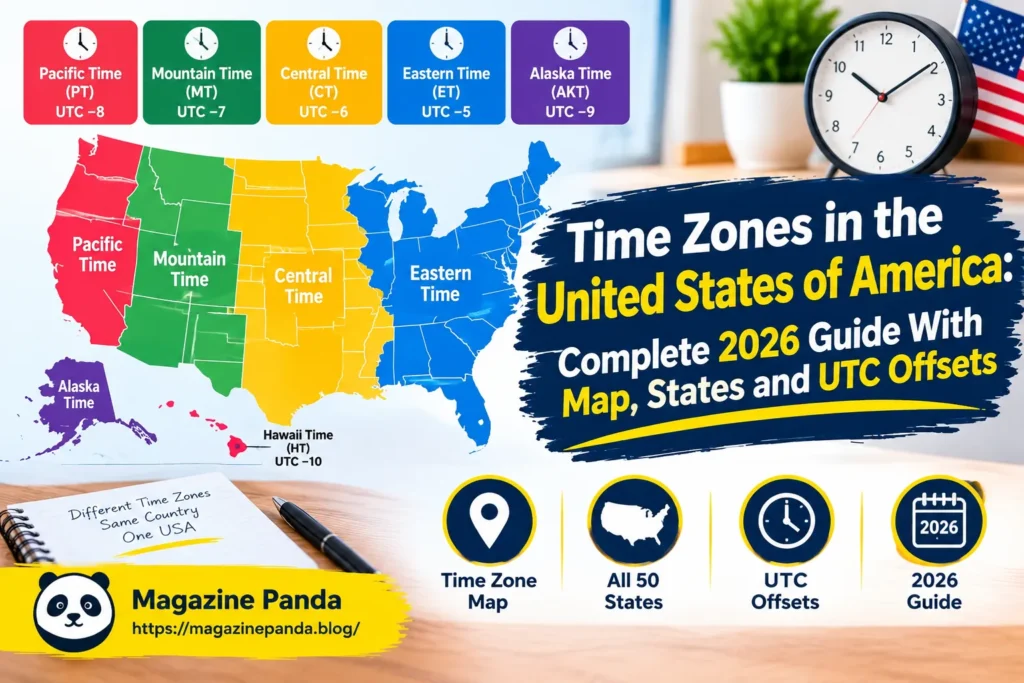

The United States of America covers a large geographical area, which means people in different parts of the country do not follow the same local time. From New York on the East Coast to California on the West Coast, the clock can differ by several hours. Understanding the time zones in the United States of America is important for travelers, businesses, students, and anyone communicating with people across the country.
The United States has six time zones across its 50 states: Eastern, Central, Mountain, Pacific, Alaska, and Hawaii-Aleutian. When its territories are included, the federal system recognizes nine standard time zones. Each zone has its own UTC offset, while most regions also adjust their clocks twice a year through Daylight Saving Time (DST).
As of November 20, 2026, the United States is observing standard time because the 2026 daylight saving period ended on November 1. This guide explains every major US time zone, state boundaries, UTC differences, daylight saving rules, and the best ways to calculate local time.
How Many Time Zones Are in the USA?
The United States has six time zones across its 50 states and nine federally established time zones when its territories are included.
The four main time zones covering the contiguous United States are Eastern, Central, Mountain, and Pacific. Alaska and Hawaii use additional time zones because of their geographical locations.
The remaining three federally recognized zones are Atlantic, Samoa, and Chamorro. These are associated with US territories rather than additional mainland states.
Here are the nine official time zones:
- Atlantic Standard Time (AST)
- Eastern Standard Time (EST)
- Central Standard Time (CST)
- Mountain Standard Time (MST)
- Pacific Standard Time (PST)
- Alaska Standard Time (AKST)
- Hawaii-Aleutian Standard Time (HAST)
- Samoa Standard Time (SST)
- Chamorro Standard Time (ChST)
These zones are established under federal law and defined through the Code of Federal Regulations. The US Department of Transportation oversees the country’s official time-zone boundaries.
All Nine US Time Zones and UTC Offsets
Coordinated Universal Time (UTC) is the international reference used to calculate time differences around the world. Each US time zone has a standard offset that indicates how many hours it is ahead of or behind UTC.
The following table shows the standard time offsets used across the United States and its territories.
| Time Zone | Abbreviation | UTC Offset |
| Atlantic | AST | UTC−4 |
| Eastern | EST | UTC−5 |
| Central | CST | UTC−6 |
| Mountain | MST | UTC−7 |
| Pacific | PST | UTC−8 |
| Alaska | AKST | UTC−9 |
| Hawaii-Aleutian | HAST | UTC−10 |
| Samoa | SST | UTC−11 |
| Chamorro | ChST | UTC+10 |
For example, when it is 12:00 PM UTC, it is 7:00 AM Eastern Standard Time and 4:00 AM Pacific Standard Time.
These are standard-time offsets. Some zones move forward by one hour during Daylight Saving Time, while others maintain the same offset throughout the year.
Eastern Time Zone (ET)
The Eastern Time Zone is the easternmost major time zone in the contiguous United States. It covers important cities, including New York, Washington, DC, Miami, Boston, and Atlanta.
It is commonly used for business activities, financial markets, government operations, and national television schedules.
Eastern Time has two seasonal abbreviations:
- EST: Eastern Standard Time, UTC−5.
- EDT: Eastern Daylight Time, UTC−4.
During standard time, Eastern Time is five hours behind UTC. During daylight time, it is four hours behind UTC.
New York City, for example, follows EST during winter and EDT during summer.
States in the Eastern Time Zone
States entirely or partly following Eastern Time include Connecticut, Delaware, Florida, Georgia, Indiana, Kentucky, Maine, Maryland, Massachusetts, Michigan, New Hampshire, New Jersey, New York, North Carolina, Ohio, Pennsylvania, Rhode Island, South Carolina, Tennessee, Vermont, Virginia and West Virginia.
Some of these states are divided between Eastern and Central Time. Therefore, their local time depends on the city or county.
Central Time Zone (CT)
The Central Time Zone covers a large area between the Eastern and Mountain regions. It includes major cities such as Chicago, Dallas, Houston, Minneapolis, New Orleans, and St. Louis.
Central Time is widely used in business, agriculture, transportation, and industrial activities across the central United States.
It has two seasonal abbreviations:
- CST: Central Standard Time, UTC−6.
- CDT: Central Daylight Time, UTC−5.
During standard time, Central Time is six hours behind UTC. During daylight time, it is five hours behind UTC.
For example, when Chicago follows CST, it is one hour behind New York. During the daylight period, the one-hour difference remains the same.
States in the Central Time Zone
States entirely or partly following Central Time include Alabama, Arkansas, Florida, Illinois, Indiana, Iowa, Kansas, Kentucky, Louisiana, Michigan, Minnesota, Mississippi, Missouri, Nebraska, North Dakota, Oklahoma, South Dakota, Tennessee, Texas and Wisconsin.
Some states share their territory with Eastern or Mountain Time. Checking the exact location is important when arranging meetings or travel.
Mountain Time Zone (MT)
The Mountain Time Zone covers parts of the western and central United States. It includes cities such as Denver, Salt Lake City, Albuquerque, Colorado Springs, and Boise.
The zone is named after the Rocky Mountains, which extend through much of the region.
Mountain Time uses two seasonal abbreviations:
- MST: Mountain Standard Time, UTC−7.
- MDT: Mountain Daylight Time, UTC−6.
During standard time, the zone is seven hours behind UTC. During daylight time, it is six hours behind UTC.
Arizona is an important exception. Most of the state follows Mountain Standard Time throughout the year rather than changing its clocks for DST.
States in the Mountain Time Zone
The Mountain Time Zone includes all or parts of Arizona, Colorado, Idaho, Kansas, Montana, Nebraska, Nevada, New Mexico, North Dakota, Oregon, South Dakota, Texas, Utah, and Wyoming.
Because several states are divided between Mountain and neighboring zones, their time can vary by county.
Pacific Time Zone (PT)
The Pacific Time Zone covers the western part of the contiguous United States. It includes major cities such as Los Angeles, San Francisco, San Diego, Seattle, Portland, and Las Vegas.
This zone is particularly important for the entertainment industry, technology companies, international trade, and West Coast business operations.
Pacific Time uses two seasonal abbreviations:
- PST: Pacific Standard Time, UTC−8.
- PDT: Pacific Daylight Time, UTC−7.
During winter, Pacific Time is eight hours behind UTC. During summer, it is seven hours behind UTC.
For example, when it is 12:00 PM in New York during standard time, it is 9:00 AM in Los Angeles.
States in the Pacific Time Zone
California and Washington are entirely within Pacific Time.
Most of Nevada and Oregon also follow Pacific Time, while parts of those states use Mountain Time. Northern Idaho follows Pacific Time, while southern Idaho follows Mountain Time.
Alaska Time Zone (AKT)
Alaska has its own time zone because of its location in the far northwestern part of North America.
Most of the state follows Alaska Time. Major locations such as Anchorage, Fairbanks, and Juneau use this time zone.
It has two seasonal abbreviations:
- AKST: Alaska Standard Time, UTC−9.
- AKDT: Alaska Daylight Time, UTC−8.
During standard time, Alaska is nine hours behind UTC. During daylight time, it is eight hours behind UTC.
Most of Alaska observes Daylight Saving Time. However, the western Aleutian Islands use the Hawaii-Aleutian Time Zone.
Hawaii-Aleutian Time Zone (HAT)
The Hawaii-Aleutian Time Zone covers Hawaii and the western Aleutian Islands of Alaska.
Hawaii follows Hawaii Standard Time (HST), which is UTC−10 throughout the year. The state does not observe Daylight Saving Time.
The western Aleutian Islands use the same standard-time offset but observe daylight, time.
The seasonal abbreviations are:
- HAST: Hawaii-Aleutian Standard Time, UTC−10.
- HADT: Hawaii-Aleutian Daylight Time, UTC−9.
Hawaii’s year-round time remains unchanged, even when other parts of the country move their clocks forward or backward.
This is why the time difference between Hawaii and mainland cities can change during the year.
US Territories and Their Time Zones
The United States also has territories that use three additional federally recognized time zones.
These zones are Atlantic, Samoa, and Chamorro.
| Territory | Time Zone | UTC Offset |
| Puerto Rico | Atlantic Standard Time | UTC−4 |
| US Virgin Islands | Atlantic Standard Time | UTC−4 |
| American Samoa | Samoa Standard Time | UTC−11 |
| Guam | Chamorro Standard Time | UTC+10 |
| Northern Mariana Islands | Chamorro Standard Time | UTC+10 |
These territories generally do not observe Daylight Saving Time.
Puerto Rico and the US Virgin Islands use Atlantic Standard Time throughout the year. American Samoa follows Samoa Standard Time, while Guam and the Northern Mariana Islands use Chamorro Standard Time.
Including these territories explains why federal law recognizes nine standard time zones even though the 50 states use six.
US Time Zones by State
The time-zone system does not always follow state borders. Some states use one time zone throughout their territory, while others are divided between two zones.
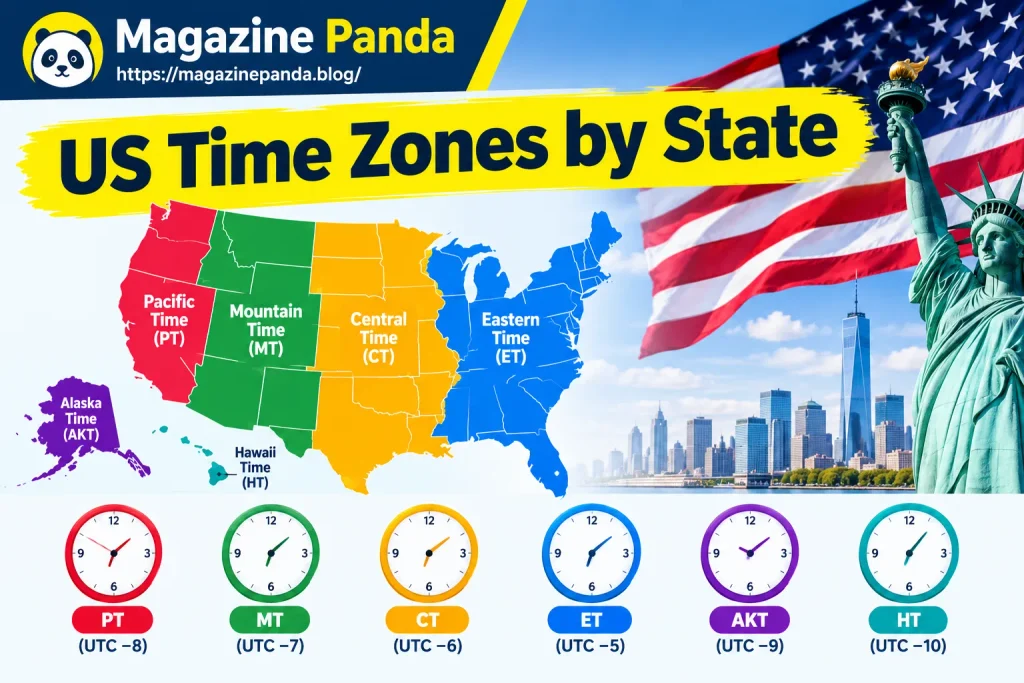
The following table provides a state-by-state overview.
| State | Time Zone |
| Alabama | Central |
| Alaska | Alaska / Hawaii-Aleutian |
| Arizona | Mountain |
| Arkansas | Central |
| California | Pacific |
| Colorado | Mountain |
| Connecticut | Eastern |
| Delaware | Eastern |
| Florida | Eastern / Central |
| Georgia | Eastern |
| Hawaii | Hawaii-Aleutian |
| Idaho | Pacific / Mountain |
| Illinois | Central |
| Indiana | Eastern / Central |
| Iowa | Central |
| Kansas | Central / Mountain |
| Kentucky | Eastern / Central |
| Louisiana | Central |
| Maine | Eastern |
| Maryland | Eastern |
| Massachusetts | Eastern |
| Michigan | Eastern / Central |
| Minnesota | Central |
| Mississippi | Central |
| Missouri | Central |
| Montana | Mountain |
| Nebraska | Central / Mountain |
| Nevada | Pacific / Mountain |
| New Hampshire | Eastern |
| New Jersey | Eastern |
| New Mexico | Mountain |
| New York | Eastern |
| North Carolina | Eastern |
| North Dakota | Central / Mountain |
| Ohio | Eastern |
| Oklahoma | Central |
| Oregon | Pacific / Mountain |
| Pennsylvania | Eastern |
| Rhode Island | Eastern |
| South Carolina | Eastern |
| South Dakota | Central / Mountain |
| Tennessee | Eastern / Central |
| Texas | Central / Mountain |
| Utah | Mountain |
| Vermont | Eastern |
| Virginia | Eastern |
| Washington | Pacific |
| West Virginia | Eastern |
| Wisconsin | Central |
| Wyoming | Mountain |
Important: This table uses broad state-level classifications. It does not replace the official county-level time-zone boundaries. Alaska also has a small western Aleutian area in the Hawaii-Aleutian zone, and most of Arizona remains on Mountain Standard Time throughout the year.
States That Have Two Time Zones
Fourteen states have areas that use two different time zones. This happens because official boundaries can follow county lines, rivers and geographical features instead of state borders.
The states are:
| State | Time Zones |
| Florida | Eastern / Central |
| Idaho | Pacific / Mountain |
| Indiana | Eastern / Central |
| Kansas | Central / Mountain |
| Kentucky | Eastern / Central |
| Michigan | Eastern / Central |
| Nebraska | Central / Mountain |
| Nevada | Pacific / Mountain |
| North Dakota | Central / Mountain |
| Oregon | Pacific / Mountain |
| South Dakota | Central / Mountain |
| Tennessee | Eastern / Central |
| Texas | Central / Mountain |
| Alaska | Alaska / Hawaii-Aleutian |
For example, Florida’s eastern peninsula follows Eastern Time, while parts of the western Panhandle use Central Time.
Similarly, western Texas, including El Paso, follows Mountain Time, while most of the state uses Central Time.
These differences make it important to check the city or county rather than assuming every location within a state uses the same clock.
Daylight Saving Time in the USA 2026
Daylight Saving Time is a seasonal clock adjustment used by most US states.
During this period, clocks move forward by one hour in March and return to standard time in November.
The purpose is to shift more daylight into the evening during warmer months.
According to the National Institute of Standards and Technology, the 2026 schedule was:
| Event | Date and Time |
| DST Started | March 8, 2026, at 2:00 AM |
| Clocks Moved Forward | 2:00 AM to 3:00 AM |
| DST Ended | November 1, 2026, at 2:00 AM |
| Clocks Moved Backward | 2:00 AM to 1:00 AM |
As of November 20, 2026, Daylight Saving Time has ended in regions that observe it. These areas are currently following standard time.
Under the current federal schedule, Daylight Saving Time begins on the second Sunday in March and ends on the first Sunday in November.
The next scheduled start is March 14, 2027.
States That Do Not Observe Daylight Saving Time
Although most US states change their clocks twice a year, there are exceptions.
Hawaii: The entire state follows Hawaii Standard Time throughout the year.
Arizona: Most of Arizona remains on Mountain Standard Time and does not move its clocks forward during summer.
Navajo Nation: The Navajo Nation observes Daylight Saving Time, including its territory in Arizona. This creates an important exception within a state that otherwise does not follow DST.
Several US territories also remain on standard time throughout the year:
- American Samoa
- Guam
- Northern Mariana Islands
- Puerto Rico
- US Virgin Islands
These exceptions are important when scheduling calls, arranging travel or comparing time differences between locations.
Time Difference Between Major US Cities
The time difference between American cities depends on their geographical locations and whether Daylight Saving Time is in effect.
During standard time, the four main continental time zones are one hour apart.
| City | Time Zone | Standard UTC Offset |
| New York | EST | UTC−5 |
| Washington, DC | EST | UTC−5 |
| Miami | EST | UTC−5 |
| Chicago | CST | UTC−6 |
| Dallas | CST | UTC−6 |
| Houston | CST | UTC−6 |
| Denver | MST | UTC−7 |
| Phoenix | MST | UTC−7 |
| Los Angeles | PST | UTC−8 |
| San Francisco | PST | UTC−8 |
| Seattle | PST | UTC−8 |
| Anchorage | AKST | UTC−9 |
| Honolulu | HST | UTC−10 |
For example, when it is 9:00 AM in New York during standard time, the local times are:
- Chicago: 8:00 AM
- Denver: 7:00 AM
- Los Angeles: 6:00 AM
- Anchorage: 5:00 AM
- Honolulu: 4:00 AM
Phoenix also follows UTC−7 during winter. However, during summer, it does not move to Mountain Daylight Time like Denver.
Difference Between EST and EDT
EST and EDT are two abbreviations used for Eastern Time, but they represent different seasonal offsets.
EST means Eastern Standard Time. It is five hours behind UTC and is used during the standard-time period.
EDT means Eastern Daylight Time. It is four hours behind UTC and is used during Daylight Saving Time.
The same naming pattern applies to other US time zones.
| Standard Time | Daylight Time | Difference |
| EST | EDT | 1 hour |
| CST | CDT | 1 hour |
| MST | MDT | 1 hour |
| PST | PDT | 1 hour |
| AKST | AKDT | 1 hour |
People often use ET, CT, MT, and PT when referring to a location’s time without specifying whether standard or daylight time is active.
This is useful for schedules that take place throughout the year because the abbreviation can change while the local clock remains in the same time zone.
How to Convert US Time Zones to UTC
UTC is a useful reference for converting time between different American locations and international destinations.
During standard time, subtract the appropriate number of hours from UTC to calculate local US time.
For example:
- UTC 12:00 = Eastern 7:00 AM
- UTC 12:00 = Central 6:00 AM
- UTC 12:00 = Mountain 5:00 AM
- UTC 12:00 = Pacific 4:00 AM
- UTC 12:00 = Alaska 3:00 AM
- UTC 12:00 = Hawaii 2:00 AM
During Daylight Saving Time, the applicable offsets change by one hour in zones that observe DST.
Always check the date when converting time because the same UTC can correspond to different local times during different seasons.
Who Controls Time Zones in the United States?
The US Department of Transportation (DOT) is responsible for overseeing the country’s official time zones and their boundaries.
Its authority is established through federal legislation and regulations.
The Standard Time Act of 1918 introduced federal oversight of standard time. Later, the Uniform Time Act of 1966 established a more consistent national framework for Daylight Saving Time.
Under the current rules, states can exempt themselves from observing DST through state law. However, they cannot independently adopt permanent Daylight Saving Time without a change in federal law.
The National Institute of Standards and Technology (NIST) provides official time information and operates Time.gov, which displays accurate time for US time zones.
The US Naval Observatory also provides time-zone conversion information and official references for standard and daylight time.
These organizations play different roles in maintaining reliable time information across the country.
History of Time Zones in the United States
Before standardized time zones were introduced, American cities used local solar time. This meant that neighboring towns could have slightly different clock times.
The problem became more serious as railway transportation expanded. Train schedules became difficult to coordinate because each city could follow its own local time.
In 1883, American and Canadian railroads adopted a coordinated system of four time zones: Eastern, Central, Mountain, and Pacific.
This change helped improve railway scheduling and reduced confusion for travelers.
In 1918, the Standard Time Act introduced federal oversight of time zones through the Interstate Commerce Commission.
Later, when Congress established the Department of Transportation in 1966, responsibility for overseeing time-zone boundaries was transferred to the new department.
The Uniform Time Act of 1966 also established a more consistent system for observing Daylight Saving Time.
Another major change came through the Energy Policy Act of 2005. Its updated DST schedule took effect in 2007, extending the daylight period by several weeks.
Today, the Department of Transportation continues to oversee official time-zone boundaries and uniform time observance across the United States.
Final Wordings
The United States has a complex time-zone system because of its large geographical area and the inclusion of several territories.
The six time zones used across its 50 states are Eastern, Central, Mountain, Pacific, Alaska, and Hawaii-Aleutian. When territories are included, the federal system recognizes nine standard time zones.
Understanding these differences is useful for international communication, business meetings, travel planning, and everyday scheduling.
Daylight Saving Time adds another important consideration because most US states move their clocks forward in March and backward in November. However, Hawaii, most of Arizona, and several territories follow different rules.
For accurate time information, always check the exact city or county and confirm whether standard or daylight time is currently in effect.
Knowing how US time zones work makes it much easier to coordinate activities across the country without confusion.
Frequently Asked Questions About US Time Zones
1. How many time zones are in the United States?
There are six time zones across the 50 US states. When US territories are included, federal law recognizes nine standard time zones.
2. What are the six US time zones?
The six time zones covering the states are Eastern, Central, Mountain, Pacific, Alaska, and Hawaii-Aleutian.
3. Which US states have two time zones?
Fourteen states have areas using two time zones: Alaska, Florida, Idaho, Indiana, Kansas, Kentucky, Michigan, Nebraska, Nevada, North Dakota, Oregon, South Dakota, Tennessee, and Texas.
4. Does every US state observe Daylight Saving Time?
No. Hawaii and most of Arizona do not observe Daylight Saving Time. The Navajo Nation in Arizona does observe it.
5. When does Daylight Saving Time end in the USA?
In 2026, Daylight Saving Time ended on November 1 at 2:00 AM local time. Under the current federal schedule, it ends on the first Sunday in November each year.
Continue Exploring Our Latest Article: PPV.to in 2026: Is the Sports Streaming Website Seized, Safe, or Gone?