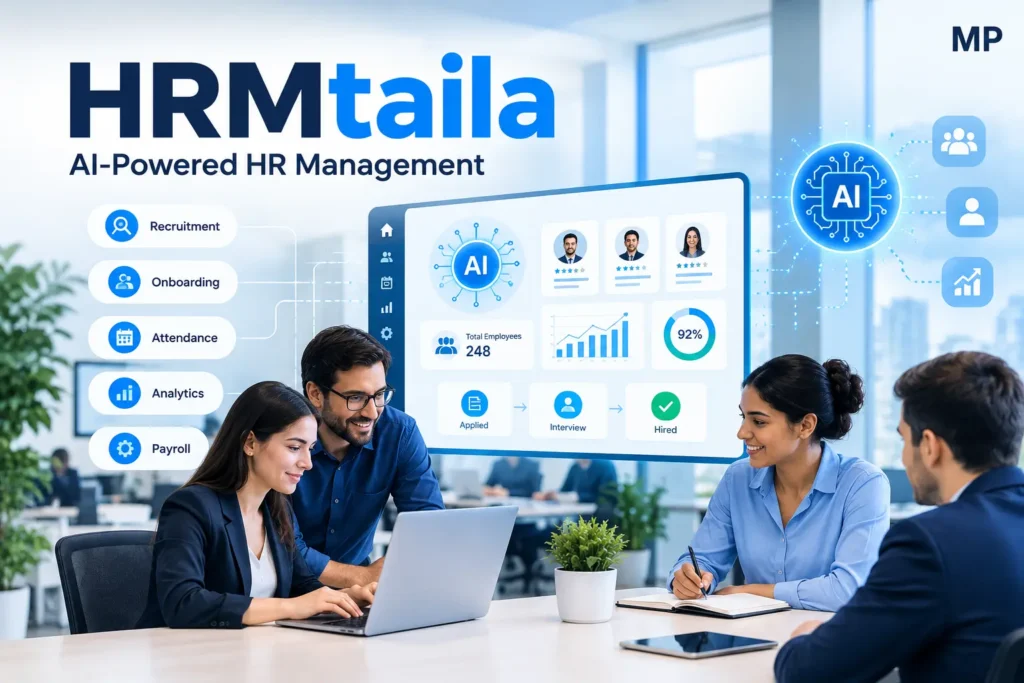

HRMtaila is an emerging online term commonly linked with artificial intelligence, human resource management, automation, and workforce analytics. Unlike established HR software with official documentation and a clear company behind it, HRMtaila does not currently have one universally confirmed definition or product identity. Recent online discussions mainly use the term to describe the wider idea of smarter, AI-assisted HR management. The concept connects technology with recruitment, onboarding, employee support, workforce data, and routine HR tasks while keeping people involved in important decisions.
What Is HRMtaila?
HRMtaila is best understood as an emerging digital term associated with AI-powered human resource management. Recent articles connect it with automation, employee data, recruitment, workforce analytics, onboarding, performance management, and HR administration. However, there is currently no strong public evidence establishing HRMtaila as a widely recognized software brand or formal HR technology standard.
This distinction is important.
When an unfamiliar technology keyword starts appearing online, it can be tempting to treat it as an established application. But several recent pages discussing HRMtaila also acknowledge that its exact identity remains unclear.
For now, the most accurate approach is to understand HRMtaila through the real technology trends surrounding AI in human resources rather than inventing a company history, founder, pricing plan, or product features that cannot be verified.
What Does HRMtaila Mean?
The term appears to have a strong connection with HRM, the common abbreviation for Human Resource Management.
The meaning of the remaining part, “taila,” is not clearly documented by an authoritative source. Some online writers interpret the complete term as a label for AI-powered or intelligent HR management, but that interpretation should not be presented as confirmed etymology.
What is clearer is the context in which HRMtaila is being discussed.
Recent pages associate it with technology that can help HR departments manage recruitment, employee records, onboarding, workforce information, reporting, and repetitive administrative work.
So, rather than giving HRMtaila an unsupported fixed definition, it is more useful to explain it as an emerging term connected with the movement toward intelligent and automated HR systems.
Is HRMtaila a Real Software Platform?
There is currently no clearly established evidence of a major commercial HR platform officially operating under the HRMtaila name.
Search results contain several articles describing the term as an AI-powered HR concept. At the same time, those articles do not provide the type of primary documentation normally associated with established software, such as detailed product documentation, a confirmed developer, official pricing, or a well-documented company history.
This means readers should be careful with claims that HRMtaila definitely has a specific app, subscription plan, customer base, or collection of proprietary tools.
It is possible that the term may later become connected to a specific product or organization. For now, however, its online meaning is still developing.
How Does HRMtaila Relate to AI in HR?
The connection becomes easier to understand when looking at how artificial intelligence is already being used in human resources.
Modern HR departments handle large amounts of information and repetitive processes. These can include job applications, employee questions, onboarding documents, attendance information, training records, reports, and workforce planning.
AI can help process information faster and automate certain repetitive workflows.
IBM explains that AI in recruitment can automate repetitive activities, improve efficiency, assist candidate interactions, and reduce some of the administrative workload placed on recruiters.
Microsoft similarly describes AI-powered HR solutions that can provide employees with access to HR information, handle common questions, create or resolve HR tickets, and support automated workflows.
This is the real technology landscape that gives the HRMtaila concept meaning.
HRMtaila and Recruitment Automation
Recruitment is one of the clearest areas where AI can support HR teams.
A modern hiring process can involve hundreds or even thousands of applications. Reviewing every application manually can consume significant time.
AI-supported recruitment tools can help organize applications, identify relevant skills, assist with candidate communication, and support scheduling. IBM notes that AI and AI assistants are increasingly being used throughout the recruitment process.
An HRMtaila-style approach could therefore connect recruitment data with other HR workflows.
For example, once a candidate is selected, information collected during recruitment could potentially move into the onboarding process rather than being entered repeatedly.
The important point is that AI can assist recruiters, but automated recommendations should not automatically become final employment decisions.
HRMtaila for Employee Onboarding
Employee onboarding is another area where automation can save time.
New employees often need information about company policies, benefits, working procedures, training, leave, workplace systems, and administrative requirements.
An AI-supported HR system can provide employees with quick access to common information and guide them through routine tasks.
Microsoft describes AI-powered HR assistants that can help employees find HR knowledge, complete tasks, and manage HR requests through digital workflows.
This can make the first few weeks of employment more organized while allowing HR professionals to focus on questions that require personal attention.
HRMtaila and Workforce Analytics
Workforce analytics involves using employee and organizational data to understand patterns and support planning.
For example, HR teams may examine recruitment numbers, employee turnover, attendance, training activity, performance information, or workforce needs.
AI can help identify patterns within large datasets more quickly than manual analysis.
This could make an HRMtaila-style system useful for organizations that want to understand their workforce through data rather than relying only on spreadsheets and manual reports.
However, analytics must be handled responsibly because HR data can be sensitive. Organizations need appropriate controls around access, privacy, security, and how employee information is used.
HRMtaila for Payroll and HR Administration
Payroll itself requires accuracy, but many surrounding HR tasks are repetitive.
Digital HR systems can help organize employee information, leave records, attendance data, documents, and administrative requests.
An AI-assisted system could potentially help identify missing information, send reminders, answer common questions, or organize reports.
That does not mean AI should independently control sensitive payroll decisions. Financial and employment information requires appropriate human review and strong security controls.
The broader goal is to reduce repetitive administrative work so HR teams have more time for people-focused responsibilities.
Benefits of AI-Powered HR Management
The biggest potential benefit is time savings.
When technology handles repetitive tasks, HR professionals can spend more time communicating with employees, supporting managers, resolving complex problems, and improving workplace experiences.
AI can also provide faster access to information. Employees may not need to wait for an HR representative to answer a simple question if an approved digital assistant can provide the relevant policy or process.
Another benefit is consistency. Automated workflows can help ensure that routine tasks follow the same process each time.
However, these benefits depend on the quality of the technology, the underlying data, proper implementation, and human oversight.
What Are the Risks of HRMtaila?
AI in HR also creates important challenges.
Privacy is a major concern because HR systems may handle personal, employment, salary, performance, and other sensitive information.
SHRM’s 2026 research identifies privacy and security concerns among the primary technical barriers limiting the expansion of AI in HR.
Bias is another important issue.
If an AI hiring system produces unfair results, keeping a human involved in the final hiring decision does not automatically remove the risk. SHRM reported in 2026 that employers need to validate AI-enabled selection processes because automated systems can disadvantage candidates based on protected characteristics.
This is why responsible AI use requires testing, monitoring, transparency, and human review.
Can HRMtaila Replace HR Professionals?
AI can automate parts of HR work, but that is different from replacing the entire HR function.
Human resources involves communication, empathy, conflict resolution, leadership, workplace culture, sensitive conversations, and decisions that require context.
SHRM’s 2026 research found that human interaction remains a significant barrier to complete automation, with many HR professionals indicating that employee, leadership, and applicant preferences would prevent HR from becoming fully automated.
The more practical model is therefore human-led HR supported by intelligent technology.
AI can handle certain repetitive activities while HR professionals remain responsible for judgment, relationships, fairness, and accountability.
What Could the Future of HRMtaila Look Like?
The future meaning of HRMtaila is still uncertain.
It may remain an emerging keyword associated with AI and HR technology. It could also eventually become the name of a specific product, service, or digital project if an identifiable organization develops it.
The broader direction of HR technology is easier to see.
AI assistants, automated workflows, recruitment tools, employee self-service, workforce analytics, and digital HR systems are already developing. Microsoft, IBM, and other technology providers are investing in these areas.
As these technologies mature, HR departments may use AI for more routine work while keeping people at the center of sensitive decisions.
HRMtaila vs Traditional HR Software
Traditional HR software mainly focuses on storing information and managing defined workflows.
AI-enabled HR technology can add another layer by analyzing information, answering questions, recognizing patterns, and assisting with repetitive tasks.
For example, a traditional system might store an employee’s leave balance.
An AI-enabled system could potentially answer a question about that balance, explain the relevant company policy, and guide the employee through the next step.
This does not make traditional HR software obsolete. In many organizations, AI works as an additional layer on top of existing HR systems.
Why Is HRMtaila Getting Attention?
The unusual keyword has started appearing in multiple online articles during 2026, with many of those pages connecting it to AI-powered human resource management.
That growing search presence does not necessarily mean that HRMtaila is already an established technology.
Instead, it shows how quickly new terminology can spread across the web.
For readers, the key is to distinguish between an emerging online term and a documented commercial product.
For content creators, this distinction is equally important. Repeating an unverified claim across several articles does not make the claim more reliable.
FAQ’s About HRMtaila
What is HRMtaila?
HRMtaila is an emerging online term associated with AI-powered human resource management, automation, workforce analytics, recruitment, and digital HR workflows.
Is HRMtaila an official HR software?
There is currently no strong public evidence establishing HRMtaila as a widely recognized commercial HR software platform. Recent articles mainly describe it as an emerging concept.
Is HRMtaila related to artificial intelligence?
Yes, current online discussions commonly connect HRMtaila with artificial intelligence, automation, employee support, and workforce analytics.
Can AI help with recruitment?
Yes. AI is already being used to support recruitment tasks such as candidate communication, application processing, and other repetitive activities.
Can AI replace HR professionals?
AI can automate some HR tasks, but complete replacement is not a practical description of modern HR. Human communication, judgment, accountability, and workplace relationships remain important.
What are the biggest AI risks in HR?
Privacy, security, bias, inaccurate recommendations, lack of transparency, and excessive dependence on automated decisions are among the major concerns.
Does HRMtaila have an official creator?
No clearly verified creator or organization behind the term has been established in the sources reviewed. Its exact origin remains uncertain.
Final Wording
HRMtaila is best viewed as an emerging online term connected with the wider growth of AI-powered human resource management. Its exact origin and product identity remain unclear, so claims about a specific company, application, founder, or pricing should not be treated as established facts without primary evidence. The technology behind the current interpretation is real, however. AI is already changing recruitment, employee support, onboarding, analytics, and HR administration. The most useful future for this kind of technology is likely to involve automation of routine work while keeping human judgment at the center of important workplace decisions.


Pingback: EMC Activator Facts: What It Is, Features, Safety & Activation Lock