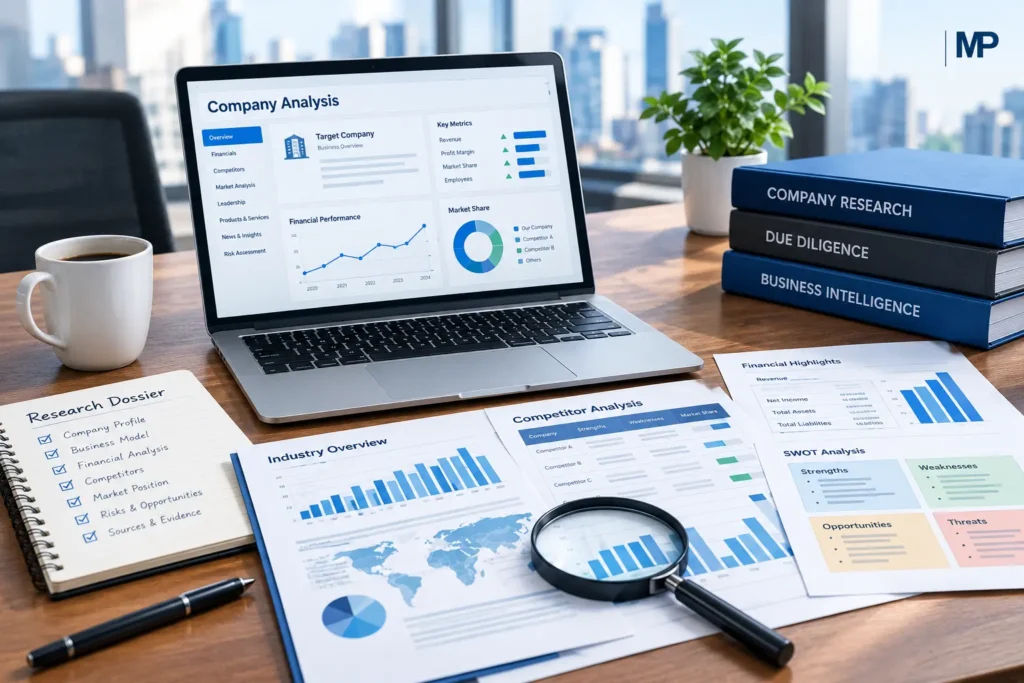

A research dossier for a target company is a structured document that brings important business information, supporting evidence, and analysis into one place. Instead of keeping scattered notes from websites, reports, news articles, databases, and company pages, a dossier organizes the information around a clear research objective.
A good dossier can help with business research, competitive analysis, sales preparation, investment research, partnership evaluation, supplier research, and preliminary due diligence. The exact information required depends on why the company is being investigated. An investor may focus heavily on financial performance and risk, while a sales team may care more about customers, decision-makers, products, and current business priorities.
The most important difference between a simple company profile and a research dossier is evidence and analysis. A profile may tell you when a company was founded and what it sells. A dossier should also explain where the information came from, how current it is, what it means, and what remains uncertain. Current research guides consistently emphasize defining the objective and connecting important findings to reliable sources.
What Is a Research Dossier?
A research dossier for a target company is a detailed collection of verified or clearly attributed information about a specific business.
The word “target” simply means the company being researched. It does not necessarily refer to Target Corporation. The target could be a private startup, public corporation, supplier, competitor, potential acquisition, technology company, agency, manufacturer, retailer, or prospective business partner.
A basic company profile normally contains facts such as the company’s name, location, industry, products, executives, and founding date.
A research dossier goes further by examining ownership, business model, revenue sources, customers, competitors, financial performance, workforce, technology, legal exposure, reputation, risks, opportunities, and recent developments.
The purpose is not simply to collect as many facts as possible. The purpose is to build a useful picture of the organization that can support a specific business question.
Why a Dossier Matters
Business information is usually scattered across many sources.
One website may contain leadership information. An annual report may contain financial data. A government database may provide registration details. News publications may report acquisitions or lawsuits. Professional networks may provide workforce information.
Looking at these sources separately can make it difficult to understand the larger picture.
A research dossier brings those findings together and gives every important fact a place in the overall analysis. This makes it easier to identify connections, contradictions, missing information, and areas that deserve additional research.
A dossier can also make future updates easier. If the company releases new financial results or changes its leadership, the researcher can update the relevant section instead of starting the entire project again.
Start With the Objective
The first step should not be opening Google and searching the company name.
Start by writing down why you are researching the business.
For example, the objective might be to understand whether a company could become a suitable supplier. Another project might investigate a potential acquisition. A sales team might want to understand a prospect before an important meeting.
These objectives require different information.
A useful objective could be:
“Evaluate the target company’s business model, financial position, market presence, competitors, leadership, and major business risks.”
This gives the research a direction.
Without a defined objective, company research can quickly become a large collection of facts that does not answer the original question. Current research frameworks recommend defining the decision, scope, questions, and timeframe before collecting evidence.
Create Research Questions
After defining the objective, turn it into practical questions.
Useful questions include:
- What does the company sell?
- Who owns the company?
- Who manages it?
- Who are its customers?
- How does it make money?
- Which markets does it serve?
- How large is the business?
- What are its major products or services?
- Who are its competitors?
- What has changed recently?
- What financial information is available?
- What legal or regulatory issues exist?
- What risks could affect the business?
- What opportunities appear to exist?
- Which important facts remain uncertain?
These questions become the foundation of the dossier.
Each major source you collect should help answer at least one question.
Confirm the Correct Company
Before collecting detailed information, make sure you have identified the right business.
Companies can have similar names. A business may also operate under a brand name that differs from its registered legal entity.
Record the following:
| Field | Information to Record |
| Legal name | Registered company name |
| Brand name | Public-facing name |
| Website | Official domain |
| Headquarters | Main business location |
| Industry | Primary industry |
| Parent company | If applicable |
| Subsidiaries | Relevant subsidiaries |
| Geographic market | Countries or regions served |
| Ownership | Public, private, subsidiary, etc. |
This step prevents one of the most damaging research errors: combining information from different companies that happen to share similar names.
It is especially important when researching multinational organizations with subsidiaries or regional entities.
Build the Company Profile
Once the identity is confirmed, create a basic company profile.
Record the founding year, headquarters, industry, ownership, founders, main products, services, markets, and official website.
This section should be concise. It provides context for the deeper analysis that follows.
The company profile should also distinguish between facts confirmed through authoritative records and statements made by the company itself.
For example, an official company page can confirm that the business advertises a particular service. It does not independently prove that the service is the largest in its market or that customers consider it superior.
That distinction becomes important throughout the dossier.
Research Company History
A company’s history can explain why its current structure looks the way it does.
Look for important milestones such as:
- Founding
- Leadership changes
- Major acquisitions
- Mergers
- Product launches
- New markets
- Funding rounds
- Rebranding
- Major partnerships
- Restructuring
- Facility openings or closures
- Major strategic changes
A simple timeline can make this information easier to understand.
| Year | Event | Source |
| 2018 | Company founded | Official record |
| 2020 | Product launched | Company announcement |
| 2022 | New market entered | Industry publication |
| 2024 | Acquisition announced | Filing / company release |
Do not create a timeline merely for appearance. Include events that help explain the company’s growth, strategy, ownership, products, or risks.
Understand the Business Model
The business model is one of the most important sections of a research dossier.
You want to understand how the company actually makes money.
Ask:
- What does it sell?
- Who pays for it?
- Is revenue recurring or one-time?
- Does the company sell directly or through distributors?
- Is it subscription-based?
- Does it depend on advertising?
- Does it license technology?
- Does it earn transaction fees?
- Does it rely heavily on a few customers?
- What are the major cost drivers?
A company can report strong sales while still facing pressure from high costs, customer concentration, debt, or declining margins.
Therefore, revenue should not be analyzed in isolation.
Analyze Products and Services
List the company’s major products and services and identify which ones appear most important.
For each major offering, consider:
What problem does it solve?
Who is the intended customer?
How is it priced?
What differentiates it?
Who competes with it?
Is demand growing or declining?
The official product pages are useful starting points because they show how the company positions its own offerings.
Independent sources can then provide additional context about market adoption, competition, reviews, or industry trends.
Research Customers
Customer research helps explain where a company’s revenue and market presence may come from.
Look for information about:
- Customer segments
- Geographic markets
- Enterprise customers
- Consumer customers
- Major publicly disclosed clients
- Customer industries
- Distribution partners
- Customer concentration
- Retention or recurring revenue where disclosed
Be careful with customer lists found on third-party websites.
A company may describe a business relationship as a partnership while another source may characterize it differently. Important relationships should therefore be verified through company announcements, filings, or confirmation from the other organization when possible.
Research Leadership
Leadership can provide useful context about strategy and corporate structure.
Record:
- CEO
- Founders
- Board members
- Chief financial officer
- Chief operating officer
- Technology leadership
- Major business-unit leaders
Do not stop at names.
Research relevant professional backgrounds, previous companies, appointments, departures, and responsibilities.
A leadership change can be particularly important when it occurs alongside a restructuring, acquisition, major strategic shift, or financial development.
Examine Ownership
Ownership is another essential part of the dossier.
Determine whether the company is:
- Publicly traded
- Privately held
- A subsidiary
- Family-owned
- Venture-backed
- Private-equity backed
- Government-owned
- Part of a larger corporate group
For public companies, regulatory filings can provide detailed ownership and corporate information.
For private businesses, ownership information may be more limited.
Do not assume that a company’s brand name represents the complete legal entity. Parent companies and subsidiaries can materially change how the business should be understood.
Research Financial Performance
Financial analysis is often one of the most important parts of a company dossier.
Depending on what is publicly available, collect:
- Revenue
- Gross profit
- Operating income
- Net income
- Cash flow
- Cash reserves
- Debt
- Capital expenditure
- Margins
- Growth rates
Always record the reporting period.
A revenue figure without a year or quarter can be misleading.
For example, “the company generated $500 million in revenue” is incomplete unless you know whether the number refers to a calendar year, fiscal year, quarter, trailing period, or estimate.
Current research guidance recommends preserving the reporting date, organizational scope, currency, and source alongside important financial figures.
Study Workforce Information
Employee information can provide useful clues about business scale and expansion.
Possible sources include:
- Annual reports
- Company career pages
- Professional networks
- Regulatory documents
- Company announcements
- Reputable business databases
However, employee estimates can vary.
One platform might report 500 employees while another reports 650 because they use different dates, definitions, or data-collection methods.
Therefore, write the measurement date and source whenever possible.
Avoid presenting a third-party estimate as a precise current headcount.
Research the Market
A company does not operate in isolation.
Study the broader market in which it competes.
Research:
- Market size
- Growth rate
- Major trends
- Regulation
- Customer behavior
- Technology changes
- Supply conditions
- Barriers to entry
- Industry consolidation
Then connect those trends to the company.
For example, a growing market may create expansion opportunities, but it may also attract new competitors.
Likewise, a technological shift may create a new product opportunity while making an existing product less competitive.
Analyze Competitors
Competitor research is essential because a company’s own description rarely provides the full competitive picture.
Identify direct competitors that offer similar products to similar customers.
Then identify indirect competitors that solve the same customer problem differently.
Compare:
| Area | Target Company | Competitor A | Competitor B |
| Main product | — | — | — |
| Target customer | — | — | — |
| Geographic reach | — | — | — |
| Pricing model | — | — | — |
| Distribution | — | — | — |
| Technology | — | — | — |
| Key difference | — | — | — |
The purpose is not simply to name competitors.
The goal is to understand where the company fits in its market.
Examine Market Position
Market position should be supported by evidence.
If a company calls itself a “market leader,” treat that as a company-reported claim unless reliable market data independently supports it.
Look for:
- Market-share estimates
- Industry rankings
- Customer adoption
- Geographic reach
- Product penetration
- Brand recognition
- Competitive pricing
- Distribution strength
Avoid turning a promotional statement into an established fact.
This is one of the most important habits in evidence-based company research.
Research Technology
Technology can be a major competitive factor.
Depending on the company, investigate:
- Website technology
- Software products
- Mobile applications
- Cloud infrastructure
- AI usage
- Data systems
- Cybersecurity
- Patents
- Proprietary technology
- Technical partnerships
Technology research should answer a business question rather than becoming a list of software names.
For example, discovering that a company uses a particular cloud provider may be interesting, but it becomes more useful when connected to scalability, cost, product strategy, or infrastructure requirements.
Check Intellectual Property
Intellectual property can be important for technology, pharmaceutical, manufacturing, media, and other companies.
Research:
- Patents
- Trademarks
- Copyright-related assets
- Proprietary technology
- Brand registrations
- Licensing arrangements
Use official intellectual-property databases where available.
Do not assume that every technology mentioned in a company presentation is proprietary.
A business may use licensed, open-source, third-party, or partner technology.
Review Legal and Regulatory Issues
A professional dossier should include relevant legal information.
Depending on the company and industry, investigate:
- Lawsuits
- Regulatory actions
- Government investigations
- Product recalls
- Compliance issues
- Intellectual-property disputes
- Employment litigation
- Consumer complaints
- Regulatory penalties
Legal information should be handled carefully.
A lawsuit is not the same as a finding of wrongdoing. Likewise, an allegation is not equivalent to a confirmed violation.
Use neutral language and identify the source, date, and current status of the matter.
Research Reputation
Reputation research can include:
- Customer reviews
- Employee reviews
- Industry commentary
- News coverage
- Public complaints
- Professional discussions
- Social media activity
However, online reviews should not automatically be treated as representative of every customer.
Look for patterns rather than isolated comments.
A small number of negative reviews may identify an issue worth investigating, but they do not necessarily establish a company-wide problem.
Record the sample size, date range, platform, and limitations where practical.
Track Recent Developments
A dossier becomes outdated quickly if recent developments are ignored.
Search for the company’s latest:
- Product launches
- Acquisitions
- Partnerships
- Executive appointments
- Executive departures
- Funding
- Earnings
- Expansion
- Layoffs
- Regulatory events
- Major contracts
- Strategic announcements
Always distinguish the publication date from the date of the event.
A news article published in 2026 may discuss an event that happened in 2025.
That difference matters when building a timeline.
Build an Evidence Log
An evidence log is one of the most useful parts of a professional dossier.
Record:
| Field | What to Record |
| Source | Name of website or document |
| URL | Original location |
| Publication date | When the source was published |
| Access date | When you reviewed it |
| Finding | Important information |
| Reporting period | Date the information describes |
| Evidence type | Verified, company-reported, estimated, etc. |
| Notes | Limitations or conflicts |
This makes the dossier easier to audit and update.
It also helps prevent a common research problem: forgetting where an important number originally came from.
Current research frameworks specifically recommend connecting findings with their original sources, reporting periods, access dates, and verification status.
Separate Facts From Claims
Not every statement deserves the same level of confidence.
A useful system is to classify information into categories.
Verified fact: Supported by an appropriate primary or authoritative source.
Company-reported: Published or stated by the company itself.
Independent reporting: Reported by a credible outside source.
Estimated: Produced by a third-party database or analytical model.
Unverified: A claim that has not been adequately confirmed.
Disputed: Reliable sources provide conflicting information.
This classification makes the final dossier more honest and more useful.
Handle Conflicting Information
Conflicting information is normal in company research.
You may find different employee counts, revenue estimates, founding dates, headquarters, or customer figures.
Do not simply choose the number that looks most attractive.
First check whether the sources refer to different periods or entities.
Then check whether one source is primary while another is an estimate.
If the conflict cannot be resolved, preserve the uncertainty.
A professional dossier can say:
“Source A reports 2,000 employees as of March 2026, while Source B estimates approximately 2,300. The difference may reflect different measurement dates or definitions.”
That is more useful than pretending the discrepancy does not exist.
Current research guidance specifically recommends preserving conflicting accounts and explaining the difference instead of averaging incompatible figures.
Identify Risks
A company dossier should not focus only on positive information.
Consider:
Financial risks: Debt, declining revenue, weak cash flow, margin pressure.
Market risks: New competitors, shrinking demand, changing customer preferences.
Operational risks: Supply problems, workforce shortages, infrastructure dependence.
Technology risks: Cybersecurity, outdated systems, technological disruption.
Legal risks: Litigation, regulation, intellectual-property disputes.
Customer risks: High customer concentration or dependence on a small number of accounts.
Management risks: Major leadership turnover or succession concerns.
The goal is not to make a dramatic judgment.
The goal is to identify specific issues that deserve further investigation.
Identify Opportunities
The same evidence can reveal potential opportunities.
Look for:
- New markets
- Product expansion
- Geographic growth
- Partnerships
- Technology adoption
- Hiring growth
- New customer segments
- Acquisitions
- Unserved customer needs
- Competitor weaknesses
An opportunity should be connected to evidence.
For example, a new geographic expansion announcement may support a conclusion that the company is exploring that market. It does not automatically prove that the expansion will succeed.
Create the Executive Summary
The executive summary should be written after the research, even though it appears at the beginning.
Keep it focused on the findings that matter most.
A useful executive summary can include:
Company: Who the business is.
Objective: Why it was researched.
Key findings: The most important evidence.
Financial position: Major available financial observations.
Competitive position: Important market information.
Risks: Issues requiring attention.
Opportunities: Evidence-supported possibilities.
Open questions: Information that remains unavailable or uncertain.
The summary should not simply repeat the company description.
It should tell the reader what the research discovered.
Research Sources
The quality of a dossier depends heavily on its sources.
Start with primary sources whenever possible.
These can include:
- Official company website
- Annual reports
- Regulatory filings
- Government databases
- Investor-relations documents
- Official press releases
- Court records
- Patent databases
- Trademark databases
Then use reputable independent sources for context.
These may include established business publications, industry organizations, recognized financial databases, and credible research reports.
Third-party directories, review websites, social networks, and SEO databases can provide useful supporting information, but they should not automatically outrank primary evidence.
A Simple Dossier Template
The following structure can be copied into a document or spreadsheet.
| Section | Information |
| Research objective | Why the company is being investigated |
| Company identity | Legal name, brand, website |
| Headquarters | Main location |
| Founded | Year and relevant history |
| Ownership | Parent, founders, shareholders |
| Leadership | Executives and board |
| Products | Main products |
| Services | Main services |
| Customers | Customer groups and disclosed clients |
| Business model | How revenue is generated |
| Financials | Revenue, profit, debt, cash flow |
| Workforce | Employees and hiring trends |
| Market | Industry and market trends |
| Competitors | Direct and indirect competitors |
| Technology | Platforms, patents, systems |
| Legal | Lawsuits and regulatory matters |
| Reputation | Reviews and public commentary |
| Risks | Financial, market, operational, legal |
| Opportunities | Evidence-supported opportunities |
| Recent developments | Latest major changes |
| Evidence log | Sources, dates, status |
| Open questions | Missing information |
This template can be expanded or shortened depending on the research objective.
Common Research Mistakes
One common mistake is collecting information without a purpose.
A dossier can become hundreds of pages long while still failing to answer the original business question.
Another mistake is relying on a single source.
Even an official source has limitations. Company websites are valuable for primary information, but independent sources can provide additional context.
A third mistake is using undated statistics.
Revenue, employee numbers, traffic, market share, and other measurements change over time.
Another problem is confusing company claims with independent findings.
Finally, researchers sometimes hide uncertainty instead of documenting it.
A missing piece of information is not a failure. Clearly marking it as unknown is better than filling the gap with an assumption.
Final Review
Before completing the dossier, ask:
- Did I identify the correct company?
- Did I define the research objective?
- Did I verify the official website?
- Did I research ownership?
- Did I review leadership?
- Did I understand the business model?
- Did I analyze products and services?
- Did I examine customers?
- Did I review available financial information?
- Did I record reporting dates?
- Did I research competitors?
- Did I investigate legal issues?
- Did I consider reputation?
- Did I identify risks?
- Did I identify opportunities?
- Did I separate facts from estimates?
- Did I record original sources?
- Did I preserve conflicting information?
- Did I identify unanswered questions?
If several important questions remain unanswered, the dossier may require additional research.
Research Dossier vs Company Profile
These two documents are related but not identical.
A company profile usually provides a quick overview of an organization.
It may include the name, location, founding year, industry, leadership, products, and services.
A research dossier is deeper.
It combines company information with evidence, financial analysis, competitive research, risk assessment, recent developments, and source tracking.
In simple terms:
Company profile = What is this company?
Research dossier = What do we know about this company, how do we know it, what does it mean, and what still needs investigation?
That distinction is central to effective company research.
How to Keep the Dossier Updated
A dossier should not necessarily be treated as a one-time document.
For companies that matter to your work, create an update schedule.
Review important sections when there are:
- New financial results
- Leadership changes
- Major acquisitions
- New products
- Regulatory events
- Significant layoffs
- Market changes
- New competitors
- Major partnerships
Keep the original research date visible.
When updating a statistic, do not simply overwrite the old number. Preserve the previous reporting period when it helps explain the trend.
This turns the dossier into a company intelligence record rather than a static article.
Final Verdict
A research dossier for a target company is most useful when it combines structured information, reliable evidence, and clear analysis.
The process should begin with a specific objective. From there, confirm the company’s identity, research its history, understand its business model, examine products and customers, investigate leadership and ownership, review financial performance, study competitors, and evaluate market conditions.
The strongest dossiers also investigate technology, intellectual property, legal exposure, reputation, risks, opportunities, and recent developments.
Most importantly, every major claim should have a traceable source. Record the publication date, access date, reporting period, and limitations whenever those details matter. When reliable sources disagree, preserve the disagreement rather than quietly selecting the number that fits the story.
A good dossier does not attempt to make uncertainty disappear. It shows what is known, what is reported, what is estimated, what is disputed, and what still needs to be confirmed.
That makes the final document more useful for investors, sales professionals, marketers, researchers, consultants, business owners, journalists, and anyone who needs a clearer understanding of a company before taking the next step.
FAQs
What is a research dossier for a target company?
A research dossier is a structured report containing company facts, evidence, analysis, risks, competitors, and other information relevant to a specific research objective.
What should a company research dossier include?
A strong dossier can include company identity, history, ownership, leadership, products, customers, business model, financials, workforce, competitors, market information, legal issues, technology, risks, opportunities, and an evidence log.
What sources should be used for company research?
Start with primary sources such as company websites, regulatory filings, annual reports, government records, and official announcements. Use reputable independent sources to add context and verify important claims.
How do you verify information in a company dossier?
Check the original source, reporting period, publication date, access date, company identity, and scope of the information. If two credible sources disagree, investigate the reason rather than assuming one is automatically correct.
What is the difference between a company profile and a research dossier?
A company profile provides a basic overview, while a research dossier combines company information with evidence, analysis, financial and competitive research, risks, opportunities, and source tracking.
Can a research dossier be used for due diligence?
Yes. A dossier can support preliminary due diligence, but the depth required depends on the decision. Investment, acquisition, legal, and other high-stakes decisions may require professional financial, legal, accounting, or industry-specific investigation beyond publicly available research.



Pingback: The Times of India: History, News, Sections & Digital Presence
Pingback: Fidelity Crypto: Everything You Need to Know Before Getting Started - magazinepanda.blog