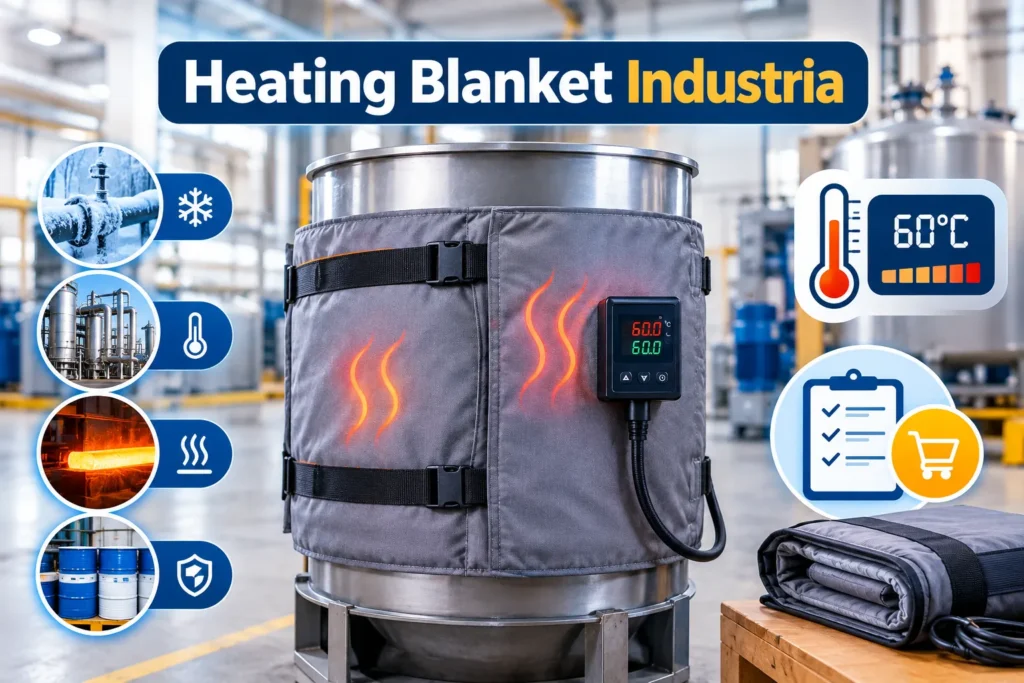

An industrial heating blanket is a flexible electric heating solution designed to deliver controlled heat directly to equipment, containers, pipes, molds, and other industrial surfaces. Unlike ordinary household heating products, industrial blankets are built for demanding applications such as freeze protection, viscosity control, process heating, composite curing, drum heating, IBC heating, and temperature maintenance.
Modern industrial heating blankets are available in different sizes, materials, wattages, voltage configurations, and temperature ranges. Some are ready-made for drums or containers, while others are engineered around a specific vessel, pipe, or production process. Manufacturers such as BriskHeat and FlexBlanket currently offer standard and custom systems for industrial applications.
Quick Information
| Detail | Information |
| Product | Industrial Heating Blanket |
| Main Function | Controlled surface heating |
| Heating Method | Electrical resistance heating |
| Common Material | Silicone rubber |
| Other Construction | Fiberglass and coated fabrics |
| Common Uses | Drum, IBC, pipe, tank and equipment heating |
| Special Uses | Freeze protection, viscosity control and composite curing |
| Temperature | Model dependent |
| Voltage | Model dependent |
| Control | Thermostat, RTD, thermocouple or digital controller |
| Design | Standard or custom |
| Outdoor Options | Available for selected models |
| Hazardous-Area Options | Available for selected certified systems |
What Is an Industrial Heating Blanket?
An industrial heating blanket is a flexible electrical heater that transfers heat directly to a surface or material. It normally contains a resistance heating element surrounded by insulating and protective materials.
Silicone rubber is one of the most common constructions because it can remain flexible while providing resistance to moisture, chemicals, and demanding working conditions. BriskHeat, for example, uses fiberglass-reinforced silicone rubber in its heavy-duty heating blankets.
The blanket can be placed around or against the object that needs heating. Electricity passes through the heating element, generating heat across the selected area. A thermostat, thermocouple, RTD, or other temperature-control device can then regulate the process.
How Does It Work?
The basic principle is straightforward. Electrical energy is converted into controlled heat through a resistance element.
When the heater receives power, its internal heating element produces thermal energy. Because the element is positioned close to the target surface, heat can be transferred directly instead of first heating a large volume of surrounding air.
Temperature control is particularly important for industrial applications. Current systems can use adjustable thermostats, digital controllers, thermocouples, RTDs, or other sensors to maintain a desired temperature.
This arrangement makes the equipment useful when a process requires steady warming rather than simply producing as much heat as possible.
Main Materials
Industrial heating blankets are manufactured from several material combinations, depending on the required temperature, flexibility, durability, and environment.
Silicone rubber is especially common in flexible industrial heaters. It provides a thin construction while allowing the heater to conform to flat, curved, or irregular surfaces.
Some products use fiberglass-reinforced silicone, while other specialized blankets use coated fabrics and insulation designed for higher-temperature applications. BriskHeat’s current heavy-duty SRL/SRP products, for example, use fiberglass-reinforced silicone rubber and are designed for industrial surface heating.
Silicone Heating Blankets
Silicone heating blankets are popular because they combine flexibility, relatively low profile, durability, and controlled heat distribution.
BriskHeat’s SRL/SRP series is specified for applications including tanks, hoppers, silos, conveyors, vats, tank trucks, low-temperature ovens, battery warming, and composite curing. The manufacturer lists an exposure-temperature range of −60°F to 450°F (−51°C to 232°C) for that product family.
Other manufacturers offer different temperature ranges. FlexBlanket currently lists silicone rubber heaters with a working range of −60°C to 250°C, demonstrating why the specification for the exact model should always be checked before installation.
Drum Heating Blankets
Drum heating is one of the most recognizable industrial applications.
Many industrial liquids become thicker when their temperature drops. Materials such as oils, resins, adhesives, waxes, and other viscous products can become difficult to pump, transfer, or process.
A drum heating blanket wraps around the container and provides controlled warming. The goal is usually not extreme heat but maintaining a useful processing temperature.
Manufacturers offer drum heaters in different sizes and configurations to fit common containers. Custom versions can also be produced when a standard drum blanket does not match the application.
IBC Heating
Intermediate bulk containers, commonly called IBCs, are widely used to store and transport liquids and semi-liquid materials.
An IBC can contain a large volume of material, making temperature control difficult when the contents become too viscous or begin to crystallize. Industrial heating blankets provide a practical way to apply heat across a substantial portion of the container.
Current industrial suppliers offer IBC heaters for standard container sizes, with some systems using multiple independently controlled heating zones. FlexBlanket, for example, lists IBC heating systems for 1,000- and 1,250-liter containers.
Pipe Heating
Industrial heating blankets can also be designed around pipes and process equipment.
Pipe heating is useful when operators need to prevent freezing or maintain the temperature of material moving through a process. Custom blankets can be shaped around pipes, valves, elbows, flanges, and other components.
FlexBlanket currently lists pipe heating blankets with different construction options and core temperature limits, including silicone, stitched, and high-silica configurations.
The correct design depends on the pipe dimensions, operating temperature, insulation, environment, and process requirements.
Composite Curing
Another important application is composite curing.
Composite materials often require a controlled temperature profile during curing. Heating blankets can be positioned over curved components to provide heat across the repair or manufacturing area.
Current industrial systems are designed for applications including composite structures and wind-turbine blade repair. Manufacturers can build blankets around the required repair footprint instead of forcing operators to use a standard rectangular heater.
This flexibility is valuable when the component has an unusual shape or when consistent heating is important to the process.
Freeze Protection
Industrial equipment can suffer problems when water or other materials freeze.
Heating blankets can provide localized warmth around vulnerable equipment, containers, pipes, valves, and other components. This is particularly useful in cold outdoor environments where freezing could interrupt operations or damage equipment.
BriskHeat lists freeze protection among the applications of its silicone heating blankets.
The correct heater size should be determined from the surface area, insulation, minimum ambient temperature, desired temperature, and expected heat loss.
Viscosity Control
Viscosity control is another major reason industries use heating blankets.
Some materials become substantially thicker when they cool. Heating them to a controlled temperature can make them easier to pump, transfer, mix, or process.
Applications can include oils, adhesives, waxes, resins, coatings, syrups, and other temperature-sensitive materials. BriskHeat specifically lists viscosity and temperature control as an application for its industrial silicone heating blankets.
The target temperature should be based on the material and process rather than simply selecting the highest temperature available from the heater.
Temperature Control
Temperature control can make the difference between a useful industrial heating system and an unsuitable one.
A basic system may use an adjustable thermostat, while more demanding applications can use digital or PID-style control with sensors and safety limits. FlexBlanket’s current controller guidance recommends considering voltage, wattage, current, sensor type, setpoint, allowable temperature variation, alarm limits, and environmental conditions when selecting a controller.
This approach is more reliable than choosing a controller simply because it is advertised as a PID controller.
Temperature Range
There is no universal temperature rating for industrial heating blankets.
Different products are engineered for different jobs. BriskHeat’s SRL/SRP series lists an exposure temperature of up to 450°F (232°C), while FlexBlanket lists silicone rubber heater working temperatures up to 250°C for its relevant product line.
Some specialized high-temperature systems can be designed for particular processes. Therefore, the manufacturer’s specification for the exact heater should always take priority over a generic temperature claim.
Voltage and Wattage
Industrial heating blankets come in different electrical configurations.
BriskHeat’s SRL/SRP range, for example, is available from 120 VAC to 600 VAC single phase, while FlexBlanket lists standard 120 VAC and 230 VAC options across its product range, with certain flexible heaters available in lower DC voltages.
Wattage also varies according to the blanket’s size and intended application. A larger surface or faster heating requirement generally requires a different heat-load calculation than a small maintenance-heating application.
Power Density
Power density describes how much heating power is delivered across a given area.
BriskHeat lists 2.50 W/in² for its SRL series on metal surfaces and 1.25 W/in² for its SRP series on plastic surfaces.
These figures demonstrate why the same heater should not automatically be used on every material. The surface, thermal conductivity, allowable temperature, and manufacturer’s recommendations all matter.
Safety Features
Industrial heaters require proper electrical and thermal protection.
Depending on the design, an industrial heating blanket may include temperature sensors, thermostats, thermal cutoffs, grounding, electrical insulation, and protective outer materials.
BriskHeat’s custom systems can incorporate thermostats, thermocouples, RTDs, and thermal cutoffs directly into the blanket design. The company also states that its custom blankets can be engineered for hazardous-area requirements.
For any industrial installation, operators should follow the manufacturer’s installation instructions and applicable electrical requirements.
Outdoor Use
Some industrial heating blankets are designed for outdoor environments.
This can be important for tanks, pipes, vehicles, storage containers, construction equipment, and other equipment exposed to weather. However, not every industrial blanket is automatically suitable for outdoor use.
Ingress protection, insulation, cable construction, temperature limits, moisture exposure, and mounting conditions should all be checked before outdoor installation.
Hazardous Environments
Certain industrial facilities handle flammable gases, vapors, or materials that require specially certified equipment.
A standard heating blanket should never be assumed to be suitable for such an environment simply because it is labeled “industrial.” The exact heater must have the required certification and protection for the applicable hazardous-area classification.
Some manufacturers offer custom heating blankets engineered for hazardous-area or explosion-proof applications. BriskHeat specifically identifies hazardous-area compliance as an option for selected custom silicone blankets.
Custom Heating Blankets
Not every industrial object has a standard shape.
Custom heating blankets can be manufactured around tanks, vessels, pipes, cylinders, molds, equipment, and irregular surfaces. BriskHeat states that its custom silicone blankets can be produced with specific shapes, cutouts, holes, and contours.
FlexBlanket similarly describes custom manufacturing based on vessel dimensions, target temperature, operating conditions, and local voltage.
Custom design can improve physical fit and temperature control when an off-the-shelf blanket is unsuitable.
Advantages
Industrial heating blankets provide several practical benefits.
Flexible installation is one of the biggest advantages. A blanket can follow the shape of a curved vessel or equipment surface instead of requiring a rigid heating chamber.
They can also deliver localized heating, which may be more practical than heating an entire room or enclosure. Their relatively thin construction can make them suitable where installation space is limited.
Another benefit is the availability of temperature-control options. Modern systems can be paired with sensors and controllers to maintain a defined process temperature.
Limitations
Industrial heating blankets are not suitable for every application.
A poorly sized heater may take too long to reach the required temperature or may not compensate for heat loss. Excessive heat can also damage sensitive materials or equipment.
Installation conditions matter as well. The blanket must be appropriate for the surface, environment, electrical supply, and required temperature.
The highest-rated heater is not necessarily the correct heater. Correct sizing and control are more important than simply choosing the maximum available specification.
How to Choose One
Before purchasing an industrial heating blanket, identify the actual heating requirement.
Start with the object being heated, its dimensions, material, starting temperature, desired temperature, and required warm-up time. Then consider insulation, ambient conditions, available voltage, wattage, controller type, environmental exposure, and any required certifications.
For specialized applications, providing the manufacturer with a drawing or detailed dimensions can make the selection process easier. Some industrial manufacturers specifically offer engineering support for custom heating systems.
Maintenance
Regular inspection helps keep an industrial heating blanket operating safely.
Operators should look for visible damage to the blanket, heating surface, insulation, power cable, connector, controller, and temperature sensor. Any signs of overheating, cuts, exposed wiring, or physical deterioration should be addressed according to the manufacturer’s instructions.
The maintenance schedule should depend on the environment and frequency of use. A blanket repeatedly moved between containers may experience different mechanical stresses from a permanently installed heater.
Industrial Applications
Industrial heating blankets are used across a wide range of sectors.
Current manufacturers identify applications in chemical processing, food and beverage, pharmaceutical operations, mining, logistics, petrochemical work, agriculture, manufacturing, aerospace, marine applications, and composite production.
The common factor is the need to maintain or increase the temperature of a particular material, container, surface, or process without relying entirely on ambient heating.
Final Wordings
Heating blanket industrial systems provide a flexible way to deliver controlled heat directly where it is needed. Their applications range from drums and IBC containers to pipes, tanks, composite structures, machinery, and process equipment. The technology is especially useful for freeze protection, viscosity control, controlled warm-up, temperature maintenance, and composite curing. Modern products are available with thermostats, digital controllers, temperature sensors, thermal cutoffs, and different electrical configurations.
The most important step is choosing the heater according to the actual application. Surface dimensions, material, target temperature, warm-up time, insulation, ambient conditions, voltage, wattage, and safety requirements should all be considered before purchase. For demanding industrial environments, a custom-engineered solution may be more appropriate than a generic blanket. A properly sized and controlled heating blanket can provide localized, repeatable heating without requiring an entire process area to be heated.
FAQs
What is a heating blanket industrial system?
It is a flexible electrical heating device designed for industrial equipment, containers, pipes, vessels, materials, and surfaces that require controlled heating.
What are industrial heating blankets used for?
Common applications include freeze protection, viscosity control, drum and IBC heating, pipe heating, tank heating, process temperature maintenance, and composite curing.
How hot can an industrial heating blanket get?
The maximum temperature depends on the specific model. For example, BriskHeat’s SRL/SRP series lists an exposure temperature up to 450°F (232°C), while some FlexBlanket silicone heaters are specified up to 250°C.
Can an industrial heating blanket be customized?
Yes. Manufacturers can produce custom sizes, shapes, cutouts, voltages, wattages, sensors, and control configurations for specific industrial equipment.
Do industrial heating blankets need temperature control?
For many applications, temperature control is highly useful. Depending on the process, a system may use a thermostat, thermocouple, RTD, thermal cutoff, or digital controller to maintain the desired temperature.
Continue Exploring Our Latest Article: DEWALT Screwdriver Set DWHT65201: Complete Guide, Sizes, Features and Uses