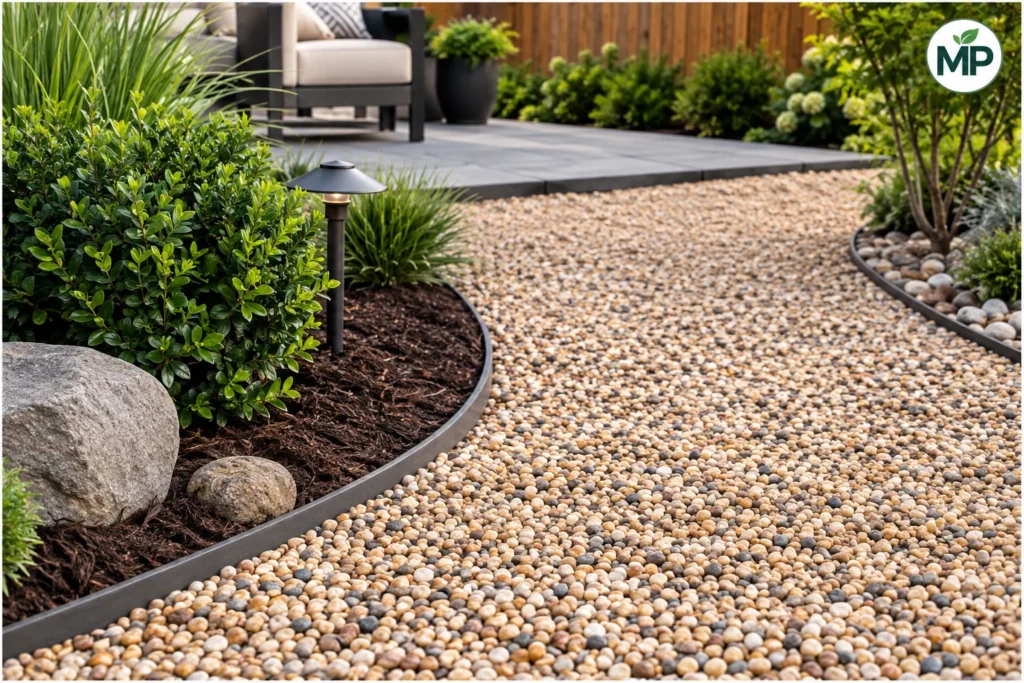

Pea gravel is one of the most recognizable landscaping materials because of its small size, rounded shape and natural appearance. It can be used to create garden paths, informal patios, decorative borders, seating areas and other outdoor spaces without the heavier construction associated with concrete or pavers.
Although the material looks simple, choosing and installing it correctly requires some planning. Its rounded stones behave differently from angular crushed rock, particularly when people walk over them or furniture is placed on top. Current 2026 guidance shows that pea gravel can be an affordable and attractive option, but the right depth, edging, base preparation and application are important for long-term performance.
Quick Review of Pea Gravel
| Quick Fact | Details |
| Material | Pea gravel |
| Typical Size | About 1/8 to 3/8 inch |
| Common Size | Around 3/8 inch |
| Appearance | Small, smooth and rounded stones |
| Common Uses | Patios, pathways, gardens and landscaping |
| Typical Material Cost | About 15–75 per cubic yard |
| Typical Project Cost | Varies by area, labor, delivery and material |
| Popular Benefit | Good drainage |
| Main Limitation | Loose stones can shift |
| Edging | Recommended for most landscape installations |
| Typical Landscape Depth | Often around 2–3 inches |
| Playground Use | Requires specific protective-surfacing depths |
| Maintenance | Raking, weed control and occasional replenishment |
What Is Pea Gravel?
Pea gravel is a collection of small, naturally rounded and relatively smooth stones that are commonly used in residential landscaping. The name comes from its small size, although the exact dimensions can vary between suppliers and products.
Current 2026 information from Angi places standard pea gravel in the 1/8-inch to 3/8-inch range, with pieces around 3/8 inch commonly used for patios and pathways. Because grading can vary, homeowners should check the actual product specifications before ordering rather than assuming every material labeled pea gravel is identical.
What Size Is Pea Gravel?
Pea gravel commonly ranges from 1/8 to 3/8 inch, although individual suppliers may offer slightly different grades. The 3/8-inch size is frequently associated with residential pathways and patio applications.
The size you choose should depend on the project. Smaller material can work well in decorative areas or between pavers, while a somewhat larger grade can provide better coverage across larger landscape surfaces. Angi’s current guide notes that smaller stones can settle more compactly and may move more easily, which can increase the need for replenishment.
What Is Pea Gravel Used For?
Pea gravel is used for a wide variety of outdoor projects because it is relatively easy to install and provides a loose, permeable surface. Common applications include garden pathways, patios, decorative beds, outdoor seating areas, dog spaces and selected drainage or landscape projects.
It is especially popular where homeowners want a softer, more natural appearance than concrete or large-format pavers. Its rounded shape also gives outdoor spaces a relaxed look that works well with gardens and informal landscape designs.
Is Pea Gravel Good for Landscaping?
Pea gravel can be an excellent landscaping material when the project suits its characteristics. Its natural color, rounded texture, relatively low material cost and ability to allow water through the surface make it useful in many residential settings.
It is particularly effective around garden areas, between larger landscape elements and in spaces where a completely solid surface is unnecessary. However, it should not be treated as a universal replacement for every hardscape material because its loose structure can make it less stable than compacted angular aggregate.
How Much Does Pea Gravel Cost in 2026?
Pea gravel pricing depends on the stone’s color, size, location, delivery distance, project dimensions and whether installation is performed by a homeowner or contractor. Current Angi data updated in July 2026 places material-only pricing around $15 to $75 per cubic yard, while some installed projects can cost considerably more depending on preparation and labor.
For a typical 200-square-foot project, Angi currently estimates total costs of approximately $170 to $560, although larger or more complicated installations can be much more expensive. Delivery, edging and ground preparation can make a noticeable difference to the final price.
What Affects the Cost?
The amount of gravel is only one part of the total budget. Project size, material type, color, delivery, excavation, base preparation, edging and labor can all influence what you ultimately pay.
Specialty colors generally cost more than standard pea gravel. A project that requires removing existing soil, installing a compacted base or building substantial edging will also cost more than a simple installation over an already-prepared area.
Is Pea Gravel Cheaper Than Pavers?
Pea gravel is often considered a budget-friendly alternative to more substantial hardscape surfaces, although the actual comparison depends on the complete project. Pavers require a prepared base and careful installation, while pea gravel generally involves excavation, base preparation, gravel placement and edging.
The lower material cost can make gravel attractive for larger areas. However, the surface may require occasional replenishment and raking, while a properly installed paver surface can provide a more rigid walking area.
Is Pea Gravel Good for Patios?
Pea gravel can work well for informal residential patios, particularly when the goal is a natural appearance and good water drainage. Its loose structure allows rainwater to move between the stones instead of creating a completely sealed surface.
One important consideration is furniture stability. Chairs with narrow legs can sink into loose gravel, and the stones can move under repeated use. Angi’s current 2026 patio guidance recommends edging to help keep pea gravel contained and maintain a defined patio boundary.
Is Pea Gravel Good for Walkways?
Pea gravel can create attractive garden walkways, especially in informal landscapes. The small rounded stones provide a comfortable, natural-looking surface and are relatively straightforward to install.
The drawback is movement. Because the stones are rounded, they do not interlock as tightly as angular crushed aggregate. That means heavy foot traffic can gradually move the stones and create uneven areas. For highly stable or accessibility-focused paths, another surface may be more appropriate.
Is Pea Gravel Good for Driveways?
Pea gravel can technically be used in some driveway applications, but it has an important limitation: the rounded stones can shift beneath vehicle tires.
Current 2026 cost guidance from Angi notes that pea gravel may not be the best choice for driveways because vehicles can have difficulty gaining traction and the small rounded stones are more prone to movement. Crushed stone is generally better suited to surfaces where stronger interlocking and stability are required.
For a frequently used driveway, the material should therefore be selected based on performance rather than appearance alone.
Does Pea Gravel Provide Good Drainage?
One of its useful characteristics is that water can pass through the spaces between individual stones. This makes pea gravel suitable for many permeable landscaping applications where homeowners want to avoid creating a completely sealed surface.
However, gravel does not automatically solve every drainage problem. Soil type, slope, grading, water volume and the underlying base all affect how effectively water moves away from an area. A poorly graded site can still experience standing water even when pea gravel is placed on top.
How Deep Should Pea Gravel Be?
The correct depth depends on what you are building. Many ordinary landscaping projects use a relatively shallow layer, while areas subject to heavier loads or specific safety requirements need a different design.
Angi’s current installation guidance notes that project depth can vary considerably, while its 2026 sizing and cost resources indicate that many landscape installations use approximately 2–3 inches. The exact depth should be determined by the intended use and the condition of the prepared base.
Playgrounds are a special case and should not be treated like ordinary landscape paths.
How Do You Install Pea Gravel?
Installing pea gravel properly begins with preparing the area rather than simply dumping stones onto the ground. A typical project involves marking the area, removing unwanted material, leveling the ground, preparing an appropriate base, installing edging and distributing the gravel evenly.
Current 2026 DIY guidance from Angi recommends tools such as a shovel, edged spade and rake, along with base sediment, landscape fabric and edging where appropriate. The guide describes pea-gravel installation as a project that requires meaningful preparation rather than just spreading stones over existing ground.
Do You Need a Base Under Pea Gravel?
A prepared base can improve stability and help create a more consistent surface. The exact base material and thickness depend on the application, soil conditions and expected load.
For a patio or pathway, a compacted aggregate base can provide better support than placing loose gravel directly onto soft soil. The base is particularly important when the surface needs to remain level under repeated use.
Do You Need Landscape Fabric?
Landscape fabric can be used as part of some pea-gravel installations, particularly where controlling the movement of soil and reducing weed growth is desirable. However, it should not be viewed as a substitute for proper site preparation.
Current installation guidance from Angi lists landscape fabric among the supplies that may be used during pea-gravel installation.
The best approach depends on the site. In some projects, a properly prepared base and appropriate edging may be more important to long-term performance than simply adding fabric.
Does Pea Gravel Need Edging?
Yes, edging is strongly recommended for most pea-gravel areas. The rounded stones naturally spread when people walk across them, when rain hits the surface or when lawn equipment passes nearby.
Edging creates a physical boundary that keeps the gravel inside the intended area. Current 2026 Angi guidance specifically recommends border materials for pea-gravel projects because they help prevent spreading and maintain clean lines.
Edging can be made from various suitable landscape materials, including metal, plastic, stone or other landscape borders.
Does Pea Gravel Prevent Weeds?
Pea gravel can reduce the amount of exposed soil in a landscape, but it does not make an area permanently weed-free. Organic material such as leaves and soil can collect between the stones, creating conditions where weeds may eventually grow.
Regular maintenance is therefore still necessary. Removing debris, pulling emerging weeds and maintaining the gravel layer can help keep the installation looking clean.
Does Pea Gravel Move?
Yes. Movement is one of the most important characteristics to understand before choosing this material. Pea gravel consists of rounded stones, so individual pieces can roll or shift instead of locking together.
This is why edging and proper preparation are important. It also explains why pea gravel can be less suitable for areas that require a rigid, highly stable surface.
Is Pea Gravel Comfortable to Walk On?
For many people, pea gravel is reasonably comfortable for casual walking, particularly when the stones are properly installed and the surface is maintained.
However, comfort depends on footwear and the project design. Loose stones can shift underfoot, so pea gravel is better suited to informal garden paths than surfaces where maximum stability is required.
Is Pea Gravel Wheelchair Accessible?
Loose pea gravel can be challenging for wheelchairs, walkers and some strollers because the stones can shift underneath wheels. This makes the surface less predictable than a properly constructed firm pathway.
If accessibility is an important requirement, a stable, smooth and appropriately designed surface should generally be considered instead of assuming that a loose gravel path will provide equivalent mobility.
Can You Use Pea Gravel Around Plants?
Pea gravel can be used around suitable plants as decorative ground cover. It can create a clean transition between planting areas and other landscape features while reducing the amount of exposed soil.
The choice should still be based on the needs of the plants and local conditions. Gravel can influence the surface environment around plants, so it is important to consider sunlight, heat, soil conditions and watering requirements rather than covering every planting bed automatically.
Is Pea Gravel Good Around a Fire Pit?
Pea gravel is commonly used around informal outdoor fire-pit areas because it provides a natural-looking, non-grass surface. It can also help define the seating area and allow rainwater to move through the surface.
However, fire safety depends on the entire fire-pit design, not simply on the presence of gravel. The fire pit itself, surrounding materials, local rules and manufacturer instructions should all be considered before construction.
Can Pea Gravel Be Used Around a Pool?
Pea gravel can be used as part of some poolside landscape designs, particularly as a decorative material around planting areas or selected outdoor spaces.
Its drainage characteristics can be useful, but loose gravel can also migrate into unwanted areas. Around a pool, good edging and careful planning are particularly important so stones do not constantly spread into walking or pool-maintenance areas.
Pea Gravel vs. Crushed Stone
The major difference between pea gravel and crushed stone is the shape of the aggregate. Pea gravel is generally rounded and smooth, while crushed stone has more angular edges.
Those angular edges allow crushed stone to interlock more effectively. That makes crushed aggregate useful when stability and compaction are priorities. Pea gravel, meanwhile, is often selected when appearance, drainage and a softer landscape character are more important.
What Are the Main Benefits?
The main benefits of pea gravel include its natural appearance, relatively affordable cost, drainage characteristics, simple installation and versatility.
It can transform a plain outdoor area without requiring the construction involved with many permanent hardscape surfaces. It is also available in different colors and can complement plants, stone borders, timber and other landscape materials.
What Are the Main Drawbacks?
The biggest disadvantages are movement, maintenance, accessibility limitations and the need for proper edging. The stones can migrate outside their intended area, particularly where there is heavy traffic or strong rainfall.
It is also not automatically the best option for every driveway, walkway or patio. The surface needs to be matched to the demands of the project rather than selected solely because it looks attractive.
How Much Pea Gravel Do You Need?
Calculating the quantity begins with measuring the length, width and planned depth of the area. The basic calculation is:
Length × Width × Depth = Cubic Volume
For irregular spaces, divide the area into smaller rectangles, triangles or circles and calculate each section separately. Angi’s 2026 calculator guidance follows this basic volume approach and notes that depth is a key part of determining the required amount. It is also sensible to account for some variation during installation because actual coverage can differ depending on the stone size, base condition and how evenly the material is distributed.
How Do You Maintain Pea Gravel?
Pea gravel is relatively easy to maintain, but it still needs occasional attention. Raking, removing leaves and debris, controlling weeds and replacing displaced stones are the main routine tasks. Heavy traffic can gradually create thin spots, while rain and normal use can move gravel toward edges. Periodically redistributing the stones helps keep the surface level and attractive.
Is Pea Gravel Environmentally Friendly?
Pea gravel can contribute to a more permeable landscape because water can pass between loose stones. This can be preferable to creating a completely impermeable surface in some residential landscape designs.
Still, the environmental value depends on the whole project. Site grading, soil conditions, runoff patterns and the source of the aggregate all matter. Gravel should be considered as one component of a landscape rather than automatically described as an environmentally superior solution.
Can Pea Gravel Be Used on a Slope?
Pea gravel can be difficult to control on steep slopes because gravity and rainfall can encourage the rounded stones to move downhill.
For sloped areas, drainage planning, edging, stabilization and aggregate selection become more important. Angular materials or engineered landscape systems may provide better stability depending on the severity of the slope.
Is Pea Gravel Suitable for Playgrounds?
Pea gravel can be used as a loose-fill protective surfacing material around playground equipment, but this is a safety-specific application and should not be treated like an ordinary landscaping project.
The U.S. Consumer Product Safety Commission’s current public playground guidance states that surfaces around playground equipment should have at least 12 inches of wood chips, mulch, sand or pea gravel, or use safety-tested rubber or similar surfacing. The CPSC handbook provides more specific information: its table lists 9 inches of compressed pea gravel for protection up to a 5-foot fall height. It also explains that loose-fill materials can compress over time, meaning installation depth and ongoing maintenance matter.
How Is Playground Pea Gravel Different?
The key difference is the safety requirement. A decorative garden path might use only a few inches of material, while playground surfacing is designed to provide impact attenuation under play equipment. The CPSC recommends maintaining appropriate protective surfacing and keeping it distributed around equipment. Its public playground checklist also emphasizes that protective surfacing should extend at least six feet around play equipment in relevant situations.
For a playground, follow the applicable safety guidance and equipment manufacturer’s requirements rather than using ordinary landscaping depth calculations.
Is Pea Gravel a Good Choice for Every Project?
No single landscaping material works perfectly everywhere. Pea gravel makes sense when you want a natural appearance, permeability, relatively simple installation and a loose surface, but another material may be better when stability, accessibility or vehicle traction is the priority.
The best choice depends on how the area will actually be used. A quiet garden path has different requirements from a driveway, accessible walkway or playground.
Final Thoughts
Pea gravel remains a practical landscaping material in 2026 because it combines a natural appearance, flexible design options, relatively affordable pricing and useful drainage characteristics. It can be used for patios, pathways, garden areas, decorative borders and other outdoor spaces when the installation is properly planned. Its biggest strength is also one of its biggest limitations: the stones are small, smooth and rounded. That makes them visually appealing, but it also means they do not lock together like angular crushed stone. Edging, a suitable base and regular maintenance can help control movement and keep the installation looking neat. Current 2026 pricing data shows that material costs can range widely, with Angi reporting roughly 15–75 per cubic yard for materials, while complete project costs depend heavily on size, labor, preparation and delivery.
For homeowners, the most important step is to choose pea gravel according to the actual job. Use it where its loose, permeable nature is an advantage, and consider a more stable aggregate or hard surface where strength, accessibility or vehicle traction is more important.
Frequently Asked Questions
What size is pea gravel?
Pea gravel commonly ranges from 1/8 to 3/8 inch, with around 3/8 inch frequently used for residential patios and pathways. Exact sizes can vary by supplier.
How much does pea gravel cost?
Current 2026 Angi data puts material pricing at roughly 15–75 per cubic yard, while complete project costs depend on labor, delivery, preparation, edging and project size.
How deep should pea gravel be?
Many ordinary landscape applications use approximately 2–3 inches, but the appropriate depth depends on the project. Playground surfacing has separate safety requirements.
Does pea gravel need edging?
Yes. Edging helps prevent rounded stones from spreading into lawns, gardens and other areas and gives the installation a cleaner boundary.
Is pea gravel good for driveways?
It can be used, but it is not usually the most stable driveway aggregate because its rounded stones can shift and reduce traction. Crushed stone generally provides better interlocking.
Does pea gravel stop weeds?
No. It can reduce exposed soil but does not eliminate weeds. Organic debris can collect between the stones and create conditions for new growth.
Is pea gravel good for patios?
Yes, pea gravel can work well for informal patios because it provides good drainage and a natural appearance. Edging and proper preparation are important for keeping the stones contained.
Is pea gravel safe for playgrounds?
It can be used as protective loose-fill surfacing, but playground installations must follow applicable safety guidance. The CPSC lists specific depth requirements for pea gravel based on fall-height considerations.
Does pea gravel move?
Yes. Its rounded shape means it can shift under foot traffic, rain and vehicles. Proper edging and a suitable base can help control movement.
How do you calculate pea gravel?
Multiply the length × width × depth of the area to determine the required volume. Irregular areas can be divided into simpler shapes before calculating the total.
Explore Our New Post: Siding With Fiber Cement: Costs, Benefits, Installation and Maintenance in 2026