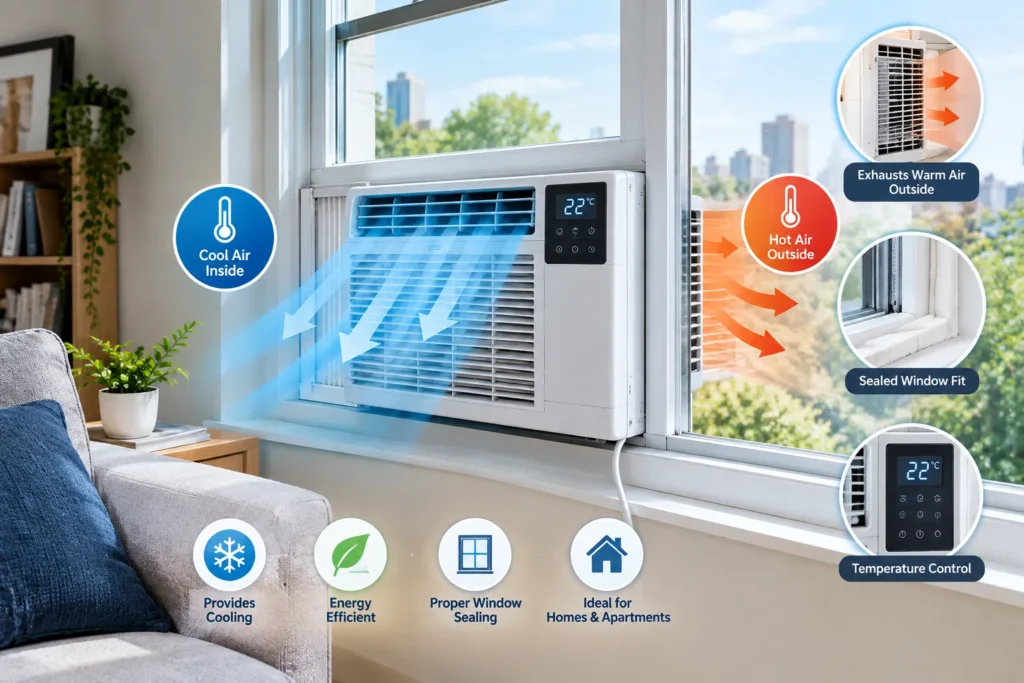

AC on windows, more commonly called a window air conditioner or window AC, is a compact cooling system designed to fit into a suitable window opening. It is commonly used to cool bedrooms, apartments, offices, living rooms, and other individual spaces without installing a complete central air-conditioning system.
Window AC units remain an important category of room air conditioners in 2026. The U.S. The Department of Energy defines a room air conditioner as an enclosed unit designed for mounting in a window or through a wall to provide conditioned air to an enclosed space. Modern models have also moved beyond basic cooling. Depending on the model, today’s window AC units can include variable-speed compressors, Wi-Fi controls, heating modes, improved efficiency, lower-impact refrigerants, and energy-saving operating modes.
Quick Information
| Detail | Information |
| Common Name | Window AC |
| Full Name | Window Air Conditioner |
| Main Purpose | Room cooling |
| Installation | Suitable window opening |
| Capacity | Model dependent |
| Efficiency Metric | CEER |
| Efficient Models | ENERGY STAR options available |
| Compressor Technology | Fixed-speed or variable-speed |
| Refrigerants | Model dependent; current listings include R-32 |
| Common Window Type | Double-hung |
| Special Configurations | Casement and casement-slider |
| Controls | Manual, remote and smart options |
| Maintenance | Filter, airflow and exterior cleaning |
| Best Application | Individual rooms and smaller spaces |
What Is AC on Windows?
A window AC is a self-contained air-conditioning appliance installed in a window opening. Unlike a central HVAC system, it does not require a separate outdoor condenser connected to an indoor air handler.
The indoor-facing portion circulates cooled air into the room, while the rear section extends toward the outside and releases the heat removed from the indoor air.
This design makes window AC particularly useful when a homeowner needs to cool one room or a limited area rather than the entire building.
How Does a Window AC Work?
The cooling process begins when warm room air enters the air conditioner. The air passes over the evaporator coil, where heat is absorbed by the refrigerant circulating inside the system.
The compressor then moves the refrigerant through the cooling cycle. At the outdoor side of the unit, the condenser releases the collected heat outside.
The cooled air is returned to the room while the process continues until the thermostat determines that the desired temperature has been reached.
The basic goal is simple: remove heat from inside the room and transfer it outdoors.
Why Use a Window AC?
One of the biggest advantages is that a window AC can provide localized cooling.
If a household spends most of its time in a bedroom, home office, or living room, a room air conditioner can cool that space without requiring the entire property to be conditioned.
Window units can also be useful in apartments, older properties, temporary housing, and buildings where installing a central HVAC system would be expensive or impractical.
Their relatively compact design makes them attractive when the cooling requirement is limited to one or several rooms.
Window AC vs. Central AC
Central air conditioning is designed to distribute conditioned air throughout a building using a network of ducts or other distribution equipment.
A window AC takes a different approach. It focuses on the room where it is installed.
Central systems can provide whole-home cooling, while window units allow individual rooms to be cooled separately. The right option depends on the property’s layout, existing HVAC system, budget, installation limitations, and cooling requirements.
For someone who only needs occasional cooling in one bedroom, installing an entire central system may not be necessary.
Window AC vs. Portable AC
Portable air conditioners are positioned inside the room and normally use an exhaust hose connected to a window kit.
A window AC is physically mounted in the window opening, with its heat-releasing components positioned toward the exterior.
This difference can affect efficiency, noise, available floor space, and installation. A window unit also does not occupy valuable floor space inside the room.
However, window compatibility is essential because not every window can accommodate every model.
Choosing the Right Cooling Capacity
One of the most important decisions is selecting the appropriate cooling capacity.
Air conditioners are commonly rated in BTUs per hour, which indicates their cooling capacity. The required capacity depends on factors such as room size, ceiling height, insulation, sunlight exposure, occupancy, and heat-producing appliances.
ENERGY STAR specifically warns that bigger is not always better and recommends properly sizing a room air conditioner according to the space being cooled.
An oversized unit may cool the air quickly without providing ideal humidity control, while an undersized unit may struggle to maintain the desired temperature.
Energy Efficiency
Energy efficiency is one of the most important differences between modern window AC models.
The U.S. Department of Energy uses Combined Energy Efficiency Ratio (CEER) when evaluating room air-conditioner efficiency. Its current purchasing guidance gives an example in the 8,000–13,999 BTU/h range where an ENERGY STAR-qualified unit has a CEER of 14.7 compared with 10.9 for a less-efficient example.
ENERGY STAR says certified room air conditioners are at least 19% to 36% more energy efficient than applicable minimum federal standards, depending on the equipment category.
That makes the efficiency label worth checking before purchasing.
What Is CEER?
CEER means Combined Energy Efficiency Ratio.
It is a performance measurement used for room air conditioners that takes cooling efficiency and certain energy use while the unit is not actively cooling into account.
When comparing similarly sized window AC units, a higher CEER generally indicates better rated efficiency.
However, the rating should not be interpreted as an exact prediction of an individual household’s electricity bill. Actual consumption depends on operating hours, thermostat settings, weather, electricity prices, insulation, and the condition of the room.
2026 Energy-Efficient Models
Current ENERGY STAR listings show that modern window ACs can achieve substantially higher efficiency than older basic models.
For example, current ENERGY STAR Most Efficient listings include several window units with CEER ratings around 16.0 or higher. Listed examples include 8,000 BTU models with CEER 16.0, 10,000 BTU models with CEER 16.0, and 14,000 BTU models with CEER 16.0.
ENERGY STAR’s current database also includes models with even higher ratings. Some listed 9,500 BTU window units reach a CEER of 17.6.
These figures show how much efficiency can vary between individual products.
Inverter Window AC
Variable-speed or inverter compressor technology is one of the notable features in newer window air conditioners.
A conventional compressor generally operates at fixed output levels and cycles on and off according to cooling demand. A variable-speed compressor can adjust its operation as conditions change.
Current ENERGY STAR listings show many modern window AC models using variable-speed compressors.
This technology can help a properly designed system maintain temperature more consistently and may improve efficiency under suitable operating conditions.
Lower-GWP Refrigerants
Another change visible in current product listings is the use of lower-global-warming-potential refrigerants.
Current ENERGY STAR product data includes numerous window air conditioners using R-32, which ENERGY STAR identifies in its product listings with a global-warming-potential value of 675.
This is part of a broader transition toward refrigerants with lower climate impact than some older alternatives.
Consumers should still follow the manufacturer’s specifications and should never attempt refrigerant work themselves unless appropriately qualified.
Window AC Installation
Installing a window air conditioner is not simply a matter of placing the unit on the sill.
The appliance needs to be compatible with the window, properly supported, securely positioned, and sealed around the opening.
The exact requirements vary by manufacturer and model. Always follow the installation manual supplied with the particular unit.
This becomes especially important for heavy units or installations above ground level.
Measuring the Window
Before purchasing a window AC, measure the available opening carefully.
Check the minimum and maximum window width, opening height, sill configuration, and available clearance.
Do not assume that a unit will fit simply because another air conditioner previously worked in the same window.
Casement and sliding windows may require specially designed units rather than conventional double-hung-window models.
Support and Stability
A window AC can be heavy, particularly at higher cooling capacities.
The installation hardware must support the unit according to the manufacturer’s specifications. Depending on the model and window, an external support bracket may be recommended or required.
The condition of the window frame also matters. A damaged, rotten, or weakened frame should be addressed before installing a heavy appliance.
A secure installation protects both the appliance and the people below it.
Sealing Around the AC
Gaps around a window air conditioner can allow warm outdoor air and insects to enter the room.
Most window AC installations use side panels, foam insulation, weather seals, or other materials to close the remaining opening.
Proper sealing also helps prevent conditioned indoor air from escaping unnecessarily.
A well-installed unit should leave the window opening reasonably sealed while still allowing the appliance to operate as designed.
Drainage and Condensation
Window AC systems naturally produce condensation during cooling.
Water needs to be managed according to the unit’s design. Some models direct condensate toward the outdoor side, while others use different drainage arrangements.
Never assume that every window AC requires the same installation angle or drainage method. Follow the instructions for the exact model.
Incorrect installation can contribute to water leaking indoors.
Noise Levels
Noise can be particularly important when the unit is installed in a bedroom.
Traditional window ACs contain the compressor and other mechanical components in the same cabinet, so some operating sound is expected.
Modern variable-speed models can offer different acoustic characteristics, but noise performance varies from one product to another.
If quiet operation matters, compare the manufacturer’s noise specification and independent test results rather than relying only on a general “quiet” label.
Smart Window AC Features
Many modern window AC units offer more than a thermostat and fan-speed switch.
Depending on the product, features can include Wi-Fi connectivity, smartphone controls, scheduling, sleep settings, remote controls, energy-saving modes, and voice-assistant integration.
These features can be convenient for people who want to adjust the temperature remotely or create cooling schedules.
However, connected features should not replace the basic selection criteria of proper capacity, efficiency, installation compatibility, and reliability.
Casement Window AC
Not every window AC is designed for a traditional double-hung window.
ENERGY STAR’s room-air-conditioner criteria specifically recognize casement-only and casement-slider air conditioners as separate categories.
This is useful for homes with side-opening windows.
A casement model should be selected specifically for that window configuration rather than attempting to modify a standard unit without manufacturer approval.
Maintenance
Regular maintenance can help preserve cooling performance.
The air filter should be cleaned according to the manufacturer’s recommendations. A dirty filter can restrict airflow and make the system work harder.
The outdoor portion of the unit should also remain free of leaves, dust, and other obstructions.
Before performing maintenance that requires opening or accessing internal components, follow the manufacturer’s electrical-safety instructions.
Common Window AC Problems
Window air conditioners can develop several common problems over time.
These may include weak airflow, poor cooling, unusual noise, water leakage, ice buildup, unpleasant odors, frequent cycling, and electrical faults.
A dirty filter may cause airflow problems, while drainage or installation issues can contribute to water appearing indoors.
More serious refrigeration or electrical problems should be handled by a qualified technician rather than through trial-and-error repairs.
How Much Electricity Does a Window AC Use?
Electricity consumption depends on the air conditioner’s efficiency, cooling capacity, operating hours, and environmental conditions.
The Department of Energy provides a useful example for a 12,000 BTU/h room air conditioner operating for 750 hours per year. Its example estimates 612 kWh annually for an ENERGY STAR-level unit compared with 826 kWh for a less-efficient example.
Actual household consumption can be much higher or lower depending on how the unit is used.
A simple electricity-cost calculation is:
Annual electricity cost = annual kWh consumption × local electricity rate.
For accurate planning, use the energy information supplied with the specific model.
How to Reduce Cooling Costs
There are several practical ways to reduce unnecessary energy consumption.
Keep doors and windows closed while the AC is running, use curtains or blinds to reduce direct solar heat, clean the filter regularly, and avoid setting the thermostat unnecessarily low.
Correct sizing is also important. A larger BTU rating does not automatically mean lower electricity costs.
ENERGY STAR specifically recommends properly sizing room air conditioners instead of assuming that the largest available unit is the best choice.
Window AC for Bedrooms
Bedrooms are one of the most common applications for room air conditioners.
A properly sized unit can provide localized cooling without requiring the entire home to be conditioned.
For bedrooms, homeowners should pay particular attention to noise, nighttime temperature control, energy efficiency, and secure installation.
A model with a sleep mode or variable-speed compressor may also be useful for people who prefer more consistent nighttime cooling.
Window AC for Apartments
Window AC can be particularly useful for apartment residents.
It can provide cooling without requiring a permanent HVAC installation, although renters should check their lease and building rules first.
Some apartment buildings have specific requirements concerning support brackets, exterior appearance, window damage, and approved installation methods.
Before buying a unit, confirm that the building permits window-mounted air conditioners.
Removing a Window AC
In climates with cold winters, removing and storing a window AC can be useful.
Recent guidance notes that removing the unit can reduce heat loss through the window and protect the appliance from snow and ice.
However, the appropriate approach depends on the climate, building rules, window design, and manufacturer’s instructions.
If a unit remains installed during cold weather, it should be winterized according to the manufacturer’s recommendations.
What to Check Before Buying
Before purchasing a window AC, make a checklist.
First, measure the window and confirm that the unit physically fits. Then determine the appropriate cooling capacity for the room.
Next, compare CEER ratings, annual energy use, noise information, warranty terms, compressor technology, controls, and installation requirements.
Finally, consider whether the unit requires a support bracket or special installation hardware.
A slightly higher purchase price can sometimes make sense when the product offers substantially better efficiency or features that matter for your particular use.
Final Wordings
AC on windows remains a practical cooling solution in 2026 for people who need to cool individual rooms without installing a complete central HVAC system. Modern window air conditioners are available in a wide range of capacities and designs, with newer models offering variable-speed compressors, smart controls, improved efficiency, and lower-GWP refrigerants. Energy efficiency is particularly worth considering. Current ENERGY STAR data includes window units with CEER ratings around 16.0 and higher, while some listed models reach 17.6.
Still, the highest efficiency rating does not automatically make a particular unit suitable for every room. Correct sizing, window compatibility, secure installation, adequate drainage, proper sealing, and routine maintenance all affect the final performance. For most buyers, the best starting point is simple: measure the window, calculate the room’s cooling requirement, compare certified efficiency information, and follow the manufacturer’s installation requirements.
FAQs
What is AC on windows called?
It is commonly called a window air conditioner or window AC. It is designed to cool an enclosed room through a unit installed in a suitable window opening.
Are window AC units energy efficient?
Efficiency varies by model. ENERGY STAR-certified room air conditioners are designed to exceed applicable minimum efficiency standards, and current certified models include several with CEER ratings of 16.0 or higher.
How many BTUs do I need for a window AC?
The required capacity depends on room size, insulation, sunlight, ceiling height, occupancy, and other heat sources. ENERGY STAR recommends properly sizing the unit rather than automatically choosing the largest capacity.
Can a window AC fit any window?
No. Different models are designed for specific window configurations and dimensions. Casement and casement-slider windows may require specially designed room air conditioners.
How can I reduce the electricity cost of a window AC?
Use an appropriately sized efficient model, keep the filter clean, limit heat entering the room, keep doors and windows closed while cooling, and avoid setting the thermostat unnecessarily low.
Continue Exploring Our Latest Article: Window Replacement in Carroll County: Costs, Types, Benefits and Local Guide