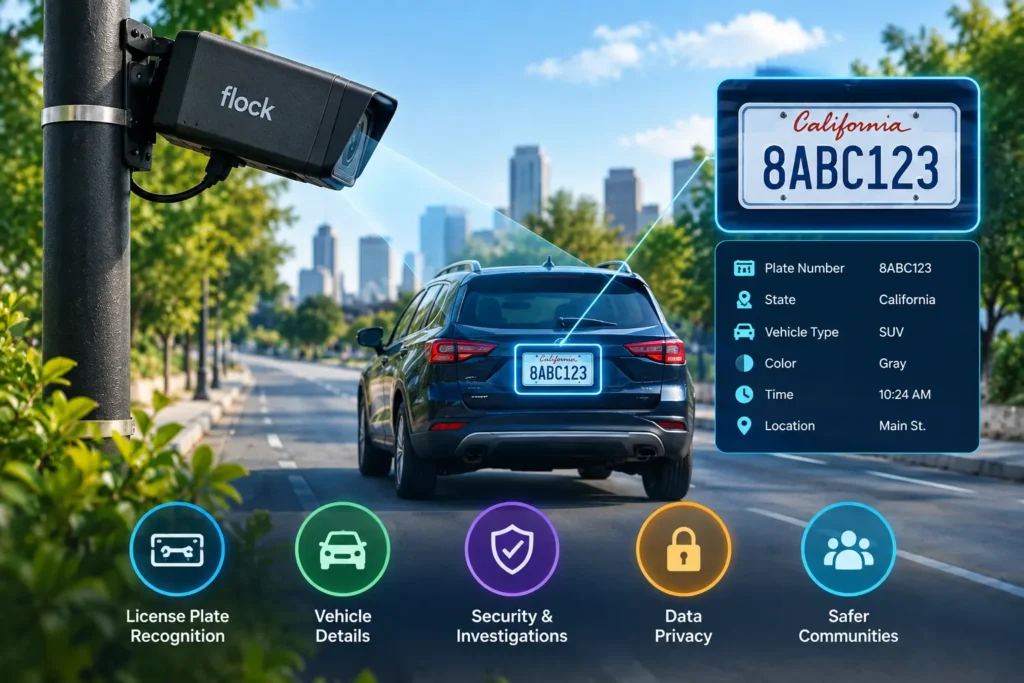

Flock cameras are automated license plate reader cameras designed to capture vehicle information from public areas. They can record a license plate, vehicle type, color, make, visible features, time, and camera location. Flock Safety says its cameras do not use facial recognition or identify people inside vehicles. The technology is used by law enforcement, neighborhoods, businesses, and other organizations for security and investigations. At the same time, Flock cameras have become the subject of a growing debate about privacy, data sharing, retention, and surveillance.
What Are Flock Cameras?
Flock cameras are a type of automated license plate reader (ALPR) system made by Flock Safety. Unlike a basic security camera, the system is designed to turn images of passing vehicles into searchable information.
When a vehicle passes a camera, the system can capture its license plate and certain visible characteristics. These may include the vehicle’s make, color, and other features that can help distinguish it from another vehicle.
Flock says its cameras focus on vehicles that are visible from public roads. The company also states that its ALPR system does not collect facial recognition data or biometric information.
This makes Flock different from a traditional CCTV camera. A normal security camera may simply record video, while an ALPR system is built to make vehicle information searchable.
How Do Flock Cameras Work?
The process is mostly automatic. A vehicle enters the camera’s view, and the camera takes several images during that vehicle’s passage.
Flock says its cameras can capture around 6 to 12 images of a vehicle during one session, depending on how the camera is configured and where it is installed. The system then processes the images and extracts information from the vehicle.
The resulting record can include the plate number, state, vehicle characteristics, date, time, and camera location. Flock’s license plate reader policy specifically identifies these categories as LPR data.
Authorized users can later search this information using details such as a plate number, vehicle color, vehicle type, date, or time period.
That search function is one of the main reasons law enforcement agencies use the technology.
What Do Flock Cameras Capture?
A Flock camera is primarily designed to capture vehicle-related information that is visible in public.
According to Flock’s current privacy information, the system can collect:
- License plate images
- Vehicle images
- License plate numbers
- Vehicle color and make
- Date and time
- Camera location
Flock says its ALPR system does not collect facial recognition data, biometric information, or driver information.
The cameras can also capture visible features that help identify a particular vehicle. For example, Flock says these may include features such as trailers, bike racks, or toolboxes.
The distinction is important. The system is designed to identify vehicles, not the people sitting inside them.
What Are Flock Cameras Used For?
Flock cameras are commonly used for public safety and vehicle-related investigations.
Law enforcement agencies can use the system to investigate stolen vehicles, identify vehicles connected to reported incidents, and develop leads after a crime.
The system can also generate alerts when a detected vehicle matches a designated watchlist or hotlist. Flock says its cameras can integrate with databases such as the National Crime Information Center for certain alerts.
Neighborhoods and other private customers may use the technology for a different reason. Their goal may be to discourage vehicle theft, monitor entrances, or provide information to police after an incident.
The exact use depends on who owns the cameras and what rules apply to that deployment.
Why Do Police Use Flock Cameras?
Traditional investigations can take time, especially when there is little physical evidence.
A vehicle may provide an important clue. If a witness remembers a vehicle’s color or partial plate, an investigator may be able to use an ALPR system to search for matching records.
For example, an investigator could search for a particular vehicle during a specific time window. If the system contains a matching record, it may provide a lead about where that vehicle was seen.
Flock describes this as a way to help investigators find objective vehicle evidence more quickly. The company says its technology supported about 1 million police investigations during the previous year, although that figure is a company-reported claim rather than an independent measurement.
How Long Do Flock Cameras Keep Data?
Data retention is an important part of the Flock cameras debate because the answer can vary by customer and local policy.
Flock’s current policy says LPR data is hard deleted on a rolling seven-day basis by default. However, the policy also allows the retention period to be changed when a customer’s law or policy requires a different schedule.
Flock’s public information similarly says that most communities now use a seven-day period unless local law requires something different.
There is also an Evidence Mode for preserving specific information connected to an active investigation.
This means readers should not assume that every Flock camera automatically has the same retention period. The local contract, law, and agency policy can make a significant difference.
Can Police Search Flock Camera Data?
Yes. Authorized users can search Flock data through the company’s system.
Flock says searches are associated with individual accounts and are logged for review. Access is controlled by the local agency, which determines who can use the system based on its policies and user roles.
Searches can use information such as a license plate, vehicle characteristics, date, and time.
This can make the system useful during an investigation because an officer does not necessarily need to know the complete plate number before searching.
However, the ability to search historical vehicle records is also a major reason privacy advocates have raised concerns about ALPR systems.
Can Flock Cameras Identify People?
Flock says its ALPR cameras do not use facial recognition.
The company states that its system does not identify the person inside a vehicle and does not collect biometric information through its ALPR technology.
That does not completely end the privacy discussion.
A vehicle’s movements can sometimes provide information about where it was seen and when. If investigators already know who is associated with a particular vehicle, those records may become relevant to an investigation.
This is why privacy discussions around ALPR systems often focus on location information and vehicle tracking, rather than facial recognition alone.
Are Flock Cameras Always Recording?
Flock cameras are designed to automatically capture vehicles as they pass through their field of view.
They are not simply ordinary video cameras that require an employee or police officer to watch a screen continuously.
The system takes still images of vehicles and converts relevant information into searchable data. Flock describes its cameras as capturing point-in-time images of vehicles visible from public roads.
This approach makes the technology useful for searching vehicle sightings later.
It also explains why the cameras can have a different privacy impact from traditional security cameras.
How Much Do Flock Cameras Cost?
Flock Safety uses a subscription-based pricing model, rather than presenting one universal price for every camera.
The company says its pricing can include installation, maintenance, cellular connectivity, footage hosting, and software updates. The final cost depends on the customer and the selected solution.
For that reason, there is no single price that applies to every Flock installation.
A neighborhood, business, and police department may have different agreements and requirements.
Anyone considering the system should look at the actual local contract instead of relying on a general online price estimate.
Flock Cameras for Neighborhoods
Flock cameras are also used by HOAs, neighborhood associations, and private communities.
In these settings, cameras are often placed near entrances or roads where vehicles regularly pass.
The goal may be to help identify vehicles involved in theft, property crime, or other incidents.
Flock offers a neighborhood feature called the HOA Safe List. According to the company, eligible residents can register their vehicle and request that associated footage be automatically deleted under the feature’s rules.
However, this does not mean the vehicle disappears from every Flock camera elsewhere.
Flock specifically says that a vehicle registered on a neighborhood Safe List can still be detected by other Flock cameras outside that community.
Are Flock Cameras Safe?
There are two different meanings of “safe” when discussing Flock cameras.
From a technical security perspective, Flock says images and metadata are encrypted throughout their lifecycle. The company also says its law-enforcement data is stored using AWS GovCloud infrastructure.
From a privacy perspective, the answer is more complicated.
The main concern is not simply whether someone can hack a camera. It is also about who can access the information, how long it is retained, whether it can be shared, and what searches are permitted.
Those questions depend heavily on the local agency and its policies.
Why Are Flock Cameras Controversial?
The central debate is about the balance between public safety and privacy.
Supporters argue that ALPR technology can help police identify stolen vehicles, locate missing people, and develop investigative leads.
Privacy advocates argue that large networks of cameras can create detailed records of vehicle movements. The ACLU has criticized Flock and similar systems over concerns about data retention, sharing, and the potential for broad surveillance.
The disagreement is therefore bigger than the question of whether a camera can read a license plate.
It involves how much vehicle information should be collected, who should have access, how long it should remain available, and what limits should apply to searches.
Are Communities Removing Flock Cameras?
Some communities have recently reconsidered their use of Flock technology.
Axios reported in August 2026 that communities around the United States were ending or reconsidering Flock contracts amid growing concerns about surveillance and potential misuse. The report also noted that Flock said it was strengthening privacy and accountability controls.
In September 2026, the University of Minnesota decided to remove a recently installed Flock camera after concerns from local officials and community members about privacy and surveillance. The university said its use was intended for public safety and subject to Minnesota law.
These examples show that local policies are changing.
They also demonstrate why the rules surrounding a particular Flock installation matter more than the camera’s brand alone.
What Privacy Controls Does Flock Offer?
Flock says several controls are built into its system.
User access is restricted, and local agencies control accounts and permissions. The company also says every search is logged so that activity can be reviewed.
Flock also says customer data is not sold and that customers control their data.
The company has announced additional misuse-detection tools, including Audit Assistance and proactive lockout features intended to identify unusual activity. Flock says Audit Assistance is planned to become mandatory for law-enforcement customers by the end of 2026.
These controls are part of Flock’s stated privacy approach.
However, outside organizations continue to question whether technical controls alone are enough to prevent inappropriate searches or overly broad data sharing.
Who Can Access Flock Data?
Access depends on the customer and its policies.
Flock says local agencies control who can access their information. Approved users receive accounts based on their roles, and searches are logged.
Data sharing is also an important issue.
Flock says customers control sharing settings. At the same time, privacy advocates have raised concerns about the ability of ALPR networks to connect information from different jurisdictions.
This is why residents who want to understand a local Flock system should ask which agencies can search the data and under what conditions.
The answer can differ from one community to another.
What Should You Check Before Using Flock Cameras?
If your neighborhood or local government is considering Flock cameras, several questions are worth asking.
Start with the contract. Find out how many cameras will be installed, where they will be placed, how much the system will cost, and who owns the collected information.
Next, check the retention period.
Ask which agencies can access the records and whether outside agencies can search them.
Finally, find out what rules govern searches and whether residents can review information about system use.
These details provide a much clearer picture of a local Flock program than the product name alone.
Flock Cameras vs. Regular Security Cameras
Although both systems use cameras, their purpose is different.
A traditional security camera is generally designed for visual monitoring. A Flock camera is designed specifically to turn passing-vehicle information into searchable records.
A regular camera may show a vehicle entering a property.
A Flock system can make it possible to search for a particular vehicle using information such as its plate, color, type, date, or time.
The searchable nature of ALPR data is the key difference.
That capability can make investigations faster, but it is also central to the privacy debate.
What Is the Future of Flock Cameras?
Flock Safety is expanding beyond traditional license plate readers.
The company’s product lineup now includes ALPR cameras, video cameras, mobile security systems, drones, and other public-safety technologies.
This means future discussions about Flock may involve more than license plates.
As these systems become more connected, communities will likely continue examining questions about data ownership, privacy, access, retention, and accountability.
The technology itself is only one part of the issue.
The rules surrounding the technology can be just as important as the camera.
Frequently Asked Questions
What are Flock cameras?
Flock cameras are automated license plate reader cameras that capture vehicle images and information such as license plates, vehicle characteristics, time, and camera location.
Do Flock cameras use facial recognition?
No. Flock says its ALPR cameras do not use facial recognition or collect biometric information through the ALPR system.
How long does Flock keep camera data?
Flock’s current default is seven days, although local law, customer policies, or an active investigation can result in different retention arrangements.
How much do Flock cameras cost?
Flock uses a subscription model that can include installation, maintenance, cellular service, hosting, and software updates. Pricing varies by customer and solution.
Why are Flock cameras controversial?
The main debate concerns privacy, data retention, sharing, access, and vehicle-location tracking. Supporters point to investigative benefits, while privacy organizations have raised concerns about broad surveillance and misuse.
Final Verdict
Flock cameras are more than ordinary security cameras. They are automated systems designed to turn passing-vehicle images into searchable information that can support investigations and security efforts. Flock says its technology does not use facial recognition and that data is protected through access controls, encryption, logging, and automatic deletion policies.
At the same time, the technology has created a serious public discussion about privacy and surveillance. The most important details can vary between communities, especially when it comes to data retention, sharing, access, and local rules. Anyone researching a Flock camera near their home should therefore look beyond the camera itself and examine the specific policy or contract governing its use.



Pingback: Latest iPhone Rumors: iPhone 18, Air 2, Foldable & 2027 Updates - magazinepanda.blog
Pingback: Ponas Robotas Explained: Meaning, Mr. Robot Connection, Cybersecurity, Story & AI Confusion - magazinepanda.blog