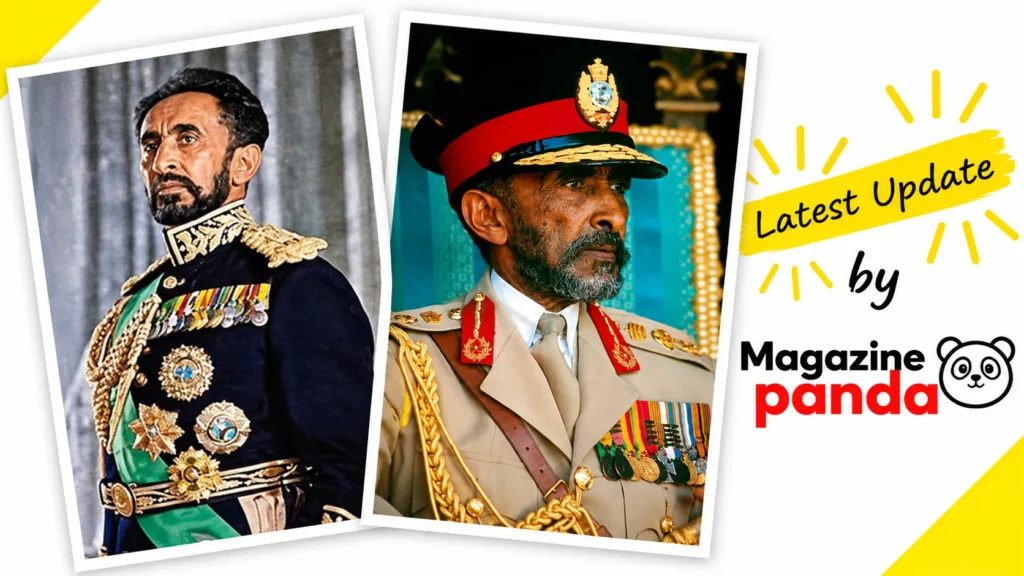

Haile Selassie I was the last reigning emperor of Ethiopia and one of the most influential African leaders of the 20th century. Born Tafari Makonnen on July 23, 1892, he ruled Ethiopia from 1930 until his overthrow in 1974. His leadership included efforts to modernize the country, resistance against Italian occupation, and an important role in the development of African unity.
He became internationally recognized after Benito Mussolini’s Italy invaded Ethiopia in 1935. Forced into exile, Selassie appealed to the League of Nations for international support and later returned to Ethiopia in 1941 with Allied assistance. His political influence extended beyond his country, particularly through his involvement in establishing the Organization of African Unity in 1963.
His personal story is equally significant. He was married to Empress Menen Asfaw, and they had six children together. He also became an important spiritual figure for the Rastafari movement, which developed in Jamaica after his coronation in 1930.
However, his reign was not without controversy. Political repression, inequality, famine, and dissatisfaction with the imperial government contributed to his removal in 1974. He died in custody on August 27, 1975, at the age of 83.
Haile Selassie Quick Biography
| Detail | Information |
| Full Name | Haile Selassie I |
| Birth Name | Tafari Makonnen |
| Date of Birth | July 23, 1892 |
| Age at Death | 83 years |
| Birthplace | Ejersa Gora, Ethiopia |
| Date of Death | August 27, 1975 |
| Nationality | Ethiopian |
| Profession | Emperor, Political Leader, Diplomat |
| Reign | 1930–1974 |
| Religion | Ethiopian Orthodox Christianity |
| Father | Ras Makonnen Wolde Mikael |
| Mother | Yeshimebet Ali |
| Wife | Empress Menen Asfaw |
| Children | Six with Empress Menen |
| Famous For | Last reigning emperor of Ethiopia |
| Major Achievement | Founding role in the Organization of African Unity |
| Net Worth | Not publicly documented |
Who Was Haile Selassie?
Haile Selassie I was an Ethiopian emperor who played a major role in shaping the country’s modern political history.
He became emperor in November 1930 after the death of Empress Zewditu. Before taking the throne, he was known as Tafari Makonnen and had already gained considerable political influence as regent and heir to the throne.
His leadership was associated with efforts to modernize Ethiopia through education, infrastructure, administrative reform, and international diplomacy.
He also became a symbol of African resistance against European colonial expansion after Italy invaded Ethiopia in 1935.
Outside Africa, his name became particularly important to the Rastafari movement, whose followers regard him as a divinely significant figure.
Although his supporters remember him as a defender of Ethiopian independence and African unity, his government also faced criticism for authoritarian rule, economic inequality, and its response to national crises.
Early Life and Childhood
Haile Selassie was born on July 23, 1892, in Ejersa Gora, a locality in the Harar region of Ethiopia.
His birth name was Tafari Makonnen. He was the son of Ras Makonnen Wolde Mikael, an influential governor and military figure, and Yeshimebet Ali.
His family had connections to Ethiopia’s imperial establishment, giving him access to political education and the royal court from an early age.
His father was a close associate of Emperor Menelik II, one of Ethiopia’s most important historical rulers.
When Tafari’s father died in 1906, the young boy came under the influence of relatives and members of the imperial court.
His education included private European tutors, traditional Ethiopian learning, and exposure to political administration.
These experiences helped him develop the knowledge and connections that later supported his rise to power.
Family Background and Royal Heritage
Tafari Makonnen came from a prominent Ethiopian family with historical connections to the country’s monarchy.
His father, Ras Makonnen, was an important political and military figure who served as governor of Harar.
His family also claimed descent from the Solomonic dynasty, a royal tradition that traced the Ethiopian imperial line to Menelik I, traditionally associated with King Solomon and the Queen of Sheba.
This ancestry was an important part of the legitimacy claimed by Ethiopia’s imperial family.
However, the historical and religious traditions surrounding the Solomonic dynasty should be understood as part of Ethiopian royal heritage rather than treated as independently established modern genealogy.
Tafari’s family position helped him gain access to influential political circles, but his eventual rise also depended on his administrative abilities and relationships with powerful members of the imperial court.
Education and Early Leadership
Haile Selassie received his education through private tutors rather than attending a modern university.
His early studies included languages, religious subjects, political administration, and aspects of European education.
At approximately 14 years old, he received his first significant administrative appointment as governor of Gara Muleta.
He later became governor of Sidamo and eventually Harar.
These responsibilities gave him practical experience in managing regional administration and dealing with political leaders.
His early career was important because it prepared him for national leadership at a time when Ethiopia was experiencing political competition over the imperial succession.
Rise to Power
Tafari Makonnen’s rise began during the political uncertainty following Emperor Menelik II’s death in 1913.
Menelik’s grandson, Lij Iyasu, initially succeeded him, but opposition to his leadership grew among powerful religious and political groups.
In 1916, Iyasu was removed from power, and Menelik’s daughter, Zewditu, became empress.
Tafari became an increasingly influential political figure during this period.
In 1917, he was appointed regent and heir to the throne, giving him substantial responsibility for the country’s administration.
He gradually strengthened his position through military influence, diplomatic relationships, and efforts to centralize government authority.
In 1928, he received the title of Negus, or king.
Following Empress Zewditu’s death in 1930, he became emperor and adopted the name Haile Selassie I.
The name is commonly translated as Might of the Trinity.
Becoming Emperor of Ethiopia in 1930
Haile Selassie was crowned emperor on November 2, 1930, in Addis Ababa.
His coronation was an important international event attended by foreign representatives and dignitaries.
He adopted several traditional imperial titles, including King of Kings, Conquering Lion of the Tribe of Judah, and Elect of God.
These titles reflected the religious and historical traditions associated with the Ethiopian monarchy.
His coronation also marked the beginning of a new period in Ethiopian political history.
He wanted to strengthen the country’s international position and introduce administrative changes that would help Ethiopia compete with modern states.
One of his early achievements was expanding Ethiopia’s diplomatic presence.
Ethiopia Joins the League of Nations
One of Haile Selassie’s important diplomatic achievements came before his coronation.
In 1923, Ethiopia joined the League of Nations, an international organization created after World War I to encourage cooperation and prevent future conflicts.
Tafari played an important role in securing Ethiopia’s membership.
The decision helped strengthen the country’s international recognition and provided a diplomatic platform for defending its independence.
In 1924, he also travelled to several European countries, becoming the first Ethiopian ruler to undertake such an extensive official European tour.
His diplomatic activities demonstrated his interest in international relations and modernization.
However, Ethiopia’s membership in the League of Nations would later be tested when Italy invaded the country in 1935.
Modernization and Reforms
Haile Selassie wanted Ethiopia to develop stronger institutions, improved infrastructure, and a more modern education system.
In 1931, he introduced Ethiopia’s first written constitution under his reign.
The document established a parliamentary structure, but political authority remained concentrated in the emperor’s hands.
After returning from exile, he continued introducing changes to government administration.
His modernization efforts included:
- Education: Expanding schools and sending Ethiopian students abroad for further study.
- Infrastructure: Supporting roads, bridges, hospitals, and public facilities.
- Administration: Strengthening central government institutions.
- Military development: Improving the organization and equipment of the armed forces.
- Legal reform: Introducing new constitutional and administrative arrangements.
- International relations: Developing diplomatic partnerships with foreign governments.
The revised constitution of 1955 expanded the formal role of parliament and introduced broader political provisions, including universal suffrage.
However, it did not create a fully democratic political system.
The emperor retained extensive authority over the government.
Italian Invasion of Ethiopia in 1935
One of the defining moments of Haile Selassie’s reign was Italy’s invasion of Ethiopia in October 1935.
Italian dictator Benito Mussolini wanted to expand Italy’s colonial empire in Africa.
The invasion followed growing tensions between the two countries, including the Walwal border incident in December 1934.
Italy launched a large military campaign against Ethiopia using modern weapons, aircraft, tanks, and chemical weapons.
Ethiopian forces resisted the invasion, but they faced major disadvantages in equipment and military resources.
Italian forces used mustard gas against Ethiopian troops and civilians, causing severe suffering.
By May 1936, Italian troops had captured Addis Ababa.
Ethiopia lost its independence, and Mussolini announced the creation of Italian East Africa.
The invasion became a major international controversy because both Italy and Ethiopia were members of the League of Nations.
Haile Selassie’s Famous League of Nations Speech
After the Italian invasion, Haile Selassie travelled to Geneva to address the League of Nations on June 30, 1936.
His speech became one of the most memorable political appeals of the period.
He called attention to Italy’s use of chemical weapons and criticized the international community for failing to protect Ethiopia.
He argued that allowing aggression against one country would threaten the security of other nations.
His appeal became a powerful symbol of resistance against fascism.
Although the League of Nations imposed sanctions against Italy, its response was insufficient to stop the occupation.
The speech later became an important historical reference in discussions about international responsibility and the failure of collective security.
Exile in England and Life in Bath
Following the Italian occupation, Haile Selassie went into exile in 1936.
He eventually settled in Bath, England, with members of the Ethiopian royal family.
Their home became Fairfield House, which remains an important historical location associated with his years in Britain.
The Ethiopian royal family arrived in Bath in August 1936 and moved into Fairfield House in October of that year.
During his exile, Selassie continued working to restore Ethiopia’s independence.
He maintained diplomatic contacts, appealed for international assistance, and supported resistance against Italian occupation.
His years in Britain were not simply a period away from power. They were also an important part of his international campaign against fascist rule in Ethiopia.
Return to Ethiopia in 1941
Haile Selassie returned to Addis Ababa on May 5, 1941, during the Allied campaign to remove Italian forces from Ethiopia.
His return was supported by Ethiopian resistance fighters and British-led military forces.
The date was symbolically important because Italian troops had entered Addis Ababa on May 5, 1936.
Five years later, the emperor returned to the capital and restored the imperial government.
His return marked the end of Italian occupation and the restoration of Ethiopian sovereignty.
He then faced the difficult task of rebuilding government institutions, military structures, and national infrastructure after years of war.
Role in African Unity
Haile Selassie became an important figure in the Pan-African movement.
He believed African countries needed greater cooperation to protect their independence and strengthen their international influence.
In May 1963, leaders from 32 independent African states gathered in Addis Ababa to establish the Organization of African Unity.
The OAU later became the African Union in 2002.
Haile Selassie played an important diplomatic role in bringing African leaders together despite disagreements about the structure and future of continental unity.
He became the organization’s first chairman.
His contribution to African unity remains one of the most significant aspects of his international legacy.
In Addis Ababa, a commemorative statue of Haile Selassie was unveiled at the African Union headquarters in 2019, recognizing his role in the creation of the OAU.
Wife: Who Was Empress Menen Asfaw?
Haile Selassie was married to Empress Menen Asfaw, one of the most prominent women in Ethiopian imperial history.
The couple married in 1911, before he became emperor.
Menen later became empress following his coronation in 1930.
She was involved in religious, charitable, and social activities and supported initiatives connected to women’s welfare and education.
She was also associated with the Ethiopian Orthodox Christian tradition.
Empress Menen died on February 15, 1962.
She remained an important figure in the royal family’s history and was remembered for her charitable work and religious devotion.
The couple’s remains were eventually interred together at Holy Trinity Cathedral in Addis Ababa.
Children and Royal Family
Haile Selassie and Empress Menen Asfaw had six children.
Their family included princes and princesses who became important members of Ethiopia’s royal history.
Their children were:
- Princess Tenagnework Haile Selassie: The eldest daughter, who remained an important figure in the imperial family.
- Prince Asfaw Wossen: The crown prince, who later became known as Amha Selassie I among Ethiopian monarchists.
- Princess Tsehai: A member of the royal family who served in nursing and humanitarian activities.
- Princess Zenebework: Another daughter of the imperial couple.
- Prince Makonnen, Duke of Harar: A son who held an important royal title.
- Prince Sahle Selassie: The youngest son in the family.
The royal family became part of Ethiopia’s political and cultural history.
Some members experienced imprisonment, exile, and political persecution following the overthrow of the monarchy in 1974.
Connection With the Rastafari Movement
Haile Selassie’s international influence extended far beyond Ethiopia.
He became a central figure in the Rastafari movement, which emerged in Jamaica during the 1930s.
The movement developed following his coronation in 1930, when some Jamaicans interpreted the event as the fulfilment of a prophecy associated with Marcus Garvey.
Rastafari followers viewed Ethiopia as a symbol of African freedom, identity, and spiritual significance.
Many regarded Haile Selassie as a divine figure or the messianic return of Christ.
However, Rastafari beliefs are diverse, and not every follower interprets his significance in exactly the same way.
Haile Selassie himself was an Ethiopian Orthodox Christian.
His personal religious identity should be distinguished from the spiritual interpretations developed by Rastafari communities.
His Historic Visit to Jamaica in 1966
On April 21, 1966, Haile Selassie visited Jamaica.
Tens of thousands of people gathered at Kingston’s airport to welcome him.
The visit became one of the most important moments in the history of the Rastafari movement.
Many Rastafari followers viewed his arrival as a deeply spiritual occasion.
The enormous crowd and enthusiastic reception became part of Jamaican cultural history.
During his visit, Selassie met Jamaican political leaders, attended official events, and received an honorary degree from the University of the West Indies.
The anniversary of his arrival became known in Rastafari communities as Grounation Day.
A significant new historical development came in September 2026, when Duke University Press published Enter the Lion: The 1966 State Visit of Emperor Haile Selassie I to the Caribbean.
Written by John P. Homiak, Giulia Bonacci, and Jahlani A. Niaah, the book brings together historical documents, newspaper reports, and oral histories examining the wider impact of his Caribbean visit.
Controversies and Criticism of His Rule
Although Haile Selassie was celebrated internationally as a defender of African independence, his domestic political record was controversial.
His government maintained a highly centralized political system.
Political parties and opposition movements faced restrictions, while the emperor retained substantial control over national institutions.
The country’s traditional landholding system also contributed to major economic and social inequalities.
Many rural Ethiopians lived in poverty and had limited access to education, healthcare, and economic opportunities.
His government introduced reforms, but critics argued that they were insufficient to address the country’s structural problems.
The failed 1960 coup attempt also demonstrated growing dissatisfaction within sections of the military and political establishment.
These problems gradually weakened public confidence in the imperial government.
The Wollo Famine and Political Crisis
The early 1970s brought a serious humanitarian and political crisis to Ethiopia.
A devastating famine affected Wollo and other areas, exposing weaknesses in the government’s ability to respond to drought and food shortages.
Poor infrastructure, unequal land distribution, poverty, and administrative failures made the situation worse.
The government also faced criticism for failing to communicate the full scale of the crisis to the public.
At the same time, inflation, unemployment, military dissatisfaction, and political unrest increased.
The combined pressure created an environment in which the imperial government struggled to maintain its authority.
The famine became one of the important factors behind the political collapse of Haile Selassie’s government.
Overthrow in 1974
In February 1974, widespread protests and military mutinies began challenging the imperial government.
The opposition included soldiers, workers, students, and other groups dissatisfied with the political and economic situation.
A military committee known as the Derg gradually took control of the country.
On September 12, 1974, Haile Selassie was removed from power.
His overthrow ended centuries of imperial monarchy in Ethiopia.
He was taken from his palace and placed under military detention.
The Derg later abolished the monarchy and established a military government that followed a Marxist-Leninist political direction.
The change marked the beginning of a deeply turbulent period in Ethiopian history.
Death: What Happened to Haile Selassie?
Haile Selassie died on August 27, 1975, while under detention by the military government.
He was 83 years old.
The circumstances surrounding his death remain controversial.
The authorities initially presented his death as resulting from natural causes.
However, later investigations and historical accounts raised serious questions about whether he had been killed on the orders of the new regime.
His death occurred during a period of political repression and violence under the Derg.
Because the original circumstances were concealed and disputed, historians have not treated every account of his final hours as conclusively established.
His death nevertheless marked the end of an extraordinary chapter in Ethiopian royal history.
Burial and Final Resting Place
Haile Selassie’s remains were not immediately given a formal imperial burial.
After his death, his body was secretly buried within the grounds of the former imperial palace.
His remains were discovered in 1992.
Following the discovery, they were transferred and later prepared for reburial.
In November 2000, a funeral ceremony took place in Addis Ababa.
His remains were eventually interred at Holy Trinity Cathedral, alongside those of Empress Menen Asfaw.
The burial became a significant event in the continuing debate about his political legacy.
For royal supporters, it represented an opportunity to honour the former emperor.
For others, the ceremony brought renewed discussion about the suffering and political repression that occurred during his reign.
Legacy and Historical Recognition
Haile Selassie’s legacy remains important in Ethiopian, African, and Caribbean history.
His contributions to international diplomacy, African unity, and resistance against fascism continue to receive recognition.
He was particularly important in bringing African leaders together during the establishment of the Organization of African Unity.
His role in the development of Pan-Africanism also influenced generations of political thinkers and activists.
His influence within the Rastafari movement further extended his historical significance beyond the African continent.
However, his legacy cannot be understood without considering the authoritarian nature of his government and the economic inequalities that contributed to his downfall.
He remains a complicated historical figure whose achievements and failures continue to be debated.
Latest Update: Haile Selassie’s Legacy in 2026
Two developments in 2026 have brought renewed attention to Haile Selassie’s history.
The first is the 90th anniversary of the Ethiopian royal family’s arrival in Bath, England.
The family arrived in Bath in August 1936 after fleeing the Italian occupation and moved into Fairfield House in October 1936.
Throughout August to November 2026, Fairfield House and its partners organized commemorative activities exploring the family’s exile, Ethiopian heritage, anti-fascist history, and relationship with the city.
A special heritage event is scheduled for November 27, 2026, as the concluding event of the anniversary programme.
The second development is the September 15, 2026 publication of Enter the Lion, a new academic book examining Selassie’s 1966 Caribbean visit and its influence on Rastafari and Pan-African connections.
These developments demonstrate that interest in his history continues well beyond Ethiopia.
Age, Height and Physical Appearance
Haile Selassie was born on July 23, 1892, and died on August 27, 1975.
He was 83 years old at the time of his death.
Historical photographs show him wearing traditional Ethiopian imperial clothing, military uniforms, and formal diplomatic attire.
He was often photographed with a neatly maintained moustache, formal headwear, and distinctive imperial decorations.
His height and weight are not consistently documented in reliable historical sources.
What Was Haile Selassie’s Net Worth?
Haile Selassie’s personal net worth has not been reliably established.
As an emperor, he controlled an imperial government and had access to royal residences, state resources, and assets associated with the monarchy.
However, those resources should not automatically be treated as his personal wealth.
There are no comprehensive financial records that establish his individual assets, investments, liabilities, or private holdings.
Online estimates of his net worth should therefore be treated as speculative.
His historical importance is better assessed through his political influence, modernization efforts, diplomatic achievements, and controversial reign.
Interesting Facts About Haile Selassie
- He was born Tafari Makonnen on July 23, 1892.
- He became regent of Ethiopia in 1917.
- He was crowned emperor on November 2, 1930.
- His imperial name means Might of the Trinity.
- He helped Ethiopia join the League of Nations in 1923.
- He addressed the League of Nations after Italy invaded Ethiopia.
- He lived in Bath, England, during his exile.
- He returned to Addis Ababa on May 5, 1941.
- He helped establish the Organization of African Unity in 1963.
- He became the first chairman of the OAU.
- He married Empress Menen Asfaw in 1911.
- They had six children together.
- He visited Jamaica on April 21, 1966.
- His arrival in Jamaica became an important Rastafari historical event.
- He was removed from power on September 12, 1974.
- He died while under detention in 1975.
- His remains were reburied at Holy Trinity Cathedral in 2000.
- Fairfield House in Bath is an important site associated with his exile.
Final Wordings
Haile Selassie I remains one of the most significant and controversial leaders in modern Ethiopian history.
His journey from Tafari Makonnen to emperor placed him at the centre of Ethiopia’s political transformation during the 20th century.
He defended his country’s independence during the Italian invasion, worked to modernize government institutions, and played an important role in bringing African leaders together through the Organization of African Unity.
His influence also reached Jamaica and the wider Caribbean through the Rastafari movement.
However, his long reign was marked by authoritarian government, economic inequality, famine, and political dissatisfaction. These problems eventually contributed to his removal in 1974.
His death in custody ended the imperial era, but his influence remained visible in Ethiopian royal history, African diplomacy, and Rastafari culture.
Haile Selassie was more than Ethiopia’s last reigning emperor. He was a symbol of African independence, a central figure in Pan-African history, and a leader whose complicated legacy continues to shape historical discussions in 2026.
Frequently Asked Questions
1. Who was Haile Selassie?
Haile Selassie I was Ethiopia’s last reigning emperor, ruling from 1930 until his overthrow in 1974. He was an important figure in African diplomacy and the Pan-African movement.
2. What was Haile Selassie’s real name?
His birth name was Tafari Makonnen. He adopted the name Haile Selassie after becoming emperor in 1930.
3. How old was Haile Selassie when he died?
He was 83 years old when he died on August 27, 1975.
4. Who was Haile Selassie’s wife?
His wife was Empress Menen Asfaw. They married in 1911 and had six children together.
5. How many children did Haile Selassie have?
He and Empress Menen had six children: Tenagnework, Asfaw Wossen, Tsehai, Zenebework, Makonnen, and Sahle Selassie.
6. Why is Haile Selassie important to Rastafari?
Many Rastafari followers regard him as a divine or messianic figure. His 1930 coronation was interpreted by early Rastafari leaders as the fulfilment of a prophecy about a powerful African king.
7. Did Haile Selassie visit Jamaica?
Yes. He visited Jamaica on April 21, 1966. Thousands of people, including members of the Rastafari community, gathered to welcome him.
8. Why did Italy invade Ethiopia?
Benito Mussolini’s government wanted to expand Italy’s colonial empire in Africa. Italy invaded Ethiopia in October 1935 and occupied the country until 1941.
9. Why was Haile Selassie overthrown?
His government faced growing opposition because of political repression, economic inequality, famine, inflation, military dissatisfaction, and failures to address national problems.
10. How did Haile Selassie die?
He died on August 27, 1975, while under detention by the military government. The circumstances surrounding his death remain disputed.
11. Where is Haile Selassie buried?
His remains are interred at Holy Trinity Cathedral in Addis Ababa, Ethiopia, alongside Empress Menen Asfaw.
12. What was Haile Selassie’s role in the African Union?
He helped establish the Organization of African Unity in 1963 and became its first chairman. The organization was later replaced by the African Union in 2002.
13. What was Haile Selassie’s net worth?
His personal net worth has not been reliably documented. Estimates published online are speculative.
Continue Exploring Our Latest Article: Vladimir Komarov: Biography, Family, Space Career and the Tragic Soyuz 1 Mission