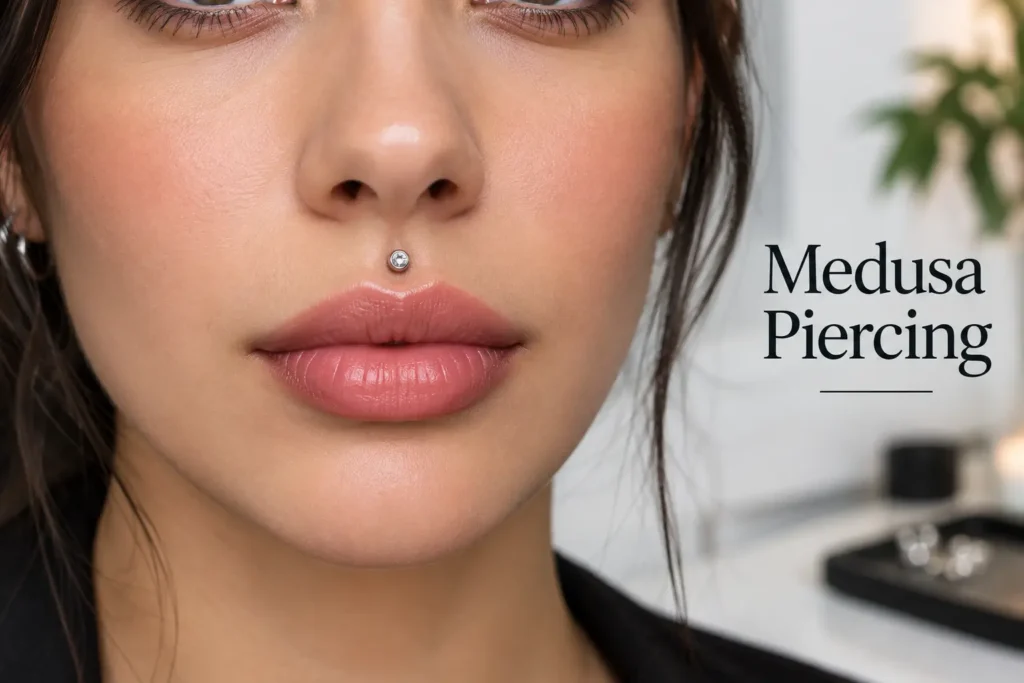

A Medusa piercing is a facial piercing placed through the philtrum, the small groove between the bottom of the nose and the center of the upper lip. It is also commonly called a philtrum piercing and is known for its centered, balanced appearance.
Unlike many lip piercings, a Medusa piercing sits directly in the middle of the upper lip. The visible jewelry is usually a small stud, while the back of the jewelry rests inside the upper lip. Because the piercing has an oral component, proper placement, jewelry sizing, hygiene, and aftercare are especially important.
If you are considering one, it helps to understand more than just how it looks. Pain, healing, jewelry choice, swelling, dental health, and infection risks should all be considered before making a decision.
What Is a Medusa Piercing?
A Medusa piercing passes through the philtrum, the natural vertical groove located between the nose and upper lip. The piercing is normally positioned above the center of the Cupid’s bow. The name “Medusa piercing” is commonly used in the piercing industry, while philtrum piercing is the anatomical term. Both names generally describe the same placement.
The piercing usually uses a flat-back labret-style stud. The decorative end remains visible outside the lip, while the flat backing sits inside the mouth. Its central position gives it a distinctive appearance. Some people choose a very small metal ball for a subtle look, while others prefer gemstones, opals, or decorative ends.
Why Is It Called a Medusa Piercing?
The term Medusa became popular because of the piercing’s distinctive position in the center of the upper lip. The name is now widely used even though philtrum piercing is the more anatomical description. It should not be confused with other upper-lip piercings. A Monroe piercing, for example, is usually positioned to one side of the upper lip, while a Medusa is centered.
This difference in placement is one reason the Medusa piercing creates such a symmetrical facial look.
What Does a Medusa Piercing Look Like?
A typical Medusa piercing looks like a small stud positioned directly above the upper lip.
The jewelry can be simple or decorative. A tiny silver or titanium ball creates a minimalist appearance, while a gemstone can make the piercing more noticeable. Because the piercing is placed in the center of the face, even a small piece of jewelry can become a strong facial feature. This is also why accurate placement matters.
A professional piercer should consider your individual anatomy instead of simply copying the placement from another person’s face. The Association of Professional Piercers recommends discussing anatomy, jewelry, placement, risks, healing, and aftercare before the procedure.
How Is a Medusa Piercing Done?
A professional piercing appointment normally begins with a consultation. The piercer examines the area and determines whether the anatomy is suitable for the intended placement. The area is then prepared using appropriate hygiene and sterilization procedures. The intended position is marked so the client can check the placement before the piercing takes place.
A sterile, single-use piercing needle should be used by a professional piercer. After the needle passes through the philtrum, the jewelry is inserted and secured.
The entire needle portion is usually very quick, although the preparation and placement assessment can take longer. Choosing an experienced piercer is important because incorrect placement can increase irritation and may cause the jewelry to sit against the teeth or gums.
How Painful Is a Medusa Piercing?
Pain levels are different for everyone, so there is no accurate number that applies to every person.
The upper lip contains many nerve endings, and the area can feel more sensitive than an earlobe. Still, the actual piercing is normally very brief. You may experience a sharp pinch followed by pressure or soreness. The discomfort usually lasts much longer than the actual needle insertion, especially during the first few days when swelling is present.
Your personal pain tolerance, anatomy, stress level, and the skill of the piercer can all affect how the experience feels.
How Long Does a Medusa Piercing Take to Heal?
Healing times vary from person to person. Some professional and medical sources describe Medusa piercings as taking several weeks to heal, with Healthline giving an estimated 8 to 12 weeks for healing. However, the outside of a piercing can look better before the internal tissue has completely healed.
During the early stage, swelling, tenderness, minor bleeding, bruising, and some discharge can occur. Medical News Today notes that swelling may settle within around one to two weeks, but this should not be confused with complete healing. Your piercer should assess the piercing before deciding that it is ready for a jewelry change or other modification.
What Jewelry Is Best for a Medusa Piercing?
A flat-back labret stud is one of the most common jewelry styles for a Medusa piercing.
The initial jewelry generally needs enough length to allow for swelling. Once the swelling has decreased, the longer post may need to be replaced with a shorter one.
This process is often called downsizing.
The Association of Professional Piercers stresses that properly fitted jewelry is important for oral piercings. Once swelling decreases, shorter jewelry can reduce unnecessary contact with teeth and gums.
Common jewelry styles include:
- Titanium labret studs
- Solid gold jewelry
- Small gemstones
- Opal ends
- Plain metal balls
- Threadless decorative ends
- Internally threaded studs
The material and construction should be appropriate for a fresh piercing. Your professional piercer can recommend jewelry based on your anatomy and the piercing itself.
Medusa Piercing Aftercare
Good aftercare can make the healing period easier and reduce unnecessary irritation.
Before touching the piercing, wash your hands thoroughly. Avoid twisting, spinning, pulling, or constantly checking the jewelry. For the outside of the piercing, sterile saline can be used according to professional aftercare instructions. The Association of Professional Piercers recommends sterile saline without additives for external cleaning.
Inside the mouth, oral hygiene is equally important. The APP recommends alcohol-free, hydrogen-peroxide-free mouth rinse or clean water for oral care. Regular brushing and flossing should continue. Do not over-clean the piercing. Excessive cleaning can irritate healing tissue rather than helping it.
What Should You Eat After a Medusa Piercing?
Eating can feel slightly awkward during the first few days because the jewelry and swelling are located close to the mouth.
The Association of Professional Piercers recommends taking your time while eating and being careful about opening your mouth too widely. It also recommends avoiding spicy, salty, acidic, and very hot foods or drinks during the early healing period.
Cold foods and drinks may feel soothing when swelling is present.
It is also sensible to take smaller bites and avoid foods that can easily catch on the jewelry.
What Should You Avoid During Healing?
A new Medusa piercing needs time to settle, so unnecessary movement should be avoided.
Do not play with the jewelry or repeatedly push it against your teeth. Avoid biting, pulling, or rolling the jewelry inside your lip. The APP also advises avoiding oral contact during healing and minimizing smoking and vaping because they can increase irritation and prolong healing.
Other things to avoid include:
- Alcohol-containing mouthwash
- Hydrogen peroxide on the piercing
- Excessive touching
- Chewing gum
- Biting the jewelry
- Sharing cups or utensils
- Unnecessary oral contact
- Swimming in pools, lakes, or other bodies of water while healing
Following professional aftercare instructions is more useful than constantly applying different products to the piercing.
Can a Medusa Piercing Damage Your Teeth?
This is one of the most important questions to consider.
Because the jewelry has a backing inside the upper lip, it can potentially come into contact with the teeth and gums. Repeated rubbing, biting, or playing with the jewelry can increase the chance of oral problems.
The American Dental Association lists tooth damage, gingival recession, soft-tissue injury, infection, and other complications among potential problems associated with oral and perioral piercings. That does not mean every Medusa piercing will cause dental damage. Jewelry fit, placement, anatomy, habits, and long-term contact all matter.
Can a Medusa Piercing Cause Gum Recession?
Yes, gum irritation and recession are recognized risks associated with oral and perioral piercings.
The risk can be influenced by the jewelry repeatedly rubbing against soft tissue. Playing with the piercing or wearing jewelry that is unnecessarily long can increase irritation.
The ADA reports gingival recession among complications associated with oral piercing and notes that habits such as biting, rolling, stroking, or sucking on the jewelry can contribute to dental damage. If you notice persistent gum irritation, recession, tooth sensitivity, or unusual damage around the teeth, speak with a dentist rather than ignoring the problem.
What Are the Signs of an Infected Medusa Piercing?
Some redness, tenderness, swelling, and minor discharge can occur during normal healing.
However, symptoms that become increasingly severe deserve attention.
Possible warning signs include:
- Increasing pain
- Significant swelling
- Heat around the piercing
- Thick or unusual discharge
- Foul odor
- Fever or chills
- Redness that continues to spread
- Feeling generally unwell
The ADA also advises monitoring oral piercings for swelling, pain, tenderness, or unusual discharge with an offensive odor.
If you think the piercing is infected, seek medical advice. Do not simply assume that severe symptoms are part of normal healing.
Should You Remove an Infected Medusa Piercing?
Removing jewelry without professional advice may not always be the right response.
The Association of Professional Piercers notes that removing jewelry while an infection is present can allow the channel to close and potentially trap infection. Professional or medical assessment is therefore important when infection is suspected.
If symptoms are severe, getting medical attention should take priority over trying to manage the problem yourself.
How to Choose a Professional Piercer
The person performing the piercing can have a major effect on the experience and healing process.
Look for a professional who can clearly explain the procedure, assess your anatomy, show appropriate sterilization practices, and provide written aftercare instructions.
The APP recommends looking for proper training, sterile equipment, appropriate jewelry, and good hygiene practices when choosing a piercer. A good piercer should also be willing to explain why a particular placement or jewelry size is suitable for your anatomy.
Do not choose a studio solely because it offers the lowest price.
Medusa Piercing Pros and Cons
A Medusa piercing can be an attractive choice, but it comes with practical considerations.
Potential advantages include:
- Distinctive centered appearance
- Many jewelry choices
- Suitable for minimalist styles
- Can complement other facial piercings
- Small jewelry can create a subtle look
Potential concerns include:
- Initial swelling and tenderness
- Infection risk
- Possible gum irritation
- Potential tooth damage
- Need for consistent oral hygiene
- Possible scarring or irritation
- Jewelry may need professional downsizing
The biggest consideration is that a Medusa piercing is not purely a skin piercing. The jewelry interacts with an area close to the mouth, teeth, and gums, so long-term care matters.
Medusa Piercing vs. Other Lip Piercings
The main difference between a Medusa piercing and many other lip piercings is its position.
A Medusa sits centrally above the upper lip. A Monroe piercing is generally positioned to one side, creating a beauty-mark-style appearance.
A labret piercing is commonly located below the lower lip, while paired piercings such as snake bites are positioned on opposite sides of the lower lip. The philtrum placement gives the Medusa its characteristic symmetrical appearance.
Is a Medusa Piercing Safe?
There is no completely risk-free piercing.
A professionally performed Medusa piercing with appropriate jewelry, sterile technique, proper placement, and careful aftercare can reduce avoidable problems. The APP emphasizes that placement and correct jewelry size are especially important for oral piercings.
At the same time, the American Dental Association advises against cosmetic oral and perioral piercings because of their potential oral health complications. Anyone considering a Medusa piercing should therefore understand both sides: professional piercing practices can reduce risk, but dental and gum complications remain possible.
How Much Does a Medusa Piercing Cost?
The price of a Medusa piercing varies considerably depending on the country, studio, piercer’s experience, jewelry material, and the type of jewelry selected.
A basic piercing with standard-quality implant-grade jewelry may cost less than a piercing using premium gold or gemstone jewelry.
Because prices differ between studios and locations, it is better to check the current price directly with a reputable professional piercer rather than relying on one universal figure.
Also ask what is included in the price. Some studios include the initial jewelry and follow-up downsizing, while others charge separately.
Can You Change Medusa Jewelry Yourself?
It is better not to change fresh jewelry yourself.
During the healing period, the piercing channel is still developing, and unnecessary movement can cause irritation or trauma.
Once the initial swelling has settled, a professional piercer can determine whether the post needs downsizing and can make the jewelry change safely.
After the piercing has fully healed, jewelry changes become easier, but cleanliness is still important.
Final Verdict
A Medusa piercing is a centered philtrum piercing that can create a clean and distinctive facial look, but its position near the mouth makes proper care especially important. Pain is usually brief, while swelling and tenderness can continue for several days. Complete healing can take weeks, and the piercing should not be treated as fully healed simply because it looks fine from the outside.
The most important factors are professional placement, suitable jewelry, good oral hygiene, careful aftercare, and regular attention to your teeth and gums. If you notice persistent irritation, gum changes, tooth damage, or possible infection, professional medical or dental advice is the safest next step.
FAQs
Is a Medusa piercing the same as a philtrum piercing?
Yes. Medusa piercing and philtrum piercing generally refer to the same upper-lip piercing placed through the philtrum.
How painful is a Medusa piercing?
Pain varies between individuals. The actual needle insertion is brief, but the area may feel sore or swollen afterward.
How long does a Medusa piercing take to heal?
Healing varies, but some professional and medical sources estimate roughly 8 to 12 weeks. Individual healing can take longer depending on anatomy and aftercare.
Can a Medusa piercing damage your teeth?
It can. Repeated contact between jewelry and teeth or gums may contribute to tooth damage, irritation, or gum recession. Proper jewelry sizing and avoiding jewelry play can help reduce unnecessary contact.
What is the best jewelry for a Medusa piercing?
A properly fitted flat-back labret stud is commonly used. The material, gauge, length, and decorative end should be selected by a professional based on your anatomy and the stage of healing.