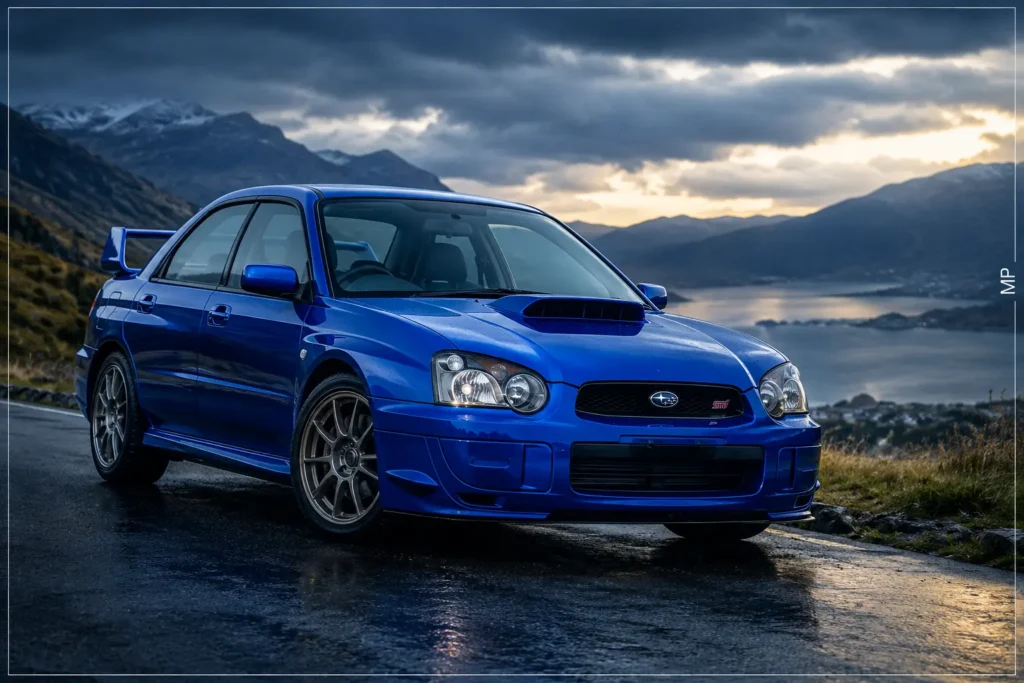

The Prodrive Performance Pack (PPP) is one of the best-known factory-sanctioned performance upgrades associated with the Subaru Impreza WRX and WRX STI. Developed by Prodrive for selected Subaru models, the package combined engine-management calibration with supporting hardware to increase power, torque, throttle response, and overall drivability.
Unlike a simple aftermarket ECU remap, the PPP was developed around specific Subaru models and model years. The exact components and performance figures changed over time, which is why a 2002 WRX STI PPP is not identical to a 2006 or 2008 version. Prodrive’s own technical documents show that the package was designed as a complete system, with the engine calibration and exhaust components working together.
Quick Bio Information
| Information | Details |
| Full Name | Prodrive Performance Pack |
| Common Name | PPP |
| Associated Brand | Prodrive |
| Main Vehicle | Subaru Impreza WRX / WRX STI |
| Other Applications | Selected Subaru Forester models |
| Main Purpose | Increased power, torque and drivability |
| Typical Hardware | ECU calibration, high-flow catalyst, sports exhaust |
| Fuel Recommendation | High-octane fuel, depending on application |
| Availability | Mainly selected Subaru UK/European-market models |
| Notable Version | 2002 WRX STI: 305 PS |
| Later Version | 2006 WRX STI: 320 PS |
| Later Version | 2008 WRX STI: around 330 PS |
What Is the Prodrive Performance Pack?
The Prodrive Performance Pack was a performance upgrade engineered for particular Subaru turbocharged models. It was particularly associated with the UK-market Impreza WRX and WRX STI, where Prodrive had a long-standing engineering relationship with Subaru.
The basic idea was straightforward: improve the car’s performance without turning it into an impractical competition vehicle. Prodrive’s technical material explains that the development focus included throttle response, acceleration and drivability, rather than simply producing the largest possible peak horsepower figure.
That philosophy helps explain why PPP cars can feel different in normal driving. Extra torque across a wider part of the rev range can make the engine feel more responsive during overtaking and acceleration, even when the peak power increase itself doesn’t appear enormous.
Prodrive and Subaru
Prodrive became closely associated with Subaru through the company’s international rally program. Its engineering work also influenced road-going Subaru models, particularly the Impreza range.
Subaru’s own historical material documents cooperation between Subaru, Subaru Tecnica International and Prodrive on special Impreza models. In 2001, for example, Subaru announced the Impreza WRX STI Prodrive Style, developed jointly around styling and aerodynamic elements inspired by the company’s WRC involvement.
The Performance Pack belongs to this wider relationship between Subaru and Prodrive. It gave customers a way to obtain additional performance through an upgrade developed specifically around the vehicle rather than relying entirely on unrelated aftermarket tuning.
What Did PPP Include?
The exact specification depended on the model year and engine, but documented packages commonly combined engine-management changes with exhaust-flow improvements.
The 2002 WRX STI package, for example, included a revised engine management system, high-flow catalyst and stainless-steel sports exhaust silencers. Prodrive specifically stated that the package was available only as a complete package because the components were designed to work together.
Later versions followed a similar principle, although the hardware changed. The 2006 WRX STI package included a recalibrated engine-management system, high-capacity fuel pump and stainless-steel sports exhaust silencers.
This is an important detail when looking at used cars. A Subaru with a Prodrive exhaust alone should not automatically be described as having an authentic PPP.
2002 WRX STI PPP
One of the clearest examples of the package comes from the 2002 Impreza WRX STI.
Prodrive’s technical brochure states that the standard engine produced 265 PS at 6,000 rpm. With the Performance Pack installed, peak output increased to 305 PS at 6,000 rpm. Maximum torque reached 405 Nm at 4,000 rpm.
That represented a substantial improvement for a road-going performance car of the period. Prodrive also highlighted the broader torque curve, stating that the PPP-equipped STI produced more torque than the standard car’s peak figure from approximately 3,000 rpm through 5,800 rpm.
In everyday terms, this meant the driver did not need to wait until the engine was close to its upper rev range to experience the benefit. The additional mid-range torque was particularly useful for overtaking and hard acceleration.
2006 WRX STI PPP
The later 2006 WRX STI Performance Pack brought another significant increase.
Prodrive’s documentation lists the upgraded car at 320 PS at 6,000 rpm and 450 Nm at 3,700 rpm. The package used a recalibrated engine-management system, high-capacity fuel pump and stainless-steel sports exhaust silencers.
Contemporary reporting also described the package as a 39 PS increase over the standard specification and noted that the stronger torque delivery improved low- and mid-range flexibility.
The package was not restricted to the STI. Prodrive also developed versions for the 2006 WRX and Forester 2.5 XT. The documented 2006 WRX package reached 270 PS, while the Forester 2.5 XT manual reached 260 PS.
2006 WRX PPP
The 2006 WRX version demonstrates why the term PPP should always be connected to a specific vehicle.
The standard 2006 WRX specification produced around 230 PS, while the Prodrive package raised peak output to 270 PS at 5,700 rpm. The package also delivered 420 Nm of torque at 3,000 rpm, according to the period technical documentation.
Prodrive’s figures indicate that the torque improvement was particularly significant at lower and middle engine speeds. The package was therefore designed to make the car feel more flexible rather than simply increasing the number printed on a dyno sheet.
That approach fits Prodrive’s stated development philosophy of improving the complete driving experience, including acceleration and throttle response.
2008 WRX STI and 330S
The later-generation cars continued the Prodrive connection.
The WRX STI 330S used a Prodrive Performance Pack that included revised engine management and an upgraded exhaust system. Contemporary coverage reported approximately 325 hp in US-style horsepower figures, while European reporting commonly described the output as 330 PS.
The important point is that the package changed the character of the car through both software and exhaust modifications. Contemporary reports also noted that peak torque arrived at a lower engine speed, supporting stronger response through the rev range.
Because different publications sometimes use PS, hp and bhp interchangeably, readers should be careful when comparing specifications from different sources.
PPP Was More Than a Remap
One of the most common misunderstandings about the Prodrive Performance Pack is that it was simply a software tune.
The available technical documentation shows otherwise. Depending on the application, PPP could include a combination of engine-management calibration, catalyst changes, sports exhaust components and fuel-system upgrades.
The 2006 STI is a good example because its package included a high-capacity fuel pump in addition to the recalibrated engine management and exhaust components.
This matched-parts approach was central to the package. Prodrive explicitly stated that the components were intended to be used together and were not offered as separate parts within the official package.
Why Torque Matters
Horsepower usually gets the attention in performance-car discussions, but torque delivery was one of the main goals of PPP development.
Prodrive’s 2002 STI documentation says the package increased torque and extended its availability over a wider engine-speed range. The company specifically highlighted the advantage during performance driving and mid-range overtaking.
That distinction matters on the road. A car that develops useful torque earlier can feel stronger during normal acceleration without requiring the driver to constantly keep the engine near its maximum power point.
For this reason, PPP specifications should be judged by looking at both peak power and the torque curve, rather than horsepower alone.
Fuel Requirements
Fuel quality was also important.
The 2006 Prodrive documentation recommends continuing to use 97 RON super unleaded to obtain the maximum benefit from the package. It also notes that the car could safely operate on lower-octane fuel, but might not produce its full potential.
This is especially relevant when buying an older PPP-equipped Subaru. The vehicle’s original tuning and intended fuel specification should be considered before assuming that any available fuel is equivalent.
Is Every Prodrive Subaru the Same?
No. PPP specifications vary considerably between model years.
An early Impreza Turbo package, a 2002 STI package and a 2006 STI package can have different power figures and different hardware. A 2006 WRX package also differs from the 2006 WRX STI package.
A useful collection of Prodrive documentation shows separate brochures covering versions from the late 1990s through 2008, including the 1999 Impreza Turbo, 2002 STI, 2003 WRX and STI, 2006 WRX and STI, and 2008 WRX STI.
Therefore, statements such as “PPP adds 40 horsepower” should always be qualified with the relevant model and year.
How to Identify a Genuine PPP
If you’re looking at a used Subaru advertised as a PPP car, documentation can be more useful than visual modifications.
The 2002 Prodrive brochure specifically mentions a certificate of fitment. This was intended to document the installation and could help with the vehicle’s provenance and resale value.
A prospective buyer should compare the car’s equipment with the specification for its exact model year. Look for the appropriate exhaust components, engine-management setup and other hardware listed for that particular package.
It is also worth checking the vehicle’s service history and asking whether any later modifications have replaced the original Prodrive components.
PPP and Reliability
A factory-developed performance package does not mean that an older Subaru is automatically trouble-free.
The Prodrive documentation does make clear that the cars could continue to be serviced normally using standard Subaru service parts after the performance package was installed.
However, the condition of an individual used car is a separate matter. Age, mileage, maintenance, previous modifications and driving habits can all affect reliability.
For a used PPP car, maintenance records can therefore be just as important as the power figure advertised by the seller.
PPP and Insurance
There is another practical point that can easily be overlooked when buying or modifying a PPP-equipped Subaru.
Prodrive’s documentation advises customers that most insurers require owners to disclose changes to vehicle specification. Failure to disclose modifications can potentially create insurance problems.
For anyone buying a car that already has a Performance Pack, confirming how the modification is recorded with the insurer is sensible.
Why PPP Became Popular
The appeal of PPP came from the balance between factory-style engineering and additional performance.
Owners were not simply buying an anonymous aftermarket modification. The packages were developed around specific Subaru models, and the documented systems combined engine calibration with supporting hardware.
The result was a performance upgrade that retained the character of the turbocharged Subaru platform while giving drivers stronger acceleration and more accessible torque.
For enthusiasts interested in the history of the Impreza, PPP also represents an interesting period when Prodrive’s motorsport identity was closely connected with Subaru’s road cars.
Prodrive Performance Pack Specs
Here is a simplified look at several documented examples:
| Model | Standard Power | PPP Power | PPP Torque |
| 2002 WRX STI | 265 PS | 305 PS | 405 Nm |
| 2006 WRX | 230 PS | 270 PS | 420 Nm |
| 2006 WRX STI | — | 320 PS | 450 Nm |
| 2006 Forester 2.5 XT | — | 260 PS | — |
| 2008 WRX STI 330S | 300 PS class | 330 PS class | Increased torque |
The figures above should be treated as model-specific factory/Prodrive figures, not as a universal PPP specification. The 2002 and 2006 figures are directly supported by period Prodrive technical material, while later 330S figures vary slightly depending on whether a source reports PS or horsepower.
Is PPP the Same as Prodrive WR Sport?
The terms can sometimes cause confusion because Prodrive used several related performance and styling programs during Subaru’s UK-market history.
Some dealer material used the WR Sport branding alongside Prodrive-developed upgrades, while specific technical documents identify individual packages as the Impreza WRX STI Performance Package.
For this reason, a buyer should not assume that every Subaru carrying a Prodrive badge has exactly the same mechanical specification.
Checking the model year, Prodrive part number and supporting documentation is a much safer way to establish what the vehicle actually has.
What Makes PPP Interesting Today?
Today, the Prodrive Performance Pack is interesting for two reasons. First, it provides a window into the engineering relationship between Subaru and Prodrive during an important era of performance cars. Second, original PPP-equipped cars can be identified by their documented specification rather than simply by aftermarket appearance.
The surviving technical brochures are particularly useful because they show how the packages evolved. They also reveal that Prodrive was concerned with usable torque, response and complete-vehicle performance, not only maximum dyno output.
For enthusiasts researching a used Impreza, those details can help separate a documented Prodrive car from one that has simply received similar-looking aftermarket parts.
Final Verdict
The Prodrive Performance Pack was a carefully developed performance upgrade for selected Subaru models, with the Impreza WRX and WRX STI being its most recognizable applications. Rather than being one universal tuning kit, PPP changed with each generation, combining different combinations of engine-management calibration, exhaust hardware, catalyst upgrades and fuel-system components.
The 2002 WRX STI provides one of the clearest examples, moving from 265 PS to 305 PS and reaching 405 Nm. The 2006 STI went further with 320 PS and 450 Nm, while later Prodrive-developed cars continued the concept with further engine and exhaust revisions.
For anyone researching a PPP-equipped Subaru today, the most important thing is to verify the exact model year and original Prodrive specification. A genuine PPP is more than a badge or exhaust—it is a package of matched engineering changes designed for a particular Subaru.
FAQs
What does PPP mean on a Subaru?
PPP stands for Prodrive Performance Pack. It refers to performance upgrades developed by Prodrive for selected Subaru models, particularly the Impreza WRX and WRX STI.
How much power does a Prodrive Performance Pack add?
The increase depends on the model and year. For example, the 2002 WRX STI increased from 265 PS to 305 PS, while the 2006 WRX STI reached 320 PS with its package.
Is a PPP just an ECU remap?
No. Documented PPP versions combined engine-management changes with hardware such as sports exhaust components, high-flow catalysts and, on some models, a higher-capacity fuel pump.
How can you check if a Subaru has a genuine PPP?
Check the vehicle’s documentation, Prodrive certificate of fitment, model-year specification and installed hardware. The exact parts should correspond with the package offered for that particular vehicle.
Is the Prodrive Performance Pack the same for every Subaru?
No. PPP specifications changed according to the model, engine and model year. A 2002 STI package and a 2006 STI package, for example, have different documented specifications and components.