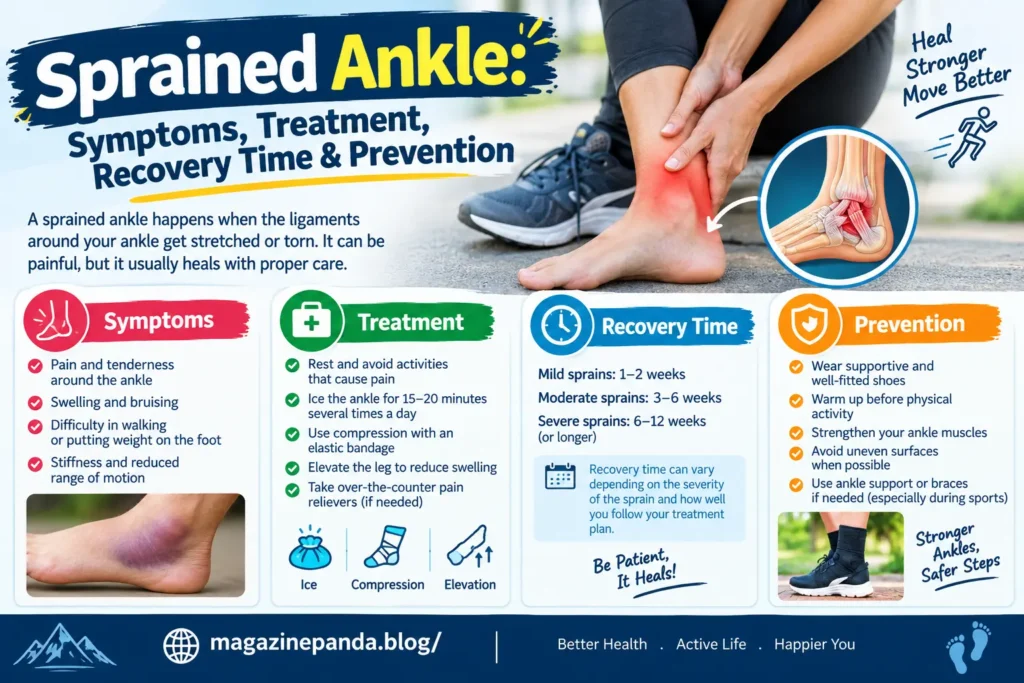

A sprained ankle happens when the ankle rolls, twists, or turns beyond its normal range and stretches or tears one or more ligaments. Most sprains affect the ligaments on the outside of the ankle. Common signs include pain, swelling, bruising, tenderness, reduced movement, and trouble putting weight on the foot. Mild injuries may improve with home care, while severe sprains can need medical evaluation, support, or physical therapy.
What Is a Sprained Ankle?
A sprained ankle is a ligament injury. Ligaments are strong bands of tissue that connect bones and help keep a joint stable.
An ankle sprain often occurs when the foot suddenly rolls inward. This can stretch the outside ankle ligaments beyond their normal limit. A fall, awkward landing, quick change of direction, or uneven surface can all cause the injury.
Ankle sprains are common in sports, but you do not have to be an athlete to get one. A simple misstep on a curb or uneven ground can be enough.
Common Sprained Ankle Symptoms
Symptoms depend on how badly the ligament has been injured. Typical signs include:
- Ankle pain, especially when putting weight on it
- Swelling around the joint
- Bruising
- Tenderness when touched
- Limited ankle movement
- A feeling that the ankle is weak or unstable
- A popping sensation or sound when the injury happens
Swelling may appear quickly after the injury. More severe injuries can make walking difficult or impossible.
A popping sound does not automatically mean that the ankle is broken, but it is one reason to pay attention to the severity of the injury.
What Causes an Ankle Sprain?
An ankle sprain occurs when the joint is forced into an unusual position.
Common causes include:
- Rolling the ankle during a fall
- Landing awkwardly after jumping
- Suddenly changing direction during sports
- Running on uneven ground
- Stepping into a hole or off a curb
- Having another person’s foot land on yours during sports
Activities involving jumping, pivoting, and rapid direction changes can increase the risk.
Previous ankle injuries also matter. An ankle that has not fully regained its strength and stability can be more likely to become injured again.
Grades of Ankle Sprain
Ankle sprains are generally described by how much ligament damage has occurred.
| Grade | General description |
|---|---|
| Grade 1 | Mild ligament stretching or a small amount of tearing |
| Grade 2 | Partial ligament tearing with more noticeable pain, swelling, or weakness |
| Grade 3 | Complete ligament tear and significant instability |
The symptoms do not always tell you the exact grade. A healthcare professional can assess the injury and determine whether additional testing is needed.
Sprained Ankle vs. Broken Ankle
A sprain and a fracture are different injuries, but they can feel similar.
A sprain affects ligaments, while a fracture involves a broken bone. Pain, swelling, and bruising can occur with both.
You should not assume that an ankle is only sprained because you can see swelling. Severe pain, inability to bear weight, pain directly over a bone, numbness, or major instability can require medical evaluation.
An X-ray may be used when a fracture is suspected. MRI, CT, or ultrasound can sometimes be used when a clinician needs more information about soft tissues or a complicated injury.
What to Do After a Sprained Ankle
Early care focuses on controlling pain and swelling while protecting the injured joint.
The familiar R.I.C.E. approach includes:
Rest: Stop activities that cause pain and avoid unnecessary walking immediately after the injury.
Ice: A cold pack can help reduce pain and swelling. Protect your skin with a thin towel rather than placing ice directly against it. Mayo Clinic recommends short icing sessions rather than prolonged exposure.
Compression: An elastic bandage or suitable ankle support can help control swelling. It should not be so tight that it affects circulation.
Elevation: Raising the ankle above heart level can help reduce swelling, especially during the early period.
The exact treatment should match the severity of the injury.
Pain Relief for an Ankle Sprain
Some people can manage pain with over-the-counter medicines such as acetaminophen, ibuprofen, or naproxen, provided these medicines are safe for them to use.
Medication is not appropriate for everyone. Existing medical conditions, allergies, pregnancy, other medicines, and certain stomach, kidney, liver, or cardiovascular problems can affect which pain reliever is suitable.
If you are unsure, ask a healthcare professional or pharmacist.
Do You Need an Ankle Brace?
A brace, elastic wrap, or sports tape may provide support while an ankle heals. Some people with a more significant injury may need crutches, a walking boot, or temporary immobilization.
The choice depends on the injury.
A brace should support the ankle without causing numbness, increased pain, or circulation problems. A severe sprain may need professional assessment before you decide how much weight to put on the foot.
When Should You See a Doctor?
Medical evaluation is especially important when symptoms are severe or do not improve.
Seek medical attention if:
- You cannot bear weight on the foot
- The ankle looks unstable or badly deformed
- You have severe pain or swelling
- You have numbness or loss of sensation
- Pain is directly over a bone
- The ankle does not improve with self-care
- You repeatedly injure the same ankle
A serious ankle injury can involve a fracture, significant ligament damage, tendon injury, or another problem that cannot be diagnosed reliably from symptoms alone.
How Is a Sprained Ankle Diagnosed?
A healthcare professional will usually begin with a physical examination.
They may check for:
- Swelling
- Tender areas
- Range of motion
- Joint stability
- Your ability to bear weight
- How the injury happened
If there is concern about a fracture or more serious tissue damage, imaging may be recommended. X-rays are useful for examining bones, while MRI provides detailed images of soft tissues such as ligaments. CT and ultrasound may also be useful in selected cases.
Sprained Ankle Recovery Time
Recovery varies considerably.
A mild sprain may improve relatively quickly, while a more serious ligament injury can take considerably longer. Mayo Clinic notes that sprain recovery can range from days to months, depending on the injury and how well the joint responds to treatment.
Do not use the calendar alone to decide when to return to sports.
The ankle should have enough movement, strength, stability, and balance for the activity you want to resume.
Exercises After an Ankle Sprain
Once pain and swelling have improved, rehabilitation becomes important.
Early exercises may focus on gentle movement. Later stages can include strengthening and balance work.
A simple example is moving the ankle through a comfortable range of motion. Some rehabilitation programs use exercises such as tracing the alphabet with the foot. As recovery progresses, strengthening and balance exercises help the muscles support the joint again.
A physical therapist can create a progression based on the severity of the injury.
Do not push through sharp or increasing pain just to speed up recovery.
Returning to Sports After an Ankle Sprain
Returning too soon can increase the chance of another injury.
Before returning to demanding activity, the ankle should be able to handle normal movement without significant pain or instability. Strength and balance should also be improving.
For athletes, a healthcare professional or physical therapist may use movement tests before allowing a full return to sport.
A gradual return is usually more sensible than immediately going back to the same level of activity.
Can a Sprained Ankle Happen Again?
Yes. Previous ankle injuries are one of the factors associated with future sprains. Poor strength, limited flexibility, and reduced balance can also increase risk.
Repeated sprains can contribute to ongoing pain and ankle instability. In some cases, people develop an ankle that repeatedly feels as if it may give way.
That is why rehabilitation is more than simply waiting for swelling to disappear.
How to Prevent Another Ankle Sprain
You can lower your risk by improving ankle strength, balance, and flexibility.
Helpful habits include:
- Warm up before exercise
- Wear shoes that fit and suit your activity
- Be careful on uneven surfaces
- Maintain ankle and leg strength
- Practice balance exercises
- Use an ankle brace or tape when recommended for a previously injured ankle
- Return to sports only after adequate recovery
Good footwear and physical conditioning can provide valuable protection, particularly during activities involving running, jumping, or rapid direction changes.
Frequently Asked Questions
How long does a sprained ankle take to heal?
It depends on the severity. Mild injuries may improve sooner, while more serious sprains can take weeks or months to fully recover.
Can you walk on a sprained ankle?
It depends on the injury. Some mild sprains allow walking, while more severe injuries can make weight-bearing extremely painful or impossible. Do not force weight onto an ankle that cannot safely support you.
Should you ice a sprained ankle?
Cold therapy can help with pain and swelling during the early stage. Use a protective layer between the cold pack and your skin and avoid excessively long sessions.
Can a sprained ankle heal on its own?
Many mild ankle sprains improve with appropriate self-care. More serious injuries may need professional treatment, rehabilitation, or temporary support.
When should I worry about ankle swelling?
Severe or rapidly increasing swelling, inability to bear weight, significant pain, numbness, or pain directly over the bones warrants medical assessment.
Final Verdict
A sprained ankle is a common injury, but it should not always be treated as a minor problem. Mild cases can often improve with protection, swelling control, gradual movement, and rehabilitation. More serious injuries may need an examination and imaging to rule out fractures or major ligament damage. The key is to let symptoms guide your activity and rebuild strength and balance before returning to demanding exercise. If pain, instability, or swelling persists, professional medical advice is the safer choice.
This article is for general information and does not replace an examination or diagnosis from a qualified healthcare professional.



Pingback: Pixelspinx.com: Website Overview, Content and Important Facts