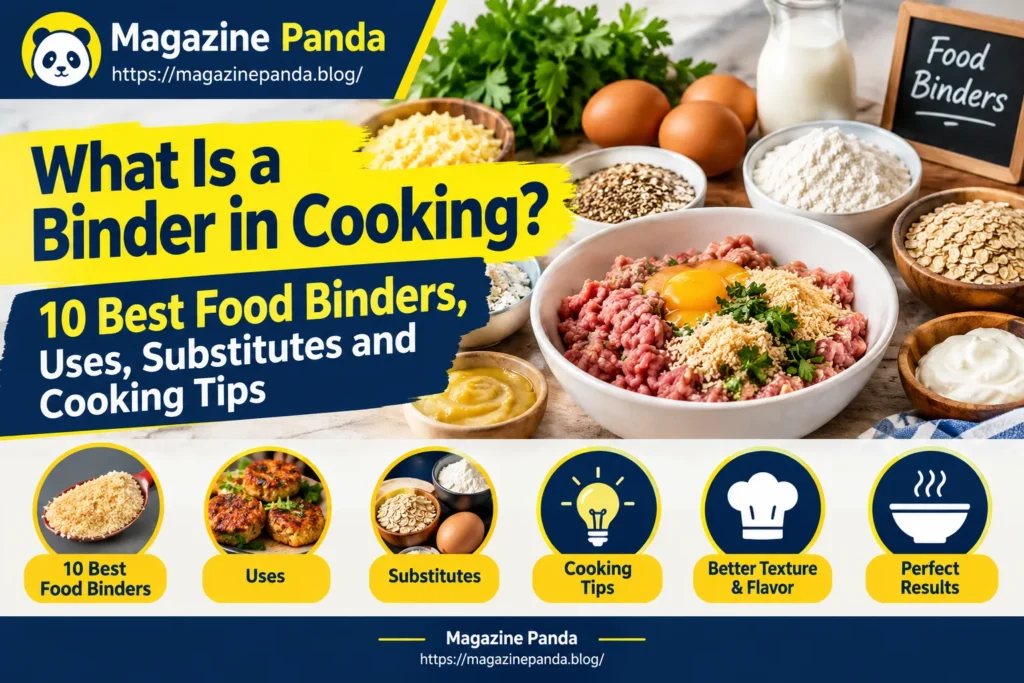

Cooking involves more than combining ingredients and heating them. The texture, consistency and structure of a dish also play an important role in determining how the final food looks and tastes. Sometimes, ingredients that are mixed together do not naturally stay in place. They may crumble, separate or lose their shape during cooking. This is where a binder in cooking becomes useful.
A cooking binder is an ingredient that helps hold different food components together. It improves the consistency of mixtures and makes it easier to prepare dishes such as meatballs, burgers, meatloaf, vegetable patties, fish cakes and baked goods.
Common binders include eggs, breadcrumbs, flour, cornstarch, ground flaxseed, chia seeds and gelatin. Each ingredient works differently, so the right choice depends on the recipe and the texture you want to achieve.
The term also has a slightly different meaning in barbecue cooking. BBQ enthusiasts use ingredients such as mustard, olive oil or mayonnaise as binders to help dry seasoning rubs stick to the outside of meat.
In this guide, we explain what a binder means in cooking, how different binding ingredients work, which substitutes are suitable for egg-free recipes and how to choose the right option for different dishes.
Quick Review
| Detail | Information |
| Term | Binder in Cooking |
| Meaning | Ingredient that holds food components together |
| Main purpose | Improve structure and consistency |
| Common binder | Eggs |
| Other popular options | Breadcrumbs, flour and starch |
| Vegan alternatives | Flaxseed, chia seeds and tofu |
| BBQ binders | Mustard, oil and mayonnaise |
| Used in | Meatballs, burgers and baked goods |
| Food science | Protein coagulation and starch gelatinization |
| Main benefit | Reduces crumbling and separation |
| Best substitute | Depends on the recipe |
| Latest research | Food hydrocolloids and plant-based binders |
| Research date | November 17, 2026 |
What Is a Binder in Cooking?
A binder in cooking is an ingredient that helps different components stick together and maintain a consistent structure.
It is commonly added to recipes containing several ingredients that might otherwise separate during preparation or heating.
For example, ground meat mixed with herbs, spices and breadcrumbs may fall apart when shaped into meatballs. Adding an egg can help create a more cohesive mixture that holds its shape during cooking.
The same principle applies to plant-based burgers. Ground flaxseed mixed with water creates a gel-like mixture that helps hold vegetables, beans and other ingredients together.
A binder does not always need to be a special commercial product. Many everyday kitchen ingredients perform this function naturally.
The important thing is to select an ingredient that works with the moisture, temperature and texture requirements of the recipe.
Why Are Binders Used in Cooking?
Binders serve several purposes in food preparation. Their main job is to improve the structure of a dish, but they can also influence moisture retention and texture.
Holding ingredients together: Binders help prevent loose mixtures from falling apart when shaped, transferred or cooked.
Improving consistency: They create a more cohesive mixture, making ingredients easier to handle.
Retaining moisture: Certain binders absorb or hold water, helping prevent food from becoming excessively dry.
Supporting texture: Some ingredients create a firm structure after heating or cooling, while others produce a soft or elastic consistency.
Reducing separation: Suitable binding ingredients help stabilize mixtures containing different components, including proteins, fats and vegetables.
Food science research published in Food Hydrocolloids identifies three important functions of food binders: stickiness, hardening and water binding.
These functions are particularly relevant when developing plant-based meat and dairy alternatives, where different proteins, fats and other ingredients must form a stable food structure.
10 Common Binders Used in Cooking
Different ingredients perform different binding functions. Some are suitable for meat mixtures, while others work better in baking, desserts or plant-based recipes.
1. Eggs
Eggs are among the most widely used binders in home cooking.
They contain proteins that change structure when heated. This process, known as protein coagulation, helps create a firmer mixture and holds surrounding ingredients together.
Eggs are commonly used in meatballs, meatloaf, fish cakes, burgers, breaded foods and baked products.
They also provide moisture and contribute to color, flavor and emulsification.
For many traditional recipes, eggs are a reliable starting point when a mixture needs to hold its shape.
2. Breadcrumbs
Breadcrumbs are another common ingredient used for binding.
They absorb moisture from surrounding ingredients, helping reduce excess liquid and improving the consistency of food mixtures.
They are particularly useful in meatballs, meatloaf, fish cakes and vegetable patties.
Breadcrumbs can also help create a softer texture by preventing meat mixtures from becoming excessively dense.
The quantity matters. Too many breadcrumbs can make a mixture dry, while too few may leave it loose and difficult to shape.
3. Flour
Flour helps bind ingredients through its starch and, in wheat flour, gluten-forming proteins.
When flour is mixed with liquid and heated, its starch contributes to thickening and structure formation.
It is used in batters, dumplings, sauces, coatings, baked foods and certain vegetable patties.
Wheat flour can also affect the final texture, so it is important to avoid adding too much to recipes where a light consistency is desired.
4. Cornstarch
Cornstarch is especially useful when a recipe requires thickening or additional structure.
When mixed with liquid and heated, its starch granules absorb water, swell and increase the mixture’s viscosity. This process is called starch gelatinization.
Cornstarch is frequently used in gravies, sauces, puddings, pie fillings and some vegetable-based mixtures.
It is also useful for people looking for a gluten-free thickening ingredient.
However, cornstarch does not perform exactly like eggs. It is better suited to recipes that need thickening and heat-set structure rather than every type of binding application.
5. Ground Flaxseed
Ground flaxseed is a popular plant-based alternative to eggs.
When combined with water, it develops a thick, gel-like consistency that helps hold food ingredients together.
This makes it useful for vegan burgers, vegetable patties, cookies and selected baking recipes.
A common starting ratio is:
- 1 tablespoon ground flaxseed.
- 3 tablespoons of water.
- Allow the mixture to rest for approximately 5 minutes.
The result is often called a flax egg.
Kansas State University Extension highlighted this method in its April 3, 2026 guidance on egg substitutes.
6. Chia Seeds
Chia seeds are another useful option for egg-free cooking.
They absorb water and develop a gel-like outer layer. This texture helps hold ingredients together in plant-based dishes.
A common starting ratio is one tablespoon of chia seeds mixed with three tablespoons of water.
Allow the mixture to rest until it thickens before adding it to the recipe.
Chia seeds work well in vegetable patties, selected baked goods and other recipes where a gel-like binder is appropriate.
Unlike finely ground flaxseed, whole chia seeds may remain visible in the finished food.
7. Oats
Oats are useful for absorbing moisture and improving the consistency of different food mixtures.
They are commonly added to meatloaf, veggie burgers, vegetable patties and homemade snack bars.
Rolled oats can provide a slightly textured result, while finely ground oats create a more uniform mixture.
Oats are not always a direct replacement for eggs, but they can work effectively alongside other ingredients.
For example, combining oats with mashed beans can create a cohesive vegetable patty.
8. Gelatin
Gelatin is an animal-derived ingredient that creates a gel when dissolved and cooled under suitable conditions.
It is commonly used in desserts, jellies, mousse, terrines and selected meat preparations.
Unlike eggs or breadcrumbs, gelatin works through the formation of a gel network.
It is particularly useful when a recipe requires a smooth, firm or slightly elastic texture.
Because gelatin comes from animal collagen, it is not suitable for vegan diets.
9. Potato Starch
Potato starch is a useful ingredient for thickening and improving food structure.
It absorbs water and develops viscosity during heating, making it suitable for sauces, fillings, coatings and selected vegetable mixtures.
It is also used in gluten-free cooking.
Potato starch can help hold certain ingredients together, but the final result depends on the amount of liquid and the cooking method.
10. Tofu
Tofu is a versatile plant-based ingredient that can contribute protein, moisture and structure.
Mashed or blended tofu is useful in vegetable patties, vegan meat mixtures and certain baked recipes.
Silken tofu provides a smoother consistency, while firmer varieties create a denser mixture.
Tofu is especially useful when a recipe needs more than simple binding because it can also contribute to the overall body of the dish.
Which Binder Is Best for Different Foods?
The best binder depends on the ingredients, cooking method and texture you want.
| Food | Recommended binder | Main purpose |
| Meatballs | Egg and breadcrumbs | Hold meat together |
| Meatloaf | Egg and breadcrumbs | Improve structure |
| Homemade burgers | Egg or suitable starch | Improve cohesion |
| Veggie burgers | Flaxseed or chia gel | Plant-based binding |
| Fish cakes | Egg and breadcrumbs | Prevent crumbling |
| Cookies | Egg or flaxseed gel | Hold dough together |
| Cakes | Eggs | Structure and moisture |
| Gravies | Flour or cornstarch | Thicken liquid |
| Puddings | Cornstarch or gelatin | Create a stable texture |
| Vegan patties | Tofu, flaxseed or oats | Hold vegetables together |
| Fruit fillings | Cornstarch or tapioca starch | Control liquid consistency |
One important point is that these ingredients are not interchangeable in every recipe. A binder that works well in a burger may produce an undesirable texture in a cake.
What Is a Binder in BBQ Cooking?
The term binder has another meaning in barbecue cooking.
In BBQ preparation, a binder is a thin layer of liquid or paste applied to the surface of meat before adding a dry seasoning rub.
Its main purpose is to help spices and seasoning adhere evenly to the meat.
Common BBQ binders include:
- Yellow mustard.
- Olive oil.
- Mayonnaise.
- Hot sauce.
- Worcestershire sauce.
- Other suitable thin sauces.
For example, someone preparing smoked pork ribs may spread a thin layer of mustard over the meat before applying paprika, black pepper, garlic powder and other spices.
Mustard is popular because it spreads easily and helps seasoning stay in place.
Olive oil is another option when cooks prefer a different flavor profile.
It is important to understand that a BBQ binder does not perform the same function as an egg in meatballs. It mainly helps seasoning stick to the outside of the meat rather than holding the internal ingredients together.
How Do Food Binders Actually Work?
Food binders work through different physical and chemical processes.
Understanding these mechanisms makes it easier to choose the correct ingredient.
Protein coagulation: Egg proteins unfold and form new interactions when heated. This creates a firmer structure that can hold surrounding ingredients together.
Starch gelatinization: Starch granules absorb water and swell when heated. This increases thickness and helps form a stable mixture.
Gel formation: Ingredients such as gelatin create a network that traps water and produces a semi-solid structure.
Water absorption: Breadcrumbs and oats absorb moisture, helping control the consistency of loose mixtures.
Hydrocolloid interactions: Certain plant-based gums and polysaccharides influence viscosity, water retention and the structure of food mixtures.
Recent research published in 2025 and 2026 continues to examine how food hydrocolloids influence texture, stability, flavor release and the performance of structured foods.
These developments are particularly relevant to plant-based products, where manufacturers need ingredients that reproduce the texture and stability of conventional foods.
Best Egg Substitutes for Binding
Eggs are useful, but they are not suitable for everyone.
People may avoid them because of allergies, dietary preferences, ingredient availability or the desire to prepare vegan meals.
Fortunately, several alternatives can perform the binding function.
| Egg substitute | Starting measurement for one egg | Best use |
| Ground flaxseed | 1 tbsp + 3 tbsp water | Burgers and baking |
| Chia seeds | 1 tbsp + 3 tbsp water | Patties and cookies |
| Plain gelatin | 1 packet + 2 tbsp warm water | Selected recipes |
| Mashed beans | About ¼ cup | Vegetable patties |
| Silken tofu | About ¼ cup | Cakes and savory mixtures |
| Applesauce | About ¼ cup | Moist baked goods |
| Mashed banana | About ¼ cup | Sweet baking recipes |
| Starch mixture | Recipe-dependent | Selected patties and fillings |
These measurements are starting points rather than universal replacements.
Kansas State University Extension’s April 2026 food-science guidance specifically recommends one tablespoon of chia or ground flaxseed mixed with three tablespoons of water for recipes that need an egg to hold ingredients together.
The University of Illinois Extension also provides similar substitution guidance.
One important distinction is that an ingredient that adds moisture does not necessarily provide the same binding or rising properties as an egg.
For example, applesauce can work well in some cakes and quick breads, but it may not provide enough structure for a firm vegetable burger.
How to Choose the Right Cooking Binder
Selecting a binder becomes easier when you consider the purpose of the recipe.
If you are preparing meatballs, eggs and breadcrumbs are usually practical choices because they help create a cohesive mixture.
For vegan burgers, ground flaxseed, chia seeds, mashed beans and tofu offer useful alternatives.
For sauces and gravies, cornstarch or flour is generally more appropriate because the main requirement is thickening and for desserts that need a firm gel, gelatin or a suitable plant-based gelling agent may be a better choice.
Before adding any binder, consider these factors:
Moisture level: A wet mixture may need an absorbent ingredient such as breadcrumbs or oats.
Cooking temperature: Some binders only develop their full structure when heated, while others form gels during cooling.
Dietary requirements: Consider whether the recipe needs to be vegan, vegetarian, gluten-free or free from specific allergens.
Desired texture: A soft burger, firm meatball and smooth pudding require different binding properties.
Flavor: Some ingredients have a noticeable taste that may influence the finished dish.
Common Mistakes When Using Binders
Using the wrong binder or adding too much can affect the final texture of a recipe.
One common mistake is adding too many breadcrumbs to a meat mixture. This can create a dry or dense result instead of a tender texture.
Another problem is using whole flaxseed instead of ground flaxseed when a smooth gel is needed. Ground seeds generally make it easier to develop a uniform mixture.
Some cooks also add cornstarch directly to hot liquid, which can encourage lumps. Mixing it with a little cold liquid first usually creates a smoother slurry.
Using a fruit puree as a direct replacement for an egg in every recipe is another common mistake. Fruit purees primarily contribute moisture and may not provide the same structure.
For BBQ cooking, applying too much mustard or oil can make the surface unnecessarily wet. A thin, even coating is generally sufficient to help seasoning adhere.
The best approach is to start with a small amount, follow the recipe’s measurements and adjust the consistency carefully.
Are Cooking Binders the Same as Thickeners?
No. Although some ingredients can perform both functions, binders and thickeners have different primary purposes.
A binder helps food components remain together, while a thickener increases the viscosity of a liquid.
For example, an egg can help hold a meatball mixture together, while cornstarch can make gravy thicker.
Some ingredients overlap. Cornstarch can help provide structure in certain mixtures while also thickening liquids.
| Ingredient function | Main purpose | Examples |
| Binder | Holds ingredients together | Eggs, flaxseed |
| Thickener | Increases liquid viscosity | Cornstarch, flour |
| Emulsifier | Helps oil and water remain mixed | Egg yolk, lecithin |
| Gelling agent | Creates a gel structure | Gelatin, agar |
| Leavening agent | Helps baked foods rise | Baking powder, yeast |
Understanding these differences makes recipe substitutions more reliable.
Latest Food Science Developments in 2026
Food binding is not only important in home kitchens. It is also a significant subject in modern food manufacturing.
Researchers are studying how proteins, starches, gums and other hydrocolloids can improve the texture and stability of plant-based foods.
A 2023 peer-reviewed review in Food Hydrocolloids identified stickiness, hardening and water binding as important functions of food binders.
Research published in 2025 examined how starch-based hydrocolloids can improve thickening, gel formation, water retention and food texture.
More recent research published in Food Chemistry on September 30, 2026, examined interactions between hydrocolloids and flavor compounds.
This is important because ingredients that change food structure can also influence how flavors are retained and released during eating.
These developments have applications in:
- Plant-based meat alternatives.
- Dairy-free products.
- Reduced-fat foods.
- Bakery products.
- Fruit fillings and desserts.
- Texture-modified foods.
- Food encapsulation and flavor delivery.
The research shows that modern binders are not simply ingredients used to stop food from falling apart. They are also important tools for developing food products with specific textures, stability and sensory qualities.
Final Wordings
A binder in cooking is an ingredient that helps hold different food components together and gives a dish a more consistent structure.
Eggs, breadcrumbs, flour, cornstarch, flaxseed, chia seeds, oats, gelatin, potato starch and tofu are among the ingredients commonly used for this purpose.
However, each binder performs differently. Some absorb moisture, others create gels, and some develop a firm structure when heated.The meaning also changes slightly in barbecue cooking, where mustard, oil or mayonnaise can help dry seasoning stick to the outside of meat.The most important thing is to select an ingredient based on the recipe rather than assuming every binder works in the same way.
With the right choice, you can prepare meatballs that stay together, burgers that hold their shape, sauces with a smooth consistency and plant-based recipes without relying on eggs.
Understanding cooking binders makes it easier to control texture, reduce crumbling and achieve more consistent results in everyday recipes.
Frequently Asked Questions
1. What is a binder in cooking?
A binder is an ingredient that holds different food components together. It helps mixtures maintain their shape and consistency during preparation and cooking. Common examples include eggs, breadcrumbs, flour and ground flaxseed.
2. What is the most common binder used in cooking?
Eggs are among the most common binders because their proteins form a structure when heated. They are frequently used in meatballs, meatloaf, burgers, fish cakes and baked goods.
3. What can I use instead of eggs as a binder?
Ground flaxseed, chia seeds, tofu and certain starch mixtures can replace eggs in suitable recipes. A common starting measurement is one tablespoon of ground flaxseed mixed with three tablespoons of water.
4. What is a BBQ binder?
A BBQ binder is a thin coating applied to meat before adding a dry seasoning rub. Mustard, olive oil and mayonnaise are common choices because they help spices adhere more evenly to the meat’s surface.
5. Can breadcrumbs be used as a binder?
Yes. Breadcrumbs absorb moisture and help ingredients form a cohesive mixture. They are commonly used in meatballs, meatloaf, fish cakes and vegetable patties.
6. Is cornstarch a good cooking binder?
Cornstarch is useful for thickening and providing structure in certain recipes. It works particularly well in sauces, gravies, fillings and some vegetable mixtures, although it does not replace eggs in every recipe.
7. Are cooking binders vegan?
Some binders are vegan, including ground flaxseed, chia seeds, oats, cornstarch, potato starch and tofu. Eggs and traditional gelatin are not suitable for vegan diets.
Continue Exploring Our Latest Article: MagazinePanda