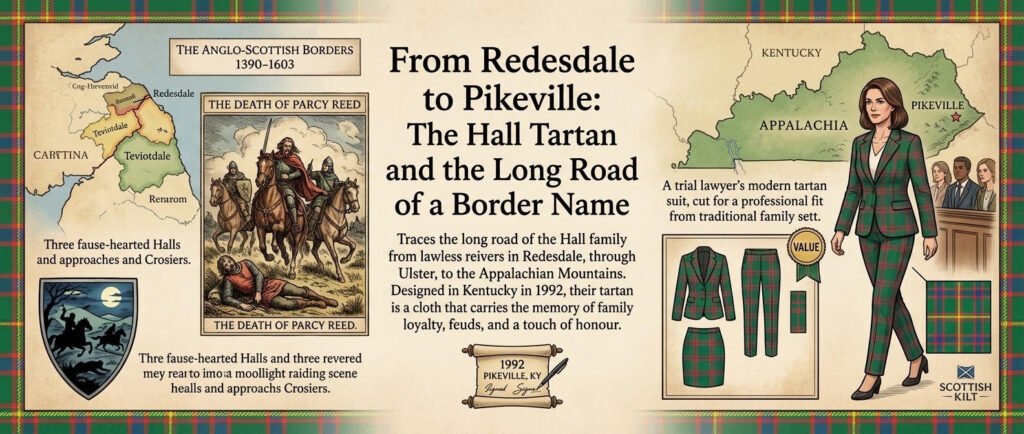

Percy Reed was the keeper of Redesdale, the law in a lawless valley, and he had made enemies of a raiding family called the Crosiers. One day he went hunting with three neighbours, brothers named Hall, from a farm called Girsonfield. Their family name would centuries later be given a very different legacy in the form of the Hall tartan, designed not on the old Border but in the mountains of eastern Kentucky. They hunted until evening and lay down to rest in a lonely spot at the head of the dale. While Reed slept, the Halls stole the bridle from his horse, poured water into the pan of his gun, and jammed his sword in its scabbard so that it would not draw. Then the Crosiers rode over the hill. Reed woke, called on his friends to stand by him, and watched the three of them mount and ride away. He was cut to pieces.
The ballad has a name for them that stuck for generations: the fause-hearted Ha’s, the false-hearted Halls.
It was not, to be fair, a world that encouraged loyalty to the law. And the story of what happened to families like the Halls, and where they went, explains a great deal about a certain corner of America, and about why a tartan for a Border name was designed, of all places, in the mountains of eastern Kentucky.
The riding names
For three hundred years, from the wars of Edward I to the union of the crowns in 1603, the frontier between England and Scotland was the most violent place in Britain. Two governments used it as a battlefield and neither could police it. The people who lived there, on both sides of the line, stopped expecting protection from any king and organised themselves instead into extended families, which they called surnames or graynes. You were an Armstrong, an Elliot, a Graham, a Kerr, a Scott, a Charlton, a Robson, a Hall, before you were English or Scottish. Your surname fed you, avenged you and, when necessary, went raiding with you by moonlight across the line for cattle. They called it reiving. It gave the English language the words bereaved and blackmail.
The Halls were one of these riding families. They were strongest in Redesdale, on the English side, and in Teviotdale and Liddesdale on the Scottish, and they turn up in the records of both kingdoms with monotonous regularity, stealing livestock and being hanged for it.
In 1603 James VI of Scotland became James I of England, and the Border ceased to be a border. He renamed it the Middle Shires and set about pacifying it with a thoroughness that amounted to ethnic clearance. Reiving families were hanged in batches without trial, conscripted into foreign wars, or transported wholesale to Ulster to settle the new plantations. Many of those Ulster families, a century later, moved on again, to Pennsylvania and then down the great valley into the back country of Virginia, the Carolinas, Tennessee and Kentucky.
They took the Border with them. Historians of American settlement have long pointed out how much of Appalachian culture, the fierce family loyalty, the suspicion of distant government, the touchy sense of honour, the fiddle tunes and the ballads, came straight from the Anglo-Scottish frontier. Even the feuds came along. Pike County, Kentucky, the scene of the Hatfield and McCoy war of the 1880s, is about as pure a piece of Border country as exists on the American continent. It is also full of Halls.
The minister’s tartan
For all those centuries the Halls, like every other Border surname, had no tartan. Borderers did not wear it. The name was sometimes counted as a sept of Clan Skene, in faraway Aberdeenshire, and Halls who wanted a kilt wore the Skene.
In 1992 a Pike County minister decided that was not good enough. The Reverend Atlas D. Hall, of Pikeville, Kentucky, designed a tartan for his own name, with the help of a respected American tartan scholar, the late Scotty Thompson. The next summer the Clan Hall Society was organised at Pikeville, with the Reverend Hall as its first president. He adjusted the design slightly in 1994, and that is the version in the Scottish tartan registers today, entered under his name.
It is a straightforward, handsome cloth. The ground is a strong green. Across it run bands of dark blue, each framed between two fine lines of red, and a single thin line of yellow marks the pivot. It is a cool, steady tartan, with none of the restlessness of the older Border setts, and the red lines give it just enough life.
The Hall tartan is now carried by the Highland outfitters alongside names a thousand years older, and made up to order as kilts, skirts, sashes, scarves and ties, or sold by the yard. Nobody should feel sheepish about its youth. Hardly any clan tartan can be traced beyond 1800, and a great many were invented by Victorian weavers and given a false pedigree. This one has an honest one: a date, a designer, a town, and a clan society that adopted it. There is something fitting, too, in where it was made. The Borders gave the Halls nothing but trouble, and it was the mountains of Kentucky, four thousand miles and four hundred years away, that finally gave them a cloth to call their own.
Lexington, Kentucky, a Monday in March
Rebecca Hall is forty-one and a trial lawyer. She grew up in Pikeville. Atlas Hall was a distant cousin of her grandfather’s and preached at his funeral. There is a framed square of the tartan on the wall of her parents’ den, and her father has a tie in it that he wears to weddings.
She has a jury trial starting at nine, and she is wearing a suit.
The suit is the tartan. A single-breasted blazer and tailored trousers, green and navy with a fine red line, over a plain ivory silk shell, with navy heels. From across a courtroom it reads as a dark, sober, well-cut suit, exactly what a jury expects. Closer up, when she walks to the box, it resolves into a grid. She has found over the years that juries remember her, and that it does no harm.
She had wanted something like it for a long time and could not find it. What most shops sell under the clumsy heading of woman plaid tailoring is a printed check on thin cloth, in nobody’s tartan in particular. What she wanted was her own family’s sett, woven, in a suit that fitted her.
She got it from Scottish Kilt, a made-to-measure Highland outfitter that works in more than five thousand tartans, the Hall among them. Their women’s tartan suits come as a blazer with trousers or a skirt, and both pieces are cut in a single run from the same length of cloth, so the shades match exactly and the lines of the pattern meet at the seams. She sent her measurements: bust, waist, hips, shoulder, sleeve, inside leg. It came cut to her, and not to a size label.
The real discovery came afterwards. The site’s own note on the range says the pieces also work separately, “which is the value,” and that has turned out to be true. The blazer goes over a black dress, or with dark jeans and boots on a Friday. The trousers go with a cream cashmere jumper, or a white shirt and loafers. She has had the matching skirt made since, knee length. Three garments have become something like nine outfits, all of them anchored by the same green and blue, and none of them requiring thought on a weekday morning.
She has two rules, learned from a colleague in Edinburgh. With a pattern this definite, everything else is plain. And never a second pattern anywhere near it.
At the lunch recess opposing counsel, an old sparring partner called Armstrong, falls into step beside her.
“Nice suit. Family colours?”
“They are.”
“I looked up the Halls once,” he says. “There’s a ballad. It’s not complimentary.”
“I know the ballad,” says Rebecca. “I also know what the Armstrongs were hanged for. I believe my people and yours stole each other’s cows for about three hundred years.”
“And now we just bill by the hour,” says Armstrong.
What a name carries
The Halls of the ballad were false-hearted because the world they lived in punished every other kind of heart. Their descendants were hanged, conscripted, shipped to Ulster, and walked over the Appalachians with very little but a surname and a long memory. It took until 1992 for one of them, a country minister, to sit down and decide that the name deserved a cloth of its own.
It is a fitting end to a long journey. A family that once had no law and no government on its side now has a tartan in the official registers of Scotland, designed in Kentucky, and one of its daughters wears it into court to argue cases before a jury. The Reverend Hall would surely have approved of that.
Read More From Magazinepanda