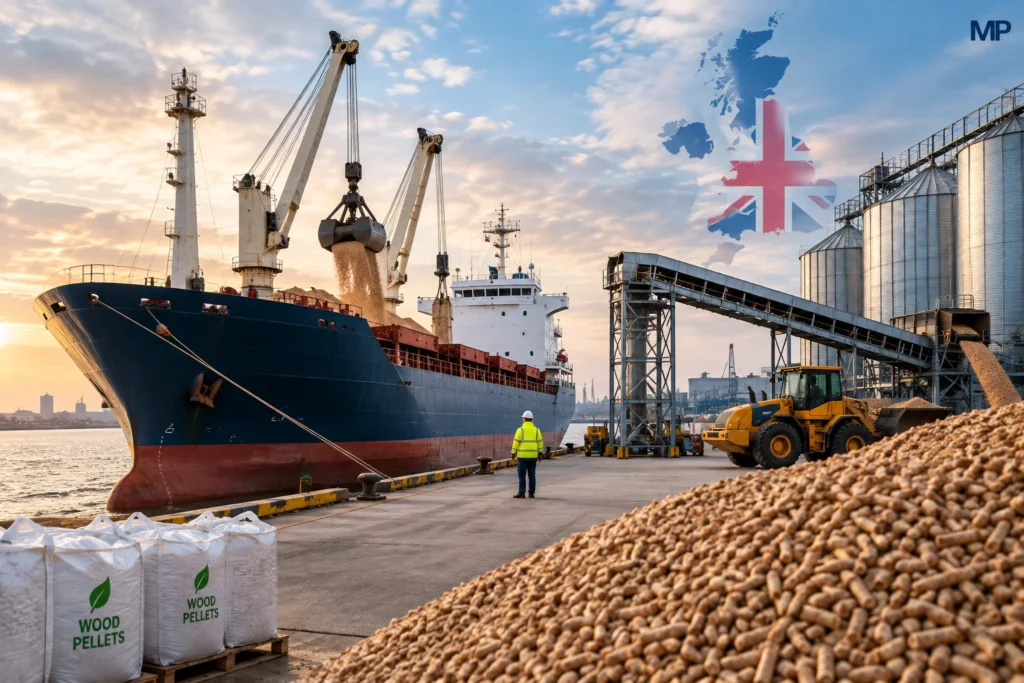

The UK remains one of the world’s largest markets for imported wood pellets, with demand closely linked to biomass electricity generation. The latest USDA forecast published in July 2026 estimates that the country will consume 10.35 million metric tonnes of wood pellets in 2026 and require around 10.15 million tonnes of imports. That would represent a new record for consumption and shows how important imported biomass remains to the UK’s energy system.
The market has changed considerably over the past few years. Imports fell sharply in 2022 and 2023 before recovering in 2024 and increasing again in 2025. At the same time, sustainability rules, supply-chain traceability, and changes to renewable-energy policy are becoming increasingly important for companies involved in the trade.
UK Wood Pellet Imports at a Glance
The latest official Forest Research figures provide a useful picture of how the market has developed.
| Year | UK wood pellet imports |
| 2020 | 9.08 million tonnes |
| 2021 | 9.13 million tonnes |
| 2022 | 7.52 million tonnes |
| 2023 | 6.36 million tonnes |
| 2024 | 9.32 million tonnes |
| 2025 | 9.8 million tonnes |
| 2026 | 10.15 million tonnes forecast |
Forest Research’s provisional 2025 statistics show that the UK imported 9.8 million tonnes of wood pellets, an increase of about 5% from 2024. The agency also reported UK apparent consumption of approximately 10.1 million tonnes in 2025.
For 2026, the latest USDA Foreign Agricultural Service forecast is higher. It estimates 10.15 million tonnes of imports against total consumption of 10.35 million tonnes.
These numbers make 2026 an important year for the market.
What Are Wood Pellets?
Wood pellets are small, compressed fuel products generally manufactured from woody materials such as sawdust, shavings, and other residues.
Their relatively high energy density makes them suitable for automated heating systems and large-scale biomass power generation. Forest Research describes wood pellets as a major form of biomass fuel used in the UK.
The pellets used by large power stations are different in scale and application from the bags commonly sold to household users for pellet stoves.
In the UK, the industrial energy sector accounts for the overwhelming majority of demand, which is why changes in power-generation policy can have a direct effect on import volumes.
Why Does the UK Import So Many Pellets?
The main reason is the country’s large biomass electricity sector.
Imported wood pellets are used extensively by industrial biomass power stations. The UK moved away from coal-fired electricity generation while supporting renewable and low-carbon energy technologies, creating a substantial market for biomass fuel.
The Department for Transport reported that wood pellets were responsible for 9.9 million tonnes of port traffic in 2025. The government describes them as the major source of biomass burned in UK power stations.
The latest USDA report says biomass energy demand is expected to remain strong in 2026, supporting the forecast of 10.15 million tonnes of imports.
2025 Was a Strong Import Year
The UK’s provisional 2025 figures show another increase after the major recovery recorded in 2024.
Forest Research reported 9.8 million tonnes of wood pellet imports in 2025, compared with 9.32 million tonnes in 2024.
The increase is notable because imports had previously fallen to only 6.36 million tonnes in 2023.
The longer-term data therefore looks more like a cycle than a simple upward trend:
9.08 million tonnes in 2020 → 9.13 million in 2021 → 7.52 million in 2022 → 6.36 million in 2023 → 9.32 million in 2024 → 9.8 million in 2025.
This recovery brought imports close to the levels seen at the beginning of the decade.
The 2026 Forecast
The most recent USDA assessment provides the clearest current outlook.
For calendar year 2026, USDA forecasts:
- 10.35 million metric tonnes of consumption
- 10.15 million metric tonnes of imports
- Continued strong demand from renewable power generation
- The UK remaining the world’s largest consumer of imported wood pellets
The report was published on July 21, 2026, making it substantially more current than older market reports that continue to circulate online.
The forecast means imports could exceed the 10-million-tonne mark for the first time in this recent period.
It is important to describe this number as a forecast, rather than a completed 2026 trade figure.
The United States Is the Main Supplier
The United States plays a dominant role in supplying the UK market.
UK port statistics show that American suppliers provided approximately 7.6 million tonnes of wood pellets in 2025, representing 77% of UK wood pellet imports.
USDA’s earlier 2025 analysis similarly showed the United States as the leading supplier, reporting that U.S. shipments accounted for nearly three-quarters of UK imports in 2024.
This concentration makes the U.S.-UK trade relationship particularly important for the market.
It also means that changes in American pellet production, forestry supply, shipping costs, exchange rates, or UK sustainability requirements can have a significant effect on the availability and cost of imported fuel.
North America Remains Important
The importance of North American supply is not new.
Forest Research reported that around 6.4 million tonnes of wood pellets were imported into the UK in 2023, with approximately 81% coming from North America and 10% from the Baltic States.
The southeastern United States has become an important production region for pellets used in the UK.
According to Forest Research, pellets produced in that region generally use lower-value material from conventional forestry and wood-processing operations. The agency notes that the quantity of wood used for pellets represents a relatively small proportion of the region’s overall forest-products output.
UK Domestic Production Is Much Smaller
Another important feature of the market is the gap between domestic production and demand.
The UK does produce wood pellets and other wood fuels, but domestic output is nowhere near sufficient to meet current demand from large-scale biomass generation.
Forest Research’s 2025 provisional figures put UK production of wood pellets and briquettes at approximately 0.3 million tonnes, while pellet imports were 9.8 million tonnes.
This explains why international suppliers remain essential.
Even if domestic production expands, the difference between local output and total demand means the UK is likely to remain dependent on international supply for the foreseeable future.
UK Ports Have Started Tracking Pellets Separately
There is an important statistical development in the latest data.
The Department for Transport introduced wood pellets as a separate cargo category in its 2025 port statistics.
Previously, wood pellets were included within the broader “other dry bulk” category. In 2025, the government began reporting them separately because of their growing importance and interest as a cargo type.
UK ports handled 9.9 million tonnes of wood pellets in 2025.
This figure should not be treated as exactly the same thing as Forest Research’s 9.8 million tonnes of imports because the datasets measure different aspects of trade and port activity.
That distinction is important when discussing UK import statistics.
Imports and Port Traffic Are Different
A common mistake in online articles is to combine every available number and describe it as “imports.”
The Forest Research figure of 9.8 million tonnes represents UK wood pellet imports in its provisional 2025 trade statistics.
The Department for Transport figure of 9.9 million tonnes represents wood pellet cargo handled by UK ports.
These statistics are closely related but are not identical measurements.
Using the correct terminology makes an article much more reliable and avoids creating confusion between imports, consumption, and port traffic.
Biomass Power Drives Demand
The industrial biomass sector is the central reason the UK imports such large quantities of pellets.
The latest USDA report estimates that UK wood pellet consumption will reach 10.35 million tonnes in 2026. It says strong demand for renewable power is driving the increase.
USDA also reports that biomass contributed between 7% and as much as 17% of total UK electricity generation in 2025, depending on the performance of other renewable sources at the same time.
This helps explain why pellet demand can remain high even as the UK continues to expand wind and solar power.
Biomass Is Not the Same as Wind or Solar
The UK’s renewable-energy mix is changing.
Wind and solar generation have expanded substantially, while government policy has increasingly focused on these technologies.
However, biomass has different operating characteristics.
Large biomass generators can provide electricity independently of whether the wind is blowing or the sun is shining. That makes biomass a different type of resource within the electricity system.
The USDA’s 2026 report notes that biomass demand remains strong, while UK energy policy is also evolving toward greater emphasis on other renewable technologies.
This creates an important question for the longer-term pellet market: how much biomass capacity will continue operating as the UK’s renewable-energy system develops?
Sustainability Is Becoming More Important
The environmental sustainability of imported biomass has been debated for years.
The UK government already applies sustainability criteria to biomass supported by relevant energy schemes.
In December 2025, the Department for Energy Security and Net Zero published a consultation on a Common Biomass Sustainability Framework.
The proposal focuses on strengthening sustainability requirements and improving monitoring, reporting, and verification across biomass sectors.
This is particularly relevant to importers because international wood-pellet supply chains can involve forestry operations, processing facilities, ports, shipping companies, and energy generators.
The more detailed the sustainability requirements become, the more important reliable documentation becomes.
Traceability Matters
For businesses supplying the UK, being able to demonstrate where biomass comes from is increasingly important.
Forest Research explains that UK sustainability requirements cover issues including forest productivity, harvest levels, greenhouse-gas emissions, and supply-chain sustainability.
The government has also been working on broader measures concerning forest-risk commodities.
For exporters, this means the commercial value of a pellet shipment is not determined solely by its physical characteristics.
Origin, documentation, sustainability evidence, certification, and supply-chain records can all matter.
Greenhouse-Gas Considerations
Wood pellets are often discussed as a renewable fuel, but that does not mean every supply chain automatically has the same environmental impact.
Forest Research notes that the carbon benefits of forest bioenergy depend on factors such as the source of the material, forest management, alternative uses of the wood, and the energy system being displaced.
Transportation also matters.
UK sustainability criteria generally consider emissions associated with harvesting, processing, drying, pellet production, and transportation.
This is why modern pellet supply chains are increasingly evaluated as a complete system rather than simply by looking at the final fuel.
What Type of Wood Is Used?
Pellets can be manufactured from several types of woody material.
Common feedstocks include sawdust, wood shavings, processing residues, and lower-value material from forestry operations.
Forest Research explains that the southeastern U.S. pellet industry generally uses lower-value material from conventional forestry and processing operations.
The distinction between high-value timber and lower-value residues is important because different types of biomass can have different economic and environmental implications.
Pellet Quality Matters
Import volume is only one part of the market.
Quality can affect storage, transportation, combustion, ash production, and the performance of equipment.
Forest Research identifies characteristics such as moisture content, ash content, calorific value, and mechanical durability as important aspects of wood-fuel quality.
Standardized specifications are particularly important when pellets are being purchased in large quantities.
For industrial buyers, consistency can be just as important as price.
Shipping and Logistics
Because the UK imports millions of tonnes of pellets every year, logistics are a major part of the market.
Large shipments generally arrive by sea, making port capacity important.
The location of storage facilities, unloading infrastructure, inland transportation, and power stations all affect the final cost and reliability of supply.
A supplier therefore needs to consider more than production capacity.
The ability to move large volumes efficiently from the production site to the UK energy market is a major commercial factor.
Why Import Prices Can Change
The price paid for imported pellets can be influenced by several factors at once.
These include:
- Production costs
- Forestry feedstock availability
- Electricity and processing costs
- Ocean freight rates
- Port charges
- Exchange rates
- Weather
- Energy demand
- Sustainability requirements
- Competing international markets
This means a change in one part of the supply chain can affect the final delivered price.
For example, increased demand in another major importing country could compete for available production and shipping capacity.
The UK Market Is Highly Concentrated
The strong U.S. share of UK imports creates both advantages and risks.
A concentrated supply chain can benefit from established infrastructure, long-term commercial relationships, and predictable logistics.
At the same time, heavy dependence on one major source means that disruptions affecting that source can have a larger effect on the UK market.
The 2025 port data showing 77% of UK pellet imports coming from the United States illustrates just how concentrated the supply relationship is.
What Could Change After 2026?
The latest data should not be interpreted as a guarantee that imports will continue increasing indefinitely.
The UK’s energy strategy is changing, and government support mechanisms for renewable electricity are also evolving.
The USDA’s 2026 assessment notes that biomass remains important but also highlights the government’s broader focus on renewable technologies such as wind and solar.
Future pellet demand could therefore depend on the economics of biomass generation, policy decisions, sustainability standards, and the performance of other energy sources.
What the Latest Data Shows
The most important conclusion from the current figures is that UK demand for imported wood pellets remains extremely high in 2026.
Official Forest Research data shows 9.8 million tonnes of imports in 2025, while the latest USDA forecast puts 2026 imports at 10.15 million tonnes.
At the same time, UK ports handled approximately 9.9 million tonnes of wood pellets in 2025, with the United States supplying around 7.6 million tonnes, or 77% of imports.
The figures show a market that is both large and highly dependent on international supply.
Last Wordings
The wood pellets import UK market remains a major part of the country’s biomass energy system. After imports dropped to 6.36 million tonnes in 2023, the market recovered to 9.32 million tonnes in 2024 and 9.8 million tonnes in 2025.
The latest USDA forecast expects 10.15 million tonnes of imports in 2026, alongside record projected consumption of 10.35 million tonnes.
The United States remains the dominant supplier, while the UK continues to rely heavily on imported biomass for industrial power generation.
However, the future of the market will not depend on demand alone. Sustainability rules, traceability, supply-chain emissions, government energy policy, and the changing role of biomass in the electricity system will all influence future imports.
For businesses researching this sector, the latest numbers point to a large and active market, but one where regulatory compliance and supply-chain transparency are becoming just as important as production capacity.
FAQs
How much wood pellets does the UK import?
The UK imported 9.8 million tonnes of wood pellets in 2025, according to provisional Forest Research statistics. The latest USDA forecast estimates 10.15 million tonnes of imports for 2026.
Which country supplies the most wood pellets to the UK?
The United States is the leading supplier. UK port statistics show that the U.S. supplied approximately 7.6 million tonnes, or 77% of UK wood pellet imports, in 2025.
Why does the UK import wood pellets?
Most imported pellets are used in the UK’s industrial biomass energy sector, particularly for electricity generation. Domestic production is much smaller than total demand, making imports necessary.
Will UK wood pellet imports increase in 2026?
The latest USDA forecast expects imports to reach approximately 10.15 million metric tonnes in 2026. This is a forecast, not a final trade figure.
Are wood pellets considered sustainable?
Sustainability depends on factors including feedstock origin, forest management, supply-chain emissions, processing, transportation, and compliance with applicable UK sustainability criteria. The UK government is developing a Common Biomass Sustainability Framework to strengthen sustainability and monitoring requirements.