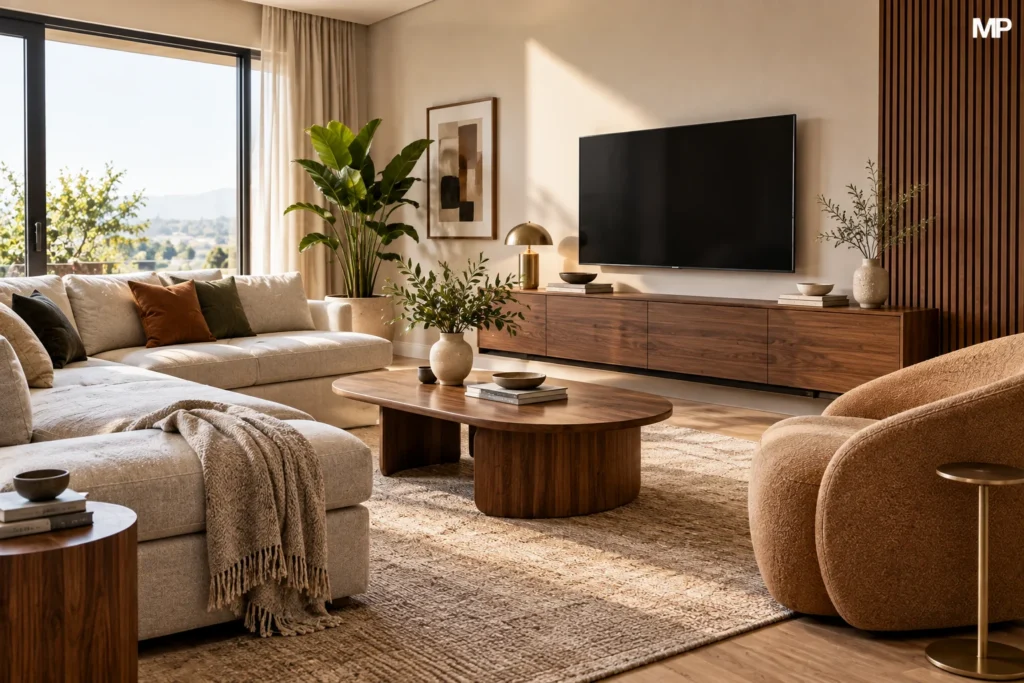

Modern furniture is known for its clean appearance, practical design, simple shapes, and thoughtful use of materials. But the term is often misunderstood. Modern does not simply mean new or fashionable. In design history, it refers to a movement that developed largely during the late 19th and 20th centuries and moved away from heavily decorated furniture toward simpler, more functional forms.
Today, the phrase is also used more broadly by furniture retailers and homeowners to describe pieces with uncluttered lines, restrained decoration, practical proportions, and a polished appearance. That broader use is one reason modern furniture can look very different from one home to another.
In 2026, the look is also becoming warmer. Designers are increasingly combining clean forms with curved silhouettes, richer woods, tactile fabrics, craftsmanship, and more personal details. The result is a style that can remain simple without making a room feel cold or empty.
Quick Information Table
| Feature | Modern Furniture |
| Main idea | Function, simplicity, and clean design |
| Typical shapes | Straight lines, geometric forms, balanced proportions |
| Common materials | Wood, plywood, metal, glass, leather, molded materials |
| Colors | Neutrals, natural wood tones, and selected accent colors |
| Decoration | Usually restrained rather than heavily ornamental |
| Popular profiles | Low, streamlined, visually light forms |
| 2026 direction | Curves, warm woods, tactile materials, craftsmanship |
| Best for | Living rooms, bedrooms, dining rooms, offices, apartments |
| Related styles | Mid-century modern, minimalist, contemporary, Scandinavian |
| Main buying priority | Comfort, proportions, quality, function, and room compatibility |
What Is Modern Furniture?
The modern furniture movement developed as designers began challenging the decorative traditions that had dominated earlier periods.
Instead of relying heavily on carved details, elaborate patterns, or decorative ornament, modern designers explored function, geometry, industrial materials, and simpler construction.
New manufacturing techniques also influenced what designers could produce. Materials such as molded plywood, tubular steel, glass, and plastics opened up possibilities that were difficult or impossible with traditional furniture-making methods.
This history is important because it explains why modern furniture often appears visually simple.
The simplicity is not necessarily about removing everything. It is about making the structure and purpose of the furniture clear.
A chair should be comfortable. A table should work well. A cabinet should provide useful storage. Decorative details should not overwhelm the basic function.
Modern Does Not Mean Contemporary
One of the most common questions is whether modern and contemporary furniture are the same.
They are not.
Modern furniture refers to a recognizable design tradition, particularly associated with modernism and the early-to-mid 20th century. Contemporary furniture refers more generally to what is being designed and produced in the present period.
This means a piece of furniture made in 2026 can be modern in appearance, contemporary, both, or neither.
For example, a new chair inspired by mid-century design can follow modern principles even though it was manufactured recently. Meanwhile, a current contemporary chair might combine curved forms, unusual fabrics, vintage references, and experimental materials.
Modern describes a design language; contemporary describes the current moment.
Main Characteristics
The easiest way to recognize modern pieces is to look at their overall structure.
Clean horizontal or vertical lines are common. Shapes are often geometric, although modern design can also include carefully controlled curves.
Ornament tends to be limited.
Furniture may also appear visually lighter than heavily decorated traditional pieces. Slim legs, raised bases, open areas, and simple surfaces can contribute to this effect.
Current 2026 descriptions of the style continue to emphasize clean lines, minimal ornament, honest materials, and function.
However, modern design should not be reduced to a room filled with white boxes.
Wood grain, leather, textured upholstery, metal, glass, and carefully chosen colors can all add warmth and character.
Clean Lines
Clean lines are one of the most recognizable features.
A modern sofa might have a simple rectangular body. A dining table may use a thin top and uncomplicated legs. A media console may have flat doors without visible handles.
These shapes help create visual order.
Clean lines can also make furniture easier to combine because the pieces do not compete heavily with one another.
This is especially useful in smaller homes where too many decorative shapes can make a room feel visually crowded.
Function Comes First
A strong modern design usually has a clear purpose.
This idea is closely connected with the modernist principle that furniture should serve its function rather than relying on decoration alone.
A modern storage cabinet, for example, should provide accessible storage while maintaining a simple exterior.
The modern desk needs enough working space and appropriate cable management.
A modern sofa needs to provide comfort while maintaining its intended visual proportions.
Good design should solve a practical problem while also looking intentional.
Materials Matter
Materials are a major part of the modern aesthetic.
Wood brings warmth and visible texture. Metal can create a slim structural appearance. Glass can make a table or cabinet look lighter. Leather can add richness to seating.
Plywood also has an important place in modern furniture history because designers explored its ability to be molded and shaped into functional forms. Modern furniture has also used plastics, composites, and other manufactured materials.
The material does not have to be expensive.
What matters is how it is used.
A simple piece made from attractive wood with carefully finished edges can look more sophisticated than an expensive piece overloaded with unnecessary decoration.
Wood Brings Warmth
Wood continues to work particularly well with modern interiors.
Oak, walnut, ash, teak, maple, and other woods can provide different colors and grain patterns.
Natural wood can prevent a minimalist room from feeling sterile.
This is particularly relevant in 2026, when designers are showing increased interest in warmer woods and more tactile materials rather than relying exclusively on cool gray or stark white palettes.
You do not necessarily need to replace every piece of furniture.
Adding one well-designed wooden table, cabinet, chair, or sideboard can introduce warmth while preserving the overall modern appearance.
Metal Adds Structure
Metal is another important material.
Steel and aluminum can create thin, strong structural components. Metal legs are common in desks, dining tables, shelving, chairs, and storage furniture.
Black metal can create stronger contrast against light wood.
Brushed or aged finishes can provide a softer appearance than highly polished surfaces.
In modern interiors, metal works best when it supports the overall design rather than becoming decoration for its own sake.
Glass Creates Visual Space
Glass can make furniture appear lighter.
A glass tabletop, cabinet door, or shelving element allows the eye to see through the structure instead of encountering another solid visual block.
This can be useful in smaller rooms.
However, glass requires practical consideration. Fingerprints, cleaning, durability, and the presence of children or pets should all be considered before choosing it.
A beautiful material still needs to make sense for the household using it.
Neutral Colors Still Matter
Modern interiors often use neutral colors because they provide a calm background for furniture and architecture.
White, beige, gray, black, cream, taupe, and natural wood tones can all work well.
But neutral does not have to mean boring.
Texture can create variation even when the palette is restrained. A warm wooden cabinet, textured sofa, stone surface, and metal lamp can all use relatively simple colors while producing a layered room.
Modern design also allows accent colors.
A single blue chair, green cabinet, burgundy sofa, or colorful artwork can become a focal point against a quieter background.
Modern and Minimalist Are Different
Modern and minimalist furniture overlap, but they are not identical.
Minimalism focuses strongly on reducing visual and physical excess. It often uses fewer objects, simpler forms, and limited decoration.
Modern furniture can be minimalist, but it does not have to be.
A modern room can contain several furniture pieces, artwork, books, plants, textiles, and decorative objects while still maintaining modern design principles.
Minimalism is about reduction; modernism is a broader design movement.
Understanding this difference can help homeowners create a modern room without making it feel empty.
Mid-Century Modern
Mid-century modern is one of the most recognizable styles associated with modern furniture.
It generally refers to design from the middle decades of the 20th century and is known for simple forms, practical construction, organic influences, and distinctive furniture profiles.
Tapered legs, warm woods, streamlined seating, and carefully proportioned tables are common visual references.
Many current products borrow from this period without being exact historical reproductions.
This is one reason mid-century-inspired furniture remains easy to incorporate into contemporary homes.
Scandinavian Influence
Scandinavian design is often associated with simplicity, functionality, natural materials, and comfortable living environments.
Its lighter woods, soft neutrals, practical shapes, and uncluttered appearance can work naturally alongside modern furniture.
The combination is especially useful for apartments and smaller homes.
Rather than filling a room with furniture, choose a few pieces that perform useful functions and leave enough open space around them.
Curved Furniture in 2026
Modern furniture does not have to be entirely angular.
One of the clearest furniture trends being reported in 2026 is the growing popularity of curved and organic silhouettes.
ELLE Decor’s January 2026 design coverage reports increased demand for sculptural curves, rounded chairs, curved sofas, and softened table forms. The publication also notes that advances in joinery and manufacturing are making complex curved wooden forms more practical to produce.
This does not mean every piece in a room needs to be curved.
A single rounded chair or curved coffee table can soften an otherwise linear space.
That balance is often more effective than following a trend throughout the entire room.
Warm Wood and Texture
Another noticeable direction in 2026 interiors is the move toward warmth.
Furniture100’s 2026 trend coverage identifies soft curves, warm woods, earthy browns, and tactile fabrics among the year’s important furniture directions.
Recent design coverage also highlights craftsmanship and material character as important themes.
This suggests that modern furniture is becoming less about creating a perfectly sterile room and more about combining simplicity with comfort and personality.
A modern room can therefore include visible wood grain, woven fabric, textured upholstery, handmade objects, or vintage pieces.
Modern Furniture for Small Spaces
Modern design can be particularly useful in apartments and compact homes.
Look for furniture with multiple functions.
A storage ottoman can provide seating and hidden storage. A console can function as both a media unit and display surface. An extendable dining table can serve everyday meals without occupying unnecessary space.
Raised furniture can also create more visible floor area.
Avoid buying large furniture simply because the room has an empty wall.
Scale matters more than the amount of furniture you can physically fit.
Leave enough room to walk comfortably and open drawers or cabinet doors without obstruction.
Modern Living Room Furniture
A modern living room often works best when the major pieces have clear relationships.
Start with the sofa.
Then consider the coffee table, chairs, media unit, side tables, lighting, and rug.
The furniture does not have to come from one matching collection.
In fact, mixing pieces can make the room feel more personal.
Current 2026 design commentary increasingly emphasizes individuality and mixing furniture rather than creating spaces that look like identical showroom sets.
Choose pieces that share a visual connection through color, material, proportion, or shape.
Modern Bedroom Furniture
A modern bedroom should balance appearance with comfort.
A low-profile bed, simple nightstands, a streamlined dresser, and soft lighting can create a calm environment.
Wood is particularly useful because it introduces warmth.
Avoid overcrowding the room.
The bedroom does not need every available surface filled with accessories.
Instead, focus on a few useful pieces and allow the architecture and materials to remain visible.
Modern Dining Furniture
Modern dining furniture often focuses on proportion and simplicity.
A clean-lined table can be paired with upholstered, wooden, or molded chairs.
The table should be appropriately sized for the room and the number of people who regularly use it.
Mixing chair styles can work, but it should be intentional.
For a more unified appearance, repeat one element such as wood tone, upholstery color, or metal finish.
Modern Office Furniture
A modern home office should prioritize ergonomics as much as appearance.
A beautiful desk is not enough if it is uncomfortable for long periods of work.
Look for an appropriate desk height, comfortable chair, sufficient legroom, and practical cable management.
Storage can be kept visually clean with closed cabinets or simple shelving.
A few plants or personal objects can make the workspace feel less sterile without compromising the overall design.
Choosing Furniture by Room Size
Large rooms can handle larger furniture, but scale is still important.
A huge sofa may dominate a medium-sized living room.
A tiny coffee table can look lost in a large seating arrangement.
Before buying, measure the room and create a rough floor plan.
Consider the distance between furniture pieces, walking paths, doors, windows, and other fixed elements.
Furniture should fit the architecture rather than simply fit through the front door.
Check Construction Quality
Appearance should not be the only buying criterion.
Look at how the furniture is constructed.
Check joints, drawer movement, hinges, hardware, finishes, and the stability of legs or frames.
For wood products, inspect edges and surfaces for signs of poor finishing.
For upholstered furniture, examine stitching and frame support when possible.
A simple piece with good construction can remain useful for years.
Consider Engineered Wood Carefully
Engineered wood is common in modern furniture.
MDF, particleboard, and hardwood plywood can all be used in furniture and cabinetry. These materials can provide consistent surfaces and efficient manufacturing.
However, composite wood products can involve formaldehyde emissions, which is why product standards and testing matter.
In February 2026, the U.S. EPA proposed adding a new quality-control test method for measuring formaldehyde emissions from composite wood products as part of updates to its formaldehyde emissions standards.
This does not mean all engineered wood furniture is problematic.
It means buyers should pay attention to specific product information, applicable standards, and manufacturer documentation rather than assuming that every material is identical.
Think About Sustainability Carefully
Sustainability is increasingly discussed in furniture design, but broad claims should be treated carefully.
A company describing furniture as “green” or “eco-friendly” should be able to explain exactly what makes the product environmentally preferable.
The U.S. Federal Trade Commission advises marketers against broad, unqualified environmental claims because they can be difficult to substantiate. Specific claims should be clear and supported by appropriate evidence.
For shoppers, that means looking for concrete information.
Ask whether a claim refers to recycled content, a particular material source, durability, certification, manufacturing practices, or something else.
Specific information is more useful than a vague environmental label.
How to Mix Modern Pieces
You do not have to redesign your entire home to introduce modern furniture.
Start with one significant piece.
A modern coffee table can update a traditional sofa arrangement.
A streamlined dining table can work with older chairs.
A contemporary-looking cabinet can sit beside a vintage armchair.
The trick is to find a connecting element.
That could be a shared wood tone, similar color, repeated metal finish, or complementary shape.
Mixing styles can make a home feel more personal than purchasing every piece from the same collection.
Avoid Matching Everything
A room filled with identical furniture can feel more like a showroom than a home.
Instead, create relationships between pieces.
For example, you might combine a walnut coffee table with a neutral sofa, black metal lighting, and a vintage chair.
The pieces are different, but the colors and materials can connect them.
This approach also makes future changes easier because you can replace one item without rebuilding the entire room.
Is Modern Furniture Still Popular in 2026?
Modern design principles remain influential, but the current interpretation is becoming broader.
Design coverage for 2026 shows a combination of clean forms, sculptural curves, warm woods, tactile materials, craftsmanship, and more individual interiors.
That is important because it challenges the idea that modern furniture must always be cold, rigid, or completely minimalist.
The modern home in 2026 can be clean and functional while still feeling warm.
It can include curved seating, natural wood, vintage references, handmade objects, and expressive lighting without losing its overall sense of order.
Common Buying Mistakes
One common mistake is buying furniture because it looks attractive in a showroom without measuring the home.
Another is focusing on color while ignoring construction quality.
Some people also choose furniture that is too large for the room.
Others buy matching sets when a more varied collection would better suit the space.
Choosing a trend simply because it is popular can also become frustrating if it does not match your personal taste.
Buy for your room and your lifestyle first, then consider trends.
How to Create a Modern Room on a Budget
You do not need to replace everything.
Start with the most visible or frequently used piece.
Replace an outdated coffee table, add a simple modern chair, update a media console, or introduce a clean-lined storage cabinet.
Paint and lighting can also change how furniture is perceived.
Secondhand furniture can be another option, especially when the underlying construction is good and the piece can be refinished.
A quality older piece with a modern silhouette can sometimes work better than inexpensive furniture purchased simply because it is new.
Final Verdict
Modern furniture is ultimately about purposeful design rather than a single color, material, or shape. Its roots are connected to modernism and the move toward function, simpler forms, new manufacturing techniques, and reduced ornamentation.
Today, the style has become more flexible. Clean lines and practical proportions can be combined with natural wood, metal, glass, leather, textiles, vintage pieces, and carefully chosen color.
The 2026 furniture landscape also shows that modern interiors are becoming warmer and more tactile. Curved silhouettes, richer wood tones, craftsmanship, and personal details are increasingly being used alongside simpler modern forms.
When choosing furniture, focus first on scale, comfort, construction, function, and the existing character of your home. Then use current trends as inspiration rather than strict rules.
The best modern interior is not necessarily the one with the newest furniture. It is the one where every major piece has a purpose, the proportions work together, and the room feels comfortable enough to actually live in.
FAQs
What is modern furniture?
Modern furniture is associated with a design tradition that emphasizes function, clean lines, simple forms, and restrained ornamentation. Historically, it developed alongside modernist design movements and new manufacturing technologies.
What is the difference between modern and contemporary furniture?
Modern refers to a particular design tradition, especially associated with modernism and the 20th century. Contemporary furniture refers to current design and changing tastes. The two can overlap, but they are not identical.
What materials are commonly used in modern furniture?
Common materials include wood, plywood, metal, glass, leather, plastics, and engineered wood products. The choice depends on the furniture’s purpose, appearance, construction method, and budget.
Is modern furniture still popular in 2026?
Modern design remains influential in 2026, although current furniture trends increasingly combine simple forms with curves, warm woods, tactile materials, and handcrafted details.
How can I make my home look more modern?
Start with furniture that has clean proportions and practical forms. Reduce unnecessary clutter, introduce simple lighting, use a coordinated color palette, and mix natural materials such as wood with metal, glass, or textured fabrics.
Is minimalist furniture the same as modern furniture?
No. Minimalism emphasizes reducing visual and physical excess, while modern furniture comes from a broader design tradition. A modern room can contain several decorative and functional elements without being strictly minimalist.

Pingback: How to Measure a Room for Furniture: A Complete Guide - magazinepanda.blog
Pingback: Wood Pellets Import UK: Latest Market Data, Suppliers and Trends in 2026 - magazinepanda.blog