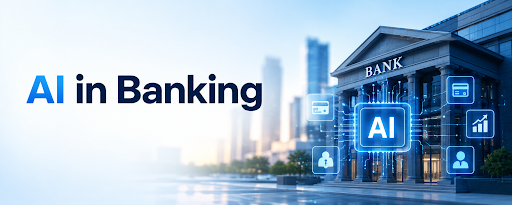

Banking has always been a data business. Every transaction, loan application, and customer interaction produces information that can reveal risk, intent, and opportunity. For most of the industry’s history, turning that information into decisions depended on rules engines, manual reviews, and teams working through queues of paperwork.
AI is changing how that work gets done. Banks are now using it to spot fraud as it happens, speed up lending decisions, automate compliance checks, and give customers fast answers at any hour. Yet many institutions still find their AI initiatives stuck at the pilot stage, held back by legacy systems, regulatory concerns, and scattered data.
This guide looks at where AI is creating real value in banking today, the obstacles that slow adoption, and a practical path to taking AI from experiment to everyday operations.
Where AI Is Making the Biggest Difference in Banking
Real-Time Fraud Detection
Traditional fraud systems rely on fixed rules, such as flagging transactions above a certain amount or from an unusual location. Fraudsters learn these rules quickly. AI models take a different approach by learning each customer’s normal behavior and spotting subtle anomalies across devices, locations, merchants, and transaction timing.
The result is earlier detection and fewer false alarms. Customers are less likely to have legitimate payments blocked, and fraud teams can focus on the cases that genuinely need investigation.
Faster, Smarter Credit Decisions
Lending decisions have traditionally depended on a narrow set of data points and lengthy manual underwriting. AI-assisted credit models can analyze a broader range of signals, including cash flow patterns and transaction history, to assess risk more accurately. Document intelligence tools extract information from bank statements, pay slips, and tax records automatically, cutting the time between application and approval.
For borrowers with thin credit files, this approach can open access to credit that older scoring methods would have denied.
KYC, AML, and Compliance Automation
Compliance teams spend enormous effort on know-your-customer checks, anti-money laundering monitoring, and regulatory reporting. AI can verify identity documents, screen customers against watchlists, and monitor transactions for suspicious patterns at a scale manual teams cannot match.
Instead of reviewing every alert by hand, analysts receive prioritized cases with supporting context already gathered. That makes investigations faster and more consistent.
Intelligent Customer Service
AI-powered virtual assistants can handle balance inquiries, card blocks, transaction disputes, and product questions around the clock across mobile apps, websites, and messaging channels. When a conversation needs a human, the assistant hands it over with full context so the customer does not have to repeat themselves.
Behind the scenes, relationship managers and call center agents get AI-generated summaries of customer history and suggested next steps, which improves both speed and service quality.
Personalized Financial Guidance
By analyzing spending habits and financial goals, AI helps banks offer relevant suggestions, from savings nudges and budgeting insights to timely product recommendations. Done well, personalization builds trust because customers receive guidance that genuinely fits their situation rather than generic marketing.
Back-Office Efficiency
Reconciliation, reporting, document processing, and audit preparation are repetitive, rule-heavy tasks that consume significant staff time. AI and intelligent automation can handle much of this work, reducing errors and freeing teams to focus on analysis and decision-making.
What Holds Banks Back
Legacy core systems. Many banks run on core platforms that were built decades ago and were never designed to share data in real time. Connecting AI models to these systems without disrupting daily operations is often the hardest part of the project. This is where experienced engineering matters most, and why many banks work with partners offering end-to-end AI development services that cover data integration, model development, and deployment within strict security requirements.
Fragmented data. Customer information is frequently spread across separate systems for cards, loans, deposits, and service. Without a unified view, models produce incomplete or inconsistent results.
Explainability and model risk. Regulators expect banks to explain how automated decisions are made, especially in lending. A model that cannot justify why it declined an application creates both regulatory and reputational risk. Model risk management, bias testing, and clear documentation need to be part of the design, not added later.
Security and privacy. Financial data is highly sensitive. AI systems must meet the same standards as any other banking platform, including encryption, access controls, audit trails, and careful handling of third-party model providers.
A Practical Roadmap for Banks
- Start with a defined business problem. Pick a use case with clear value and measurable outcomes, such as reducing false fraud alerts or speeding up document checks for loan applications.
- Get the data foundation right. Identify where relevant data lives, who owns it, and what needs cleaning before any model work begins.
- Build governance in from day one. Involve risk, compliance, and legal teams early. Document data sources, model logic, and human review points.
- Pilot in a controlled environment. Test with real data and a limited user group, measure results honestly, and refine before scaling.
- Keep humans in the loop. Use AI to prioritize, recommend, and automate routine steps, while experienced staff make the final call on complex or high-impact decisions.
- Scale what works. Once a use case proves its value, reuse the same data pipelines and governance framework to expand into new areas.
Building the Right Team
Banking AI requires a rare combination of skills: machine learning, data engineering, cloud and security engineering, and a solid understanding of financial regulation. Building that team entirely in-house can take a long time, especially when experienced specialists are in high demand.
Many banks and fintech companies keep strategy, product ownership, and domain expertise internal while they hire AI developers to strengthen specific capabilities, such as fraud modeling, LLM-based assistants, or MLOps. Dedicated developers work within existing teams and processes, so knowledge stays inside the organization as AI adoption grows.
Final Thoughts
AI in banking is no longer about experimenting with chatbots. It is becoming part of the core of how banks detect risk, serve customers, and run operations. The institutions moving ahead are not necessarily those with the biggest technology budgets. They are the ones that start with focused use cases, invest in clean and connected data, treat governance as a design requirement, and combine AI capability with human judgment. That approach turns AI from a promising pilot into a lasting advantage.