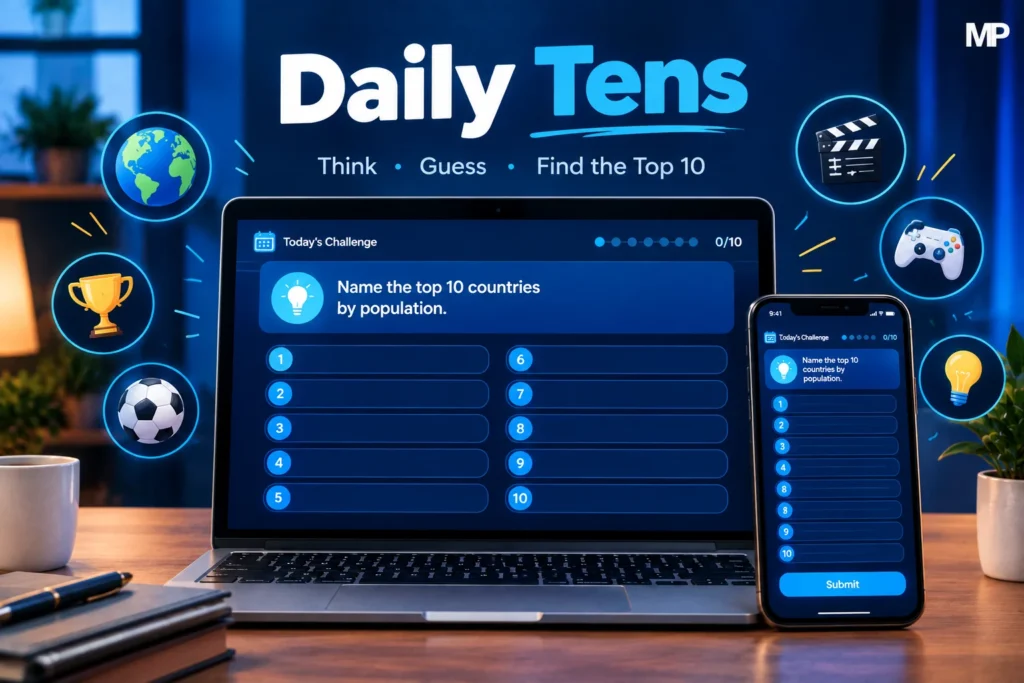

Daily Tens is a browser-based trivia game built around a simple idea: identify the top 10 answers for a daily category. Instead of solving a word from a fixed number of letters, players have to recall names, places, teams, movies, countries, or other items that belong in a particular ranked list. The game gives players a fresh challenge each day, making it easy to turn into a short daily habit.
The concept was created as a daily trivia experience similar in spirit to other popular daily games. Creator Isaac Schiffler described DailyTens.com as a game where players name the Top Ten answers to a topic, with a new question each day.
What makes the format interesting is that knowing the general subject is not always enough. A player may recognize several correct answers quickly but struggle with the final few entries. Those missing answers can require stronger recall, knowledge of the ranking criteria, and a willingness to think beyond the most obvious choices.
Quick Information Table
| Feature | Details |
| Game | Daily Tens |
| Official website | DailyTens.com |
| Type | Daily trivia / top-10 guessing game |
| Platform | Web browser |
| Main objective | Find the top 10 answers for the daily topic |
| New puzzle | Daily |
| Typical content | Sports, geography, entertainment, history and other topics |
| Gameplay style | Guessing and knowledge recall |
| Creator information | Isaac Schiffler and collaborators |
| Comparison | Similar daily-game format to Wordle and Connections |
| Cost | Listed by current game directories as free |
| Language | English |
| Best for | Trivia fans and short daily puzzle sessions |
What Is Daily Tens?
Daily Tens is a daily top-10 trivia game available through a web browser. Each puzzle gives players a particular subject or ranking and asks them to identify the ten correct entries.
The idea was publicly described by creator Isaac Schiffler when the game launched. He explained that the site asks players to name the Top Ten answers to a topic and gives everyone a new question each day.
For example, a question might ask for the NFL teams with the most Super Bowl wins. In that situation, knowing that the category is about NFL teams is only the first step. The player must identify which teams actually belong in the top 10 according to the stated measurement.
This creates a mix of general knowledge, memory, and ranking awareness.
How Does the Game Work?
The basic gameplay is straightforward.
You receive a daily category and try to identify the ten answers that belong at the top of the relevant list. Current game listings describe Daily Tens as a trivia game where the objective is to guess the ten correct items for a particular category.
The challenge is that the category can cover many different subjects.
One puzzle might involve sports, while another could involve geography, movies, music, history, or another area of general knowledge. This variety prevents players from relying on one narrow skill set.
The result is a game that can feel easy during the first few guesses and much harder when only two or three spaces remain.
The Top-10 Format
The defining feature is the top-10 format.
You are not simply asked to name ten things that fit a broad topic. The wording normally relates to a particular ranking or measurement. That distinction matters.
Suppose a puzzle asks about countries by population. Hundreds of countries fit the general category, but only ten occupy the highest positions under the specified ranking.
This means a player needs to think about what the question is actually measuring, rather than simply listing familiar answers.
That is where much of the game’s difficulty comes from.
New Puzzle Every Day
Daily Tens follows the same basic habit-forming structure used by many popular daily games: one new challenge is released each day.
The creator described the game as updating with a new question every day when it launched. Current game directories also list it as a daily game with a new puzzle each day.
This structure gives players a reason to return regularly without requiring a long gaming session.
A person can open the game, read the category, make several guesses, and finish the challenge without setting aside an entire evening.
What Kind of Questions Appear?
The subjects can vary considerably.
Examples documented in current listings and Daily Tens promotional material include sports rankings, country statistics, and other top-10 categories. One example used by multiple game directories is NFL teams ranked by Super Bowl wins.
Daily Tens has also promoted categories involving countries and natural resources.
The variety is one of the game’s strongest characteristics because it prevents the experience from becoming a repetitive quiz about one subject.
You might know a lot about football but less about geography. Another player could have the opposite experience.
Why the Ranking Metric Matters
One of the easiest mistakes is to ignore the metric behind the list.
The word “top” does not necessarily mean the most famous, most popular, or most recognizable.
A question may rank items according to championships, population, release date, sales, historical figures, or another measurable factor.
Current descriptions of the game specifically advise players to pay attention to the metric being used for the day’s list.
That means a good player should read the entire question before making the first guess.
The ranking criterion can completely change which answers belong on the board.
Guess the Obvious Answers First
A practical strategy is to begin with answers you are highly confident about.
If the category asks for the top NFL teams by Super Bowl victories, for example, start with teams whose position near the top is well known rather than immediately searching your memory for obscure possibilities.
This has two advantages.
First, it fills part of the board quickly. Second, it confirms that you understand the category correctly.
Once several answers are established, the remaining spaces become easier to approach because you have a clearer idea of what the puzzle expects.
Think in Groups
When you get stuck, avoid thinking about the entire category at once.
Instead, divide it into smaller groups.
For a geography question, think about regions. For sports, consider historically successful teams. And movies, think about major franchises or periods. For music, consider artists, genres, or decades depending on the question.
This approach can help trigger memories that do not appear when you simply stare at an empty list.
Breaking a large topic into smaller mental groups is one of the simplest ways to improve recall.
Don’t Ignore the Wording
The exact wording of the category can provide valuable information.
A question about “largest” is different from one about “most populated.” A question about “most wins” is different from one about “most appearances.”
Even when two categories involve the same general subject, the answer set may be completely different.
Before guessing, ask yourself:
What exactly is being ranked?
That single question can prevent many avoidable mistakes.
Why Some Answers Feel Difficult
The first several answers are often easier because they are the most familiar items in the category.
The final few can be much harder.
You may know that an answer belongs to the broader subject but not remember whether it ranks inside the top 10. This is where the game moves from simple recognition into deeper recall.
For example, knowing that a country is large does not automatically mean it belongs among the ten largest countries under the metric being used.
The game therefore rewards specific knowledge rather than vague familiarity.
Is Daily Tens Free?
Current third-party game directories list Daily Tens as free to play in a browser, without requiring a purchase or installation. Alldle currently lists it as free with no signup.
Because the official DailyTens.com interface is JavaScript-based, specific interface elements can change over time.
For readers, the important point is that the game is designed as an accessible web experience rather than a traditional downloadable PC or mobile title.
Can You Play It on a Phone?
Because Daily Tens runs through a web browser, players can access it without installing a dedicated game application.
Current game directories describe it as a browser-based game and link directly to DailyTens.com.
That makes the format convenient for short sessions.
A player can open the site from a phone, tablet, or computer and attempt the daily challenge.
The exact appearance of the interface can vary depending on the browser and device.
Daily Tens vs. Wordle
Daily Tens shares an important characteristic with Wordle: both are designed around a daily puzzle.
However, the actual gameplay is very different.
Wordle focuses on identifying a five-letter word through letter-based feedback. Daily Tens focuses on general knowledge and ranked lists.
In Daily Tens, your success depends heavily on knowing facts and remembering names. There is no need to work through letter combinations in the same way.
The common element is the daily routine: one short challenge that gives players a reason to return the next day.
Daily Tens vs. Connections
Daily Tens can also be compared with Connections, another popular daily puzzle format.
The difference is that Connections asks players to identify groups of related words, while Daily Tens asks them to identify the ten correct answers for a specific top-10 topic.
That means Connections relies more heavily on recognizing relationships between words.
Daily Tens places greater emphasis on factual recall and understanding rankings.
Both can be challenging, but they exercise different types of thinking.
Does the Game Test General Knowledge?
Yes, general knowledge is central to the experience.
Current game directories classify Daily Tens under trivia and describe the objective as finding the top ten answers for a category.
However, general knowledge alone does not guarantee a perfect result.
A player might know the subject extremely well but still miss an answer because the question uses an unfamiliar metric.
This combination is what makes the game more interesting than a simple list of trivia questions.
A Good Strategy for Beginners
New players should avoid trying to solve the entire puzzle mentally before entering anything.
Instead, start with the answers you know confidently.
Then look at the remaining spaces and ask what type of answer is missing.
If the puzzle concerns countries, for example, consider whether you have covered enough regions. If it concerns sports teams, think about whether you are focusing too heavily on one era.
This method turns the puzzle into a process of elimination.
Confidence first, exploration second is a useful approach for beginners.
Use Your Guesses Carefully
If the game limits incorrect guesses, random guessing can quickly become expensive.
Current descriptions of the Daily Tens format report five incorrect guesses or lives as the basic limit.
That means every uncertain guess should have a reason behind it.
Before submitting an answer, consider:
- Does it actually fit the category?
- Is it likely to rank inside the top 10?
- Am I confusing popularity with the stated metric?
- Have I already covered similar answers?
- Is there another answer I am more confident about?
This small pause can prevent unnecessary mistakes.
Learn From Missed Answers
One of the easiest ways to improve is to remember what you missed.
After completing a puzzle, look at the answers you did not identify.
If you repeatedly miss geography questions, you may need to improve your knowledge of population statistics. If sports rankings cause problems, learning historical records may help.
The goal is not simply to memorize one previous puzzle.
Instead, use missed answers to identify knowledge gaps that may appear again in future categories.
Think About the Source
Ranking games are only as meaningful as the data behind their lists.
When a question asks for a ranking, it is useful to know what information was used to construct it.
Current descriptions of Daily Tens emphasize the ranking metric, and creator-related material shows that the game is built around factual top-10 topics.
This is important because rankings can change over time.
A country’s population changes. Sports records change. Movie totals change. New products and technologies appear.
A good trivia game therefore needs to define the measurement and, ideally, the relevant data period.
Why Daily Games Are Appealing
Daily games work because they offer a small commitment.
Instead of asking players to complete a large quiz, Daily Tens gives them one focused challenge.
That makes it easy to fit into a morning routine, lunch break, commute, or evening wind-down.
The format also creates anticipation. Once today’s puzzle is finished, players know another challenge will appear later.
For trivia fans, that combination of variety and repetition can be particularly appealing.
Playing With Friends
The creator’s original launch announcement specifically mentioned the ability to see how players compare with friends and family.
That social element can make the game more enjoyable.
A difficult category can produce very different results among people with different interests.
One person may dominate a sports category while another performs better on movies or geography.
Rather than treating every puzzle as a serious competition, the social element can simply provide a reason to compare results and discuss the answers.
How to Improve Your Score
There is no universal trick that guarantees a perfect result.
However, several habits can make your performance more consistent:
Read the metric first. Do not start guessing until you understand what is being ranked.
Enter high-confidence answers. Secure obvious entries before experimenting.
Think by category. Break broad subjects into smaller groups.
Avoid random guesses. Limited lives make careless attempts costly.
Review missed answers. Use them to build broader knowledge.
Look for ranking patterns. Historical leaders, population giants, major franchises, and dominant teams often appear in relevant categories.
These strategies do not replace knowledge, but they can help you use what you already know more effectively.
What Makes the Game Different?
The most distinctive part of Daily Tens is the combination of trivia and ranking.
Traditional trivia often asks whether a statement is true or asks for one correct answer.
Daily Tens asks something more specific: which ten answers occupy the top positions according to this particular measurement?
That small change creates a different kind of challenge.
You need to know facts, but you also need to understand how those facts relate to one another.
Daily Tens and the Daily Puzzle Trend
Daily Tens belongs to a larger group of browser games that provide a fresh challenge on a recurring schedule.
The popularity of games such as Wordle, Connections, and other daily puzzles has shown that players enjoy short experiences that can become part of a routine.
Creator Isaac Schiffler explicitly referenced Wordle, Connections, and Immaculate Grid when describing Daily Tens at launch.
Daily Tens takes that familiar daily structure and applies it to trivia.
Instead of spelling a word or grouping terms, players build a top-10 knowledge list.
Is Daily Tens Difficult?
The difficulty depends heavily on the category.
Some puzzles may immediately suggest several answers, especially when the subject is familiar.
Others can become difficult once the obvious choices are gone.
The final few entries are usually where deeper knowledge matters most. A player can understand the question perfectly and still struggle because the remaining answers are outside their usual interests.
That variability is useful because it keeps the game from having one fixed difficulty level.
Who Is Daily Tens For?
The game is particularly suitable for people who enjoy:
- General knowledge
- Trivia competitions
- Sports statistics
- Geography
- Movies and entertainment
- Historical facts
- Daily browser games
- Short puzzle sessions
- Comparing scores with friends
It can also appeal to people who enjoy games such as Wordle but want something based more heavily on factual knowledge.
Final Wordings
Daily Tens is a simple but surprisingly challenging daily trivia game built around top-10 lists. The objective is straightforward: read the day’s category, understand the ranking metric, and identify the ten answers that belong on the board. The game was created as a daily trivia experience and was designed to update with a fresh question each day.
What makes the format interesting is the difference between knowing a topic and knowing its rankings. You may recognize many items that fit the subject, but only some will actually qualify for the top 10. That forces players to think carefully about statistics, history, popularity, records, geography, or whatever measurement the puzzle uses.
For beginners, the best approach is to start with high-confidence answers, read the wording carefully, avoid unnecessary guesses, and use the remaining spaces to guide your thinking. Over time, reviewing missed answers can also improve general knowledge and make unfamiliar categories easier.
Ultimately, Daily Tens works because it keeps the basic idea small. One category, ten answers, and a short daily challenge are enough to create a trivia game that is easy to understand but difficult to master.
FAQs
What is Daily Tens?
Daily Tens is a daily browser-based trivia game in which players try to identify the top 10 answers for a specific category. The topics can cover areas such as sports, geography, entertainment, and other general-knowledge subjects.
Is Daily Tens free?
Current game directories list Daily Tens as free to play in a web browser, with no installation or purchase required.
How do you play Daily Tens?
Read the daily category, determine what is being ranked, and enter the answers you believe belong in the top 10. Correct answers are added to the board, while incorrect guesses can use up available attempts.
Is Daily Tens like Wordle?
It has a similar daily-puzzle format, but the gameplay is different. Wordle focuses on finding a word through letter feedback, while Daily Tens relies on trivia knowledge and identifying ranked answers.
How can I get better at Daily Tens?
Start with answers you know confidently, pay close attention to the ranking metric, avoid random guesses, and think about the category in smaller groups. Reviewing answers you missed can also help build useful knowledge for future puzzles.
Does Daily Tens have a new puzzle every day?
Yes. The game was designed around a new daily question, and current game directories also list it as a daily puzzle.