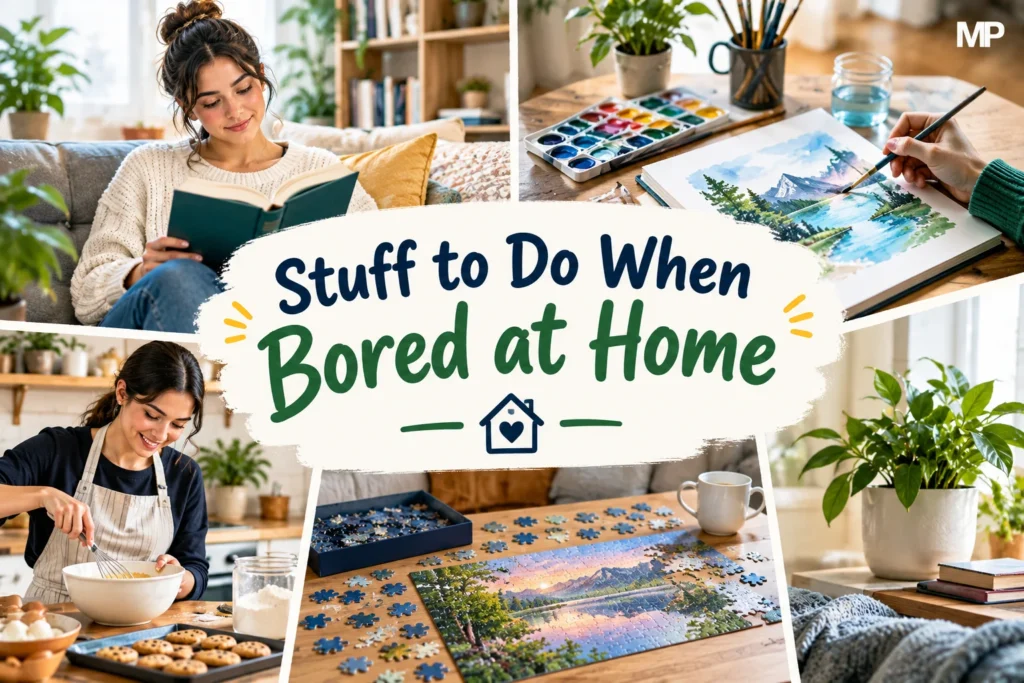

Being bored at home can happen even when you have a phone, television, internet connection, and a house full of things to do. The problem is often not a lack of options. It is simply that nothing sounds interesting at that moment. Instead of scrolling through the same apps or moving from the sofa to the kitchen and back, try one small activity that changes your routine.
There are plenty of things to do at home that cost little or nothing. You can cook something new, clean one small space, start a creative project, exercise, play a game, read, call someone, learn a skill, or simply give yourself time to relax. Recent guides covering this topic also emphasize practical activities that require little preparation.
Quick Information
| Quick Detail | Information |
| Topic | Stuff to Do When Bored at Home |
| Main intent | Find practical activities to beat boredom |
| Best for | Adults, teens, families and people spending time alone |
| Activity types | Fun, creative, productive, relaxing and social |
| Budget | Many ideas are free |
| Screen-free options | Yes |
| Solo activities | Yes |
| Family activities | Yes |
| Short activities | 5–30 minutes |
| Longer activities | 1 hour or more |
| Best approach | Pick an activity that matches your energy and mood |
Take a 10-Minute Reset
When motivation is low, don’t start with a huge project.
Set a timer for 10 minutes and choose one simple task. Make your bed, clear your desk, wash a few dishes, organize a drawer, or put away clothes that have been sitting around.
The goal is not to completely transform your home. It is to create a small change that gets you moving.
Current boredom guides frequently recommend short, manageable activities because they remove the pressure of having to commit to something complicated.
Try a New Recipe
Cooking is one of the easiest ways to turn an empty afternoon into something useful.
Look through your kitchen and choose ingredients you already have. Instead of searching for the perfect recipe, challenge yourself to make something from what is available.
You could try homemade pizza, pasta, sandwiches, pancakes, cookies, noodles, soup, or a simple dessert.
Cooking also gives boredom a clear ending: you make something, eat it, and have a result to show for your time.
Rearrange Your Room
You don’t need to buy new furniture to make your room feel different.
Move a desk, change the position of a chair, reorganize a shelf, switch your bedside arrangement, or create a small reading corner.
Even changing the position of a few objects can make a familiar room feel fresh.
If you have more time, choose one area rather than trying to reorganize the entire house. That makes the project easier to finish.
Start a Journal
Writing can be surprisingly useful when your mind feels stuck.
You don’t need to write a perfect diary entry. Open a notebook and answer simple questions such as:
What am I thinking about right now? What have I been avoiding? What would make today better? What do I want to learn this month?
You can also keep a gratitude list, write short stories, record ideas, or simply describe your day.
Read Something You’ve Been Ignoring
Most people have something they intended to read but never started.
It might be a novel, magazine, newspaper, saved article, ebook, or even a book sitting on a shelf for months.
Instead of setting a goal to read an entire book, read 10 pages.
If the book is interesting, you will probably continue. If it isn’t, you have still tested something new without spending your whole afternoon on it.
Watch a Movie Properly
Watching television is not automatically a bad way to spend free time.
The problem comes when you spend 45 minutes switching between titles and never actually watch anything.
Choose one movie before pressing play.
Make popcorn, turn off unnecessary notifications, lower the lights, and give yourself a proper movie-night experience.
You can also choose a movie from a genre you normally ignore.
Have a Mini Movie Marathon
If you have several hours available, turn a normal evening into a themed movie night.
Pick two or three movies connected by a theme. You could choose classic comedies, superhero films, animated movies, science fiction, thrillers, or movies from one particular decade.
Prepare snacks before starting so you don’t spend the entire night walking back and forth to the kitchen.
Play a Board Game
Board games are an easy option when several people are bored in the same house.
Chess, checkers, Monopoly, Scrabble, cards, and trivia games can work with different group sizes.
If you don’t own a board game, create a simple quiz using paper.
One person can write 10 questions, while everyone else tries to answer them.
Try a Puzzle
Puzzles are useful when you want something that occupies your attention without requiring a screen.
Try a crossword, Sudoku, word search, jigsaw puzzle, logic puzzle, or brain teaser.
You can start with something small rather than choosing a 1,000-piece puzzle that takes days to complete.
The goal is simply to give your brain something specific to work on.
Learn a New Skill
Boredom can become useful when you use it to learn something you have always wanted to try.
You could learn basic photography, cooking techniques, drawing, graphic design, typing skills, a language, music theory, or beginner coding.
Online tutorials make it possible to start without buying expensive equipment.
Choose one skill and spend only 20 minutes learning the basics. You can decide later whether you want to continue.
Draw Something

You don’t need to be an artist.
Take a pencil and paper and draw the first object you see.
Try drawing a cup, shoe, plant, phone, chair, or your own hand.
Another fun option is to set a five-minute timer and draw without lifting your pencil.
The point is not to create something perfect. It is to do something different.
Try Painting
Painting can make a quiet afternoon more interesting.
Use watercolor, acrylics, poster colors, or whatever supplies you already have.
If you don’t know what to paint, choose a photograph and try to recreate its basic shapes and colors.
You can also paint something intentionally abstract.
There are no rules saying the final result has to be suitable for display.
Make Something With Paper
Paper crafts are inexpensive and accessible.
Try origami, paper flowers, bookmarks, greeting cards, paper decorations, or simple models.
This can be particularly useful for families with children because the activity can be adapted to different ages. The British Council also recommends storytelling, crafts, songs, games, and creative activities as ways for children to stay engaged at home.
Create a Playlist
Open your music library and build a playlist around a specific idea.
You could create:
- A relaxing evening playlist
- Songs from your school years
- Favorite movie soundtracks
- Workout music
- Songs for driving
- New artists to discover
- Songs from one decade
You can make the process more interesting by limiting yourself to 20 songs.
Try a Home Workout
You don’t need gym equipment for basic movement.
Try squats, lunges, push-ups, stretching, walking around the house, dancing, or a beginner bodyweight workout.
If you’re not used to exercise, start gently rather than trying to complete an intense routine.
A short movement break can also be a better choice than remaining in the same position for several hours.
Have a Dance Session
Put on three songs you enjoy and dance until they finish.
That’s it.
You don’t need choreography, special clothing, or an audience.
It is one of the simplest ways to make a quiet room feel more energetic.
You can also invite friends or family members to join and turn it into a small competition.
Clean One Small Area
When your whole house looks messy, cleaning can feel overwhelming.
Instead, choose one drawer, one shelf, one table, or one corner.
Set a timer for 15 minutes and stop when it rings.
You may discover that the area is finished before the timer ends.
This approach makes cleaning feel more like a short challenge than a large household responsibility. Recent home-activity guides similarly recommend small resets rather than trying to reorganize everything at once.
Declutter Your Phone
Your physical environment isn’t the only thing that can become cluttered.
Check your phone and remove screenshots, duplicate photos, old downloads, unused apps, and unnecessary notifications.
You can also organize photographs into albums.
This is especially useful when you are bored but don’t want to spend another hour consuming content.
Instead of scrolling, you’re improving the device you already use every day.
Organize Your Computer
Your computer may have hundreds of files you no longer need.
Create folders for work, school, photos, documents, downloads, and personal projects.
Delete obvious duplicates and move important files into sensible locations.
If you have important documents, make sure you have an appropriate backup before deleting anything.
Write a Short Story
Give yourself a simple writing challenge.
Start with:
“At 11:47 p.m., someone knocked on the door.”
Then write for 15 minutes without worrying about grammar or quality.
You could also write a mystery, comedy, romance, science-fiction scene, or story based on something that happened to you.
Creative writing is especially useful when ordinary entertainment has stopped feeling entertaining.
Try Photography at Home
You don’t need an expensive camera.
Use your phone and photograph ordinary objects from unusual angles.
Try close-ups of household objects, shadows, reflections, textures, plants, food, or architectural details inside your home.
Give yourself a challenge such as “take 10 interesting photos without leaving the room.”
You may be surprised by how different familiar objects look through a camera.
Start a Small DIY Project
Look around your house for materials you already have.
You might be able to make a storage box, photo display, wall decoration, bookmark, organizer, or simple piece of room décor.
Don’t start with a project that requires 20 different supplies.
The best boredom projects are often the ones you can begin immediately.
Bake Something
Baking gives you a project with a clear result.
Try cookies, brownies, bread, cupcakes, muffins, or a simple cake.
If you don’t have everything needed for a complicated recipe, choose something with basic ingredients.
You can also turn it into a family activity by letting different people handle different parts.
Call Someone
Sometimes boredom is actually a desire for connection.
Call a friend, cousin, sibling, parent, or someone you haven’t spoken to recently.
Instead of sending “What’s up?” and waiting for a reply, ask a specific question.
“What have you been working on lately?” can lead to a much better conversation.
If calling isn’t convenient, write a thoughtful message or letter.
Have an Online Game Night
If your friends aren’t physically nearby, you can still spend time together.
Choose an online multiplayer game, trivia challenge, drawing game, or simple browser game.
You can also create your own quiz and share it through a group chat.
The activity does not have to be complicated. The main goal is to replace passive scrolling with actual interaction.
Make a Vision Board
Collect pictures, words, goals, quotes, and ideas that represent things you want to work toward.
You can make a physical board with paper and magazines or create a digital version.
Include realistic goals such as learning a skill, improving your room, saving money, traveling, reading more, or completing a project.
Keep it personal rather than making it look like something designed for social media.
Learn to Cook One Dish Well
Instead of learning five recipes badly, choose one dish and practice it.
Make notes about ingredients, cooking time, seasoning, and what you would change next time.
This turns boredom into a useful skill.
Over time, you can build a small collection of meals that you know how to prepare confidently.
Try a New Hobby
You don’t need to commit to a hobby permanently.
Treat it like an experiment.
Try knitting, drawing, chess, calligraphy, photography, gardening, journaling, baking, music, puzzles, or another activity that catches your interest.
Give it 30 minutes.
If you hate it, move on.
Boredom is a good time to test things without demanding that every experiment become a lifelong passion.
Make Your Own Trivia Quiz
Choose a topic you know well.
Write 10 questions and give them to someone else.
You can make categories such as movies, football, history, geography, celebrities, music, technology, or food.
For an extra challenge, make some questions multiple choice and some open-ended.
This is an easy activity to do alone or with family.
Try a No-Phone Hour
If you have spent the last hour switching between social apps, videos, and messages without actually enjoying them, put the phone somewhere out of reach.
Give yourself 60 minutes without checking it.
Read, cook, draw, clean, write, stretch, talk to someone, or simply sit somewhere different.
You don’t need to completely abandon technology. The point is to give your attention a break from constant notifications.
Create a Reading Corner
Choose a comfortable corner and make it inviting.
Add a chair, cushion, blanket, lamp, or small table if you have them.
Keep your current book nearby.
The goal is to make reading easier to start.
A comfortable environment can turn reading from something you “should” do into something you actually want to do.
Make a Personal Bucket List
Write down 25 things you want to experience.
They don’t all need to be huge goals.
Include small ideas such as:
- Learn to cook a favorite dish
- Watch a classic movie
- Read a particular book
- Visit a new place
- Learn a new skill
- Try a new sport
- Make something by hand
- Call an old friend
- Start a personal project
Having a list ready can be useful the next time boredom appears.
Do Something You Keep Postponing
There is probably one small task you’ve been avoiding.
Maybe you need to reply to an email, organize a folder, clean a shelf, schedule something, fix a small household problem, or finish an unfinished task.
Choose one.
Spend 15 minutes on it.
You may not finish, but you’ll have removed some of the mental weight attached to it.
Have a Self-Care Evening
Not every activity needs to be productive.
Take a shower, change into comfortable clothes, make a drink, dim the lights, listen to music, read, stretch, or simply relax. Current wellness guidance also emphasizes that self-care can include ordinary activities such as journaling, organizing your space, and taking intentional breaks rather than requiring an elaborate routine.
The important thing is choosing something that genuinely helps you recharge.
Try Something Completely New
Sometimes boredom comes from repeating the same routine.
Choose one activity you’ve never tried.
It could be learning a few words in another language, trying origami, making homemade bread, solving a puzzle, learning a magic trick, or creating digital art.
You don’t need to be good at it.
Being a beginner is part of the experience.
Things to Do When Bored at Night
Nighttime boredom can be different because you may want something quieter.
Try:
- Reading
- Journaling
- Watching a movie
- Listening to music
- Solving a puzzle
- Organizing photos
- Planning tomorrow
- Stretching
- Drawing
- Writing
- Preparing clothes for the next day
- Having a calm conversation with someone
Avoid turning every late-night boredom session into hours of scrolling.
A quiet activity may be much more satisfying.
Things to Do When You’re Alone
Being alone doesn’t automatically mean being lonely.
Solo time can be used for activities that are difficult when everyone else is around.
You could cook exactly what you want, watch a movie nobody else likes, reorganize your room, read, write, practice a skill, listen to music, or work on a personal project. Current activity guides aimed at solo time commonly recommend journaling, cooking, puzzles, learning, drawing, organizing, reading, and personal projects.
Things to Do With Family
If everyone at home is bored, choose an activity that requires participation.
Try a family trivia contest, card game, cooking challenge, indoor treasure hunt, movie night, storytelling session, karaoke, puzzle, or craft project. For children, storytelling, crafts, songs, games, and simple learning activities can provide entertainment while also encouraging creativity and interaction.
The best family activities usually don’t require expensive equipment.
Things to Do With Kids
Children often need activities that allow them to make, move, imagine, or solve something.
Build a blanket fort, create paper crafts, bake cookies, draw pictures, play a guessing game, make a treasure hunt, read a story together, or create an indoor obstacle course. The British Council recommends a combination of stories, crafts, songs, games, and educational activities for children spending time at home.
Letting children choose between two or three options can also make it easier to get them involved.
Things to Do Without Your Phone
If the problem is endless scrolling, choose something that physically separates you from the screen.
Read a physical book, cook, bake, clean, draw, paint, stretch, play cards, do a puzzle, write by hand, organize a shelf, or make something.
You don’t have to spend the entire day offline.
Even 30 minutes without a phone can make the afternoon feel different.
Quick Ideas for Very Low Energy
Sometimes you are bored but too tired to start a major activity.
Choose something tiny.
Drink a glass of water. Open a window. Change your clothes. Put on one song. Stretch for five minutes. Take a shower. Make tea. Watch one short documentary. Read five pages. Tidy one surface.
The purpose is simply to create movement.
If the first activity doesn’t help, choose another.
How to Choose the Right Activity
Instead of asking, “What can I do?”, ask a more specific question.
If you need energy, choose movement.
If your room feels chaotic, tidy something.
If your mind feels restless, try a puzzle.
If you feel creative, draw or write.
If you want company, call someone.
If you’re exhausted, choose something relaxing.
This makes the decision much easier because you are matching the activity to your current mood.
Make a Boredom List
The next time you’re bored, don’t wait until the moment arrives to think of ideas.
Create a list now.
Write down 20 activities you can do at home. Include different energy levels.
For example:
5 minutes: make tea, stretch, and tidy the surface.
15 minutes: journal, organize photos, draw.
30 minutes: cook, exercise, read.
1 hour: bake, play a game, watch a movie.
Several hours: learn a skill, complete a DIY project, organize a room.
Keep the list somewhere accessible.
Final Thoughts
There is plenty of stuff to do when bored at home, but the best choice depends on what you actually need at that moment. If you’re restless, move. If your mind is tired, choose something simple. If you want to feel productive, finish one small task. If you want entertainment, play a game or watch something intentionally.
The biggest mistake is thinking you need to find one perfect activity.
You don’t.
Pick something that takes 10 or 15 minutes, start without overthinking it, and see where it goes. Current guides on boredom repeatedly return to this same practical idea: small activities such as walking, reading, organizing, cooking, crafts, puzzles, and creative projects can turn an otherwise empty stretch of time into something more enjoyable or useful.
And if the first idea doesn’t work, that’s fine.
Try another one.
FAQs
What are some fun things to do when bored at home?
You can watch a movie, play a game, bake something, try a new recipe, draw, make a playlist, solve a puzzle, or call a friend. Choose something that matches your mood rather than forcing yourself into an activity you don’t enjoy.
What can I do when I’m bored at home alone?
Reading, journaling, cooking, drawing, learning a skill, exercising, organizing your room, photography, puzzles, and personal projects are all good solo options. Recent activity guides also recommend using alone time for hobbies and small creative projects.
What can I do instead of scrolling on my phone?
Try a no-phone activity such as reading, cooking, cleaning one small area, drawing, baking, stretching, playing cards, writing, or solving a puzzle. Even a short screen-free period can give you a different way to spend your free time.
What are some things to do when bored with friends at home?
Play board or card games, create a trivia quiz, cook together, have a movie night, try karaoke, play online multiplayer games, or organize a small competition. The best activities are usually simple enough that everyone can join.
What can I do when bored at night?
Choose quieter activities such as reading, journaling, watching a movie, listening to music, stretching, drawing, planning the next day, or organizing something small. If you’re tired, choose something relaxing rather than starting a demanding project.
What can kids do when bored at home?
Kids can build blanket forts, make paper crafts, play games, draw, bake, tell stories, create treasure hunts, or try simple educational activities. The British Council recommends stories, crafts, songs, games, and creative learning activities for children at home.



Pingback: How to Remove Water Stains From Wood: Easy Methods That Work