

Duaction is an emerging term commonly used online to describe the connection between learning and practical action. Instead of treating education and practice as completely separate stages, the idea encourages people to learn a concept and then use it through a task, project, experiment, simulation, or real-world situation.
The term has appeared in a growing number of online articles during 2026, where it is generally explained as a combination of learning with action. However, there is an important distinction to make: Duaction itself is not currently a universally standardized academic theory with one official definition, founder, or established set of rules. Its underlying ideas overlap with much older and well-documented approaches such as experiential learning, active learning, applied learning, and work-based learning.
Quick Bio Information
| Information | Details |
| Term | Duaction |
| Common meaning | Combining learning with practical action |
| Main idea | Learn, apply, review, and improve |
| Common explanation | A blend of “dual” and “action” |
| Area | Education, training, skill development |
| Status | Emerging/informal online term |
| Established academic theory? | Not currently verified as a standardized framework |
| Related concepts | Experiential learning, active learning, project-based learning, work-based learning |
| Practical focus | Turning knowledge into usable skills |
| Possible users | Students, professionals, teachers, trainers, independent learners |
| Typical activities | Projects, experiments, simulations, practice, workplace tasks |
| Core cycle | Learn → Apply → Review → Improve |
What Is Duaction?
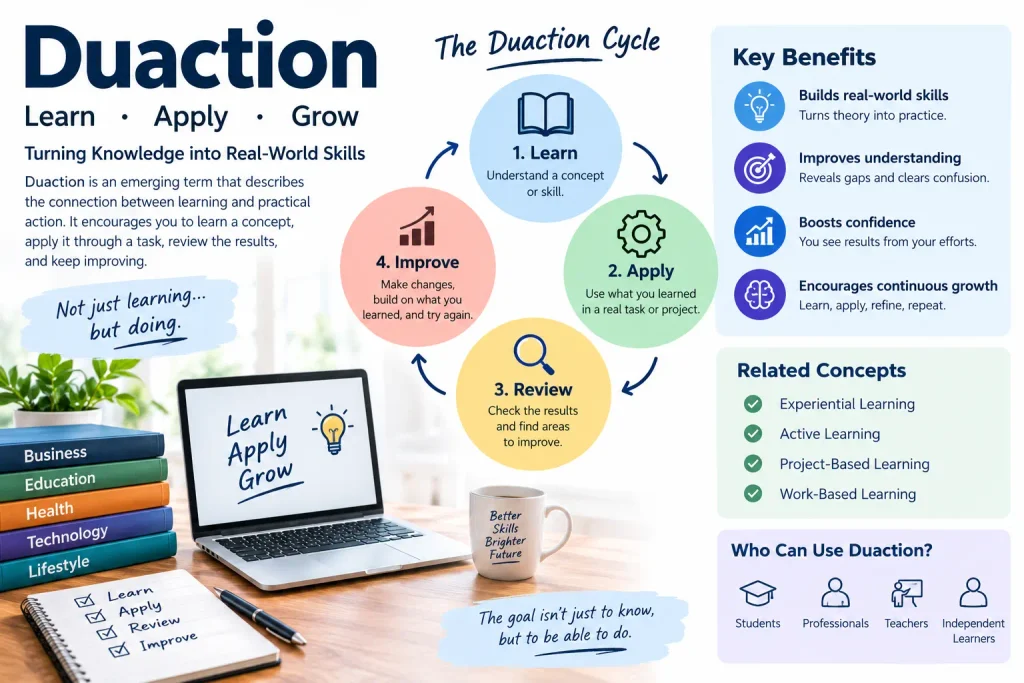
At its simplest, Duaction means connecting knowledge with action.
A learner does not necessarily wait until the end of a course to use what they have learned. Instead, a concept can be introduced in a manageable amount and then followed by an activity that allows the learner to put that knowledge into practice.
For example, someone learning web development might study HTML for a short period and then immediately build a simple webpage. After seeing the result, the learner can identify errors, receive feedback, and make improvements.
This is the central idea behind the term as it is currently described online: learning becomes closely connected to doing.
Duaction Meaning
The most common online explanation of Duaction meaning connects the word with the ideas of “dual” and “action.” The intended concept is that two elements work together: acquiring knowledge and applying it.
However, the exact origin of the word is not firmly established in academic literature.
That means it is better to describe Duaction as an emerging label for a practical learning concept rather than claiming that it represents a formally recognized educational discipline.
This distinction also makes the term easier to understand. The interesting part is not the name itself but the learning process behind it.
How Duaction Works
A simple Duaction-style learning cycle can contain four main stages:
Learn: Understand a concept, process, or skill.
Apply: Use the knowledge in a practical activity.
Review: Examine the result and identify mistakes or successful elements.
Improve: Make changes and try again.
The cycle can continue as the learner becomes more capable.
For example, a person learning photography might study exposure, take photographs using the concept, review the images, identify problems with lighting, and then adjust camera settings for the next attempt.
The important point is that practice is connected directly to instruction rather than being treated as something that happens much later.
Why Practical Application Matters
Knowing information and being able to use it are not always the same thing.
A student may understand the definition of a programming function but still struggle to write working code. Someone may study marketing theory but find it difficult to create an actual campaign. A trainee may understand workplace procedures but feel uncertain when faced with an unfamiliar situation.
Practical activities expose the learner to those gaps.
Established research on active learning has long emphasized the value of students taking an active role through activities such as discussion, practice, and applying concepts. ERIC records research describing active involvement, practice, and application as important elements of active learning.
Duaction uses a similar basic principle under a newer label.
Duaction and Experiential Learning
The closest established concept is experiential learning.
ERIC defines experiential learning broadly around “learning by doing,” including knowledge and skills gained outside traditional book or lecture settings through work, play, and other experiences. Its related areas include internships, job shadowing, service learning, apprenticeships, and work-based learning.
Research on experiential learning also emphasizes the role of active participation, real-world problems, experience, reflection, and experimentation. A systematic review indexed by ERIC discusses a revised experiential learning cycle involving concrete experience, reflective observation, conceptualization, and active experimentation.
This is why Duaction should not be presented as though the basic principle of learning through practice was invented by the term.
The underlying educational approach has a much longer history.
Duaction and Active Learning
Active learning focuses on getting learners involved in the learning process rather than asking them to remain passive recipients of information.
An active learning activity might ask students to solve a problem, discuss a concept, complete an exercise, explain an idea, or apply information to a specific situation.
Duaction overlaps with this approach because both place importance on participation and application.
The main difference is mostly one of emphasis. Duaction descriptions found online place particular attention on connecting the learning stage with practical action. Active learning is a much broader and established educational term used in academic research.
Duaction and Work-Based Learning
Work-based learning provides another strong comparison.
The Institute of Education Sciences explains that work-based learning connects classroom learning to workplace experiences. Examples include workplace tours, job shadowing, internships, cooperative education, on-the-job training, and apprenticeships.
These experiences allow learners to apply academic or technical knowledge in practical settings.
For example, a student studying information technology might learn networking concepts in class and then work on a supervised network setup.
That is very close to the basic “learn and apply” principle associated with Duaction.
A Simple Example
Imagine someone learning digital marketing.
First, the learner studies the basics of keyword research.
Instead of reading about keywords for several weeks without using them, the learner selects a small website and performs keyword research on an actual topic.
The learner then creates a simple content plan.
After publishing or testing the work, they examine the results and identify what could be improved.
The learner returns to the theory, adjusts the approach, and tries again.
That process creates a connection between knowledge, action, feedback, and improvement.
Duaction for Students
Students can apply this concept to many subjects.
A biology student could perform a controlled experiment after learning the relevant theory. A computer science student could build a small application after studying a programming concept. A business student could analyze a real company rather than working only with hypothetical examples.
The practical activity does not have to be large.
In fact, small tasks can make the approach easier to manage.
A short exercise immediately following a lesson can show whether the learner actually understands the concept.
Duaction for Professionals
The same idea can be useful in professional development.
Employees often complete training courses, watch presentations, or read manuals before returning to their normal responsibilities.
A more practical approach can introduce a concept and then provide an opportunity to use it in a controlled work task.
For example, someone learning a new customer-service system could practice handling a simulated customer request immediately after learning the system.
That gives the learner an opportunity to identify problems before dealing with more complicated real situations.
Duaction in Online Learning
Online education makes practical application particularly interesting.
Digital courses can combine short lessons with:
- Interactive exercises
- Coding environments
- Simulations
- Quizzes
- Projects
- Case studies
- Assignments
- Real-world challenges
A learner can move from watching a lesson to completing an activity without leaving the learning environment.
This can help reduce the distance between “I understand this” and “I can actually do this.”
However, the quality of the activity matters. Simply adding a quiz after every video does not automatically create meaningful practical learning.
Duaction and Technology
Technology can make practical learning easier to organize.
Simulation software, coding platforms, virtual laboratories, collaborative tools, artificial intelligence systems, and online project environments can allow learners to practice skills without needing access to a full physical workplace.
For example, a coding student can write and test programs immediately after studying programming concepts.
Similarly, a business student can use a simulated company scenario to practice decision-making.
Technology is therefore not the definition of Duaction. It is simply one possible way to connect learning with action.
Duaction in the Workplace
Businesses can use practical learning when training employees.
A company introducing new software could combine a short explanation with guided exercises.
A sales team could study a new sales process and then practice it through role-play.
A manager learning a reporting system could build an actual sample report rather than only reading instructions.
Work-based learning research similarly emphasizes connecting classroom or instructional learning with real-world contexts and practical skills. IES notes that high-quality work-based learning can help students apply classroom learning in business and community settings.
Benefits of Duaction
The potential benefit of this approach is straightforward: learners get opportunities to use information instead of only remembering it.
Practical application can help reveal misunderstandings.
Suppose a learner believes they understand a concept. When they attempt to use it, they may discover that they cannot complete the task without additional explanation.
That feedback is valuable.
The learner can then return to the relevant material, correct the misunderstanding, and attempt the activity again.
Experiential learning research also identifies active participation, real-world problems, and reflection as important features of meaningful learning experiences.
Skill Development
One major reason practical learning is attractive is that many skills cannot be demonstrated through memorization alone.
Writing, programming, designing, repairing equipment, conducting experiments, presenting ideas, managing projects, and handling workplace situations all require some form of practice.
A learner may know the theory but still need repeated attempts to develop reliable performance.
Duaction places that practice closer to the learning process.
Feedback and Improvement
Feedback is another important part of the process.
A learner completes a task, reviews the outcome, receives feedback, and then changes the approach.
For example, a student writing an article might learn about structure, write a short piece, receive feedback about clarity and organization, and revise the article.
The revision creates another learning opportunity.
This makes the process more than simply “learn and do.” A stronger model is learn, do, review, and improve.
Possible Limitations
Duaction should not be presented as a solution for every educational problem.
Some subjects require substantial theoretical foundations before practical work can begin.
A medical student, for example, cannot safely perform complex procedures simply after reading one short lesson.
Similarly, advanced mathematics may require extensive conceptual development before practical application becomes useful.
The most sensible approach is therefore balanced learning.
Direct instruction can establish foundations. Practice can develop skills. Reflection can deepen understanding. Feedback can correct errors.
Different methods can work together.
Is Duaction a Formal Theory?
Based on the current evidence, Duaction should not be described as a universally standardized academic theory.
Current online descriptions characterize it as an emerging or informal term for connecting learning with practical action. They also note that there is no single universally accepted definition, founder, or standardized framework associated with the word.
That does not make the concept meaningless.
The underlying principles have clear relationships with established educational practices. The important distinction is between the established learning methods and the newer label being used online to describe some of those ideas.
Duaction vs Traditional Learning
Traditional education is sometimes described as theory first and application later, but real educational systems are more varied than that.
Many classrooms already include experiments, discussions, projects, practical assignments, internships, and other forms of active learning.
Therefore, it would be inaccurate to suggest that traditional education always means memorization followed by a final exam.
Instead, Duaction can be viewed as an emphasis on keeping learning and application closely connected.
It can complement conventional instruction rather than necessarily replacing it.
Duaction vs Experiential Learning
The two concepts have significant overlap.
| Duaction | Experiential Learning |
| Emerging online label | Established educational concept |
| Emphasizes learning plus action | Emphasizes learning through experience |
| Often described as learn → apply → review | Commonly involves experience, reflection, conceptualization, and experimentation |
| No single standardized definition currently verified | Extensive academic literature |
| Practical application is central | Practical experience is central |
| Can describe small learning activities | Can include internships, projects, fieldwork, and other experiences |
The key difference is academic maturity and documentation, not necessarily the practical idea behind the terms.
How to Practice Duaction
Anyone can use the basic concept without adopting the word itself.
Start with a clear learning objective.
Learn only enough information to understand the next practical task.
Then perform the task.
After completing it, review the result. Identify mistakes, questions, and areas of uncertainty.
Finally, return to the learning material and improve the next attempt.
For example:
Learn: Study basic photography exposure.
Apply: Take photographs using manual settings.
Review: Examine brightness, shadows, and detail.
Improve: Adjust shutter speed, aperture, or ISO.
Repeat: Take another set of photographs.
The cycle turns information into experience.
Who Can Use Duaction?
The concept can be adapted by many groups.
Students can use projects and practical assignments.
Teachers can connect lessons with real tasks.
Professionals can practice new workplace skills.
Trainers can combine instruction with simulations.
Entrepreneurs can test business concepts through small experiments.
Independent learners can build projects around subjects they study.
The method is especially useful when the skill can be demonstrated through an observable activity.
What Makes It Effective?
The strongest practical learning activities usually have a clear purpose.
The learner should know what they are trying to accomplish, what knowledge is relevant, and how success will be evaluated.
Feedback also matters.
A learner who repeatedly practices the wrong method may simply reinforce mistakes.
Good instruction therefore combines explanation, practical activity, feedback, and reflection.
Research on experiential learning emphasizes reflection as an important part of turning experience into meaningful learning.
Duaction in Career Preparation
Career preparation is an area where practical learning has an obvious role.
Students may learn about a profession in the classroom but gain a different understanding when they experience workplace conditions.
IES describes work-based learning as a continuum that can include career awareness, workplace tours, job shadowing, internships, co-ops, on-the-job training, and apprenticeships. These experiences connect academic learning with workplace contexts.
This provides a strong real-world example of the broader principle behind Duaction.
What Duaction Is Not
Duaction should not be treated as a magic shortcut for learning.
It does not mean that reading, lectures, theory, or memorization are unnecessary.
It also does not mean that every lesson needs to become a large project.
And because the term itself has no universally accepted academic standard at present, claims that Duaction guarantees specific learning improvements should be treated cautiously unless supported by independent research.
The most defensible interpretation is much simpler:
Learn something, use it, examine what happened, and improve.
Last Wordings
Duaction is an emerging term used online to describe the connection between learning and practical action. Its central idea is easy to understand: people should have opportunities to use what they learn instead of leaving knowledge entirely at the theoretical level.
The concept overlaps strongly with established approaches such as experiential learning, active learning, project-based learning, applied learning, and work-based learning. These approaches have much stronger academic documentation than the newer Duaction label.
Duaction can be a useful way to describe a learn–apply–review–improve cycle, but it should not currently be presented as a universally recognized educational theory with a single official definition.
In practice, the principle can be simple and flexible. A student can apply it through a project, a professional can use it during workplace training, and an independent learner can turn a lesson into a small personal experiment.
FAQs
What does Duaction mean?
Duaction commonly refers to connecting learning with practical action. A learner studies a concept, applies it through a task, reviews the result, and uses the experience to improve.
Is Duaction an official educational theory?
Not currently in the sense of a universally standardized academic framework. Current online descriptions treat it as an emerging or informal term that overlaps with established learning approaches.
How does Duaction work?
A simple Duaction cycle is learn, apply, review, and improve. The learner connects new knowledge with an activity instead of waiting until much later to practice it.
What is the difference between Duaction and experiential learning?
Experiential learning is an established educational concept with substantial academic literature. Duaction is a newer online label that describes ideas closely related to learning through experience and practical application.
Can students use Duaction?
Yes. Students can apply the basic idea through projects, experiments, simulations, practical assignments, coding exercises, presentations, and real-world problem-solving activities.
Is Duaction useful for professional training?
The underlying approach can fit professional training because workplace learning often involves applying knowledge to practical situations. Work-based learning programs similarly connect classroom concepts with real-world skills and workplace experiences.