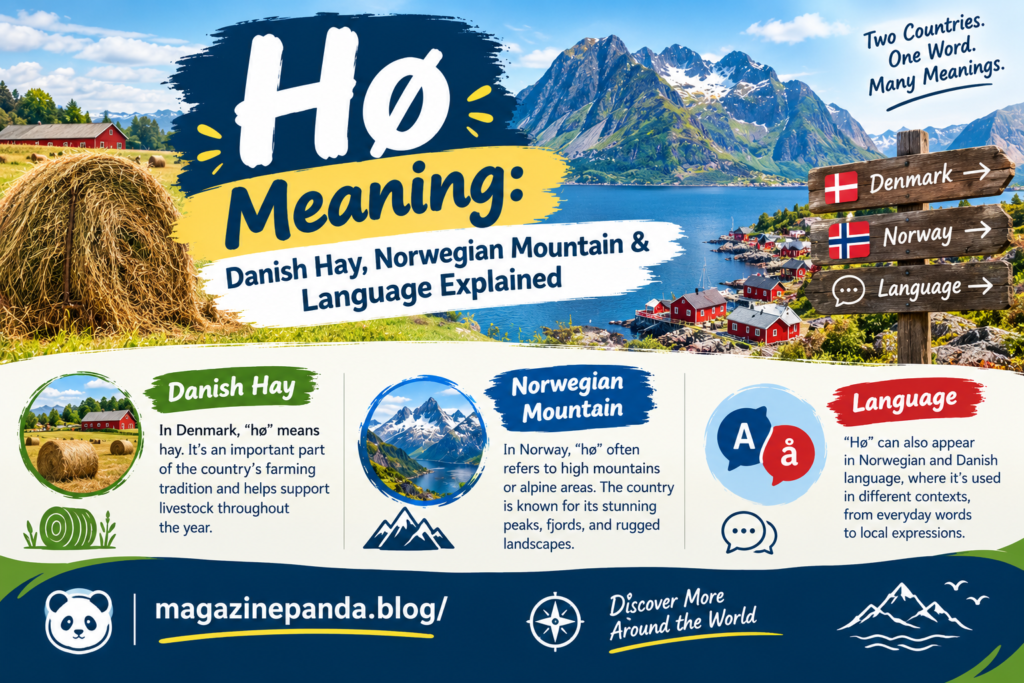

Hø has different meanings depending on the language and context. In Danish, hø means hay, or grass that has been cut and dried for animal feed. In Norwegian, the same spelling can describe a rounded or dome-shaped mountain rising from a high mountain plateau. It can also appear as an interjection in Danish and Norwegian. Because of these differences, the meaning of hø cannot be understood correctly without looking at the language and sentence where it appears.
What Does Hø Mean?
The word hø is a good example of how one short spelling can have several meanings across Scandinavian languages.
Its most common meanings include:
- Hay in Danish
- A rounded mountain in Norwegian
- An expression of rejection or contempt in Danish and Norwegian
- A representation of an awkward laugh or throat-clearing sound in some uses
These meanings are not simply different definitions of one modern English word. They come from different language uses and historical roots. That is why context matters when you see hø online, in a dictionary, or in a place name.
Hø Meaning in Danish
In Danish, hø means hay. It refers to grass that has been cut and dried so it can be stored and used as food for livestock and other animals. The Danish Dictionary gives this as the main noun meaning of the word.
Hay is an important type of rough feed. Farmers can preserve cut grass as hay when fresh pasture is not available or when animals need stored feed.
For example, Danish phrases involving hø can relate to making, collecting, drying, or storing hay.
The word is also connected with agriculture because hay is commonly used for animals such as horses, cattle, goats, and other livestock.
Hø in English
When hø is used in its Danish agricultural sense, the English translation is simply “hay.”
The Danish-English entry from Cambridge also translates hø as “hay” and gives the same basic agricultural meaning.
So if you encounter a Danish sentence about grass being cut, dried, stored, or fed to animals, hø will most likely mean hay.
Example
A simple translation would be:
Danish: hø
English: hay
The accent-like letter ø is part of the original spelling. It should not automatically be replaced with an ordinary “o,” because that changes the written form of the word.
Hø as a Norwegian Mountain Term
The meaning changes when hø appears in Norwegian geographical language.
In Norwegian, hø can refer to a rounded or dome-shaped mountain that rises from a high mountain plateau. Store norske leksikon gives this geographical meaning and notes that the word occurs in mountain names, particularly in parts of Innlandet and southern Trøndelag.
The Norwegian Academy Dictionary gives a similar definition, describing hø as a rounded, dome-like mountain rising from a high mountain plateau.
This meaning is very different from the Danish word for hay.
That is one of the main reasons the keyword can be confusing for people researching it in English.
Hø in Norwegian Place Names
The Norwegian mountain meaning becomes especially interesting when it appears inside mountain names.
Store norske leksikon gives examples such as Knutshøa in Oppdal and Knutshøe in Vågå. These names show how older geographical words can remain part of modern Norwegian place names.
The word is connected with the idea of height rather than agricultural hay in this context.
So if you see hø in a Norwegian mountain name, translating it as “hay” would produce the wrong meaning.
Where Does the Norwegian Mountain Meaning Come From?
The Norwegian mountain sense has a different historical background.
The Norwegian Academy Dictionary traces this use to Old Norse hǿð, meaning height, and connects it with older words associated with being high.
Store norske leksikon gives the same basic historical connection and lists the Old Norse form as hœð, meaning height.
This explains why the geographical meaning relates naturally to elevated land.
It also shows why two words that look identical today can have very different meanings.
Hø as an Interjection
There is another use of hø that has nothing to do with hay or mountains.
In Danish, hø can work as an interjection used to show mockery, dissatisfaction, or contempt. The Danish Dictionary records this as a separate meaning.
The exact feeling depends on the situation.
Someone might use the expression to reject something, show disbelief, or respond in a mocking way.
This type of use is closer to an emotional sound than a normal noun.
Hø and “Hø Hø”
You may also see hø hø repeated.
In Danish, this can represent a silly, artificial, or awkward laugh. The Danish Dictionary records the repeated form as a way of representing an odd or forced laugh, sometimes used with irony.
Norwegian has a similar use. The Norwegian Academy Dictionary lists hø as an interjection that can express contempt or rejection, imitate throat clearing, or represent an embarrassed or half-hearted laugh when repeated.
Therefore, “hø hø” should not be translated literally as “hay hay.”
The surrounding conversation tells you what the speaker actually means.
Hø vs Høy
One common source of confusion is the Norwegian word høy.
Although hø and høy look similar, they are not automatically the same word.
In Norwegian, høy can be used as an adjective meaning high, while the shorter form hø has its own geographical meaning when referring to a particular type of mountain.
This difference is important when researching Norwegian words or place names.
Adding or removing the final letter can completely change the meaning.
Why Does Hø Have So Many Meanings?
Languages often develop words through different historical paths.
A short word may also survive in several forms because of old vocabulary, regional use, place names, and changes in pronunciation.
In the case of hø, the Danish agricultural meaning has a historical connection with Old Norse hey and is related to the English word hay. The Danish Dictionary identifies this origin and notes the relationship with English hay.
The Norwegian mountain term has a separate connection to Old Norse hœð, meaning height.
That is why the same modern spelling can point to different concepts.
Hø Meaning by Language
| Language or context | Meaning of hø |
|---|---|
| Danish | Hay |
| Danish figurative use | Something poor, worthless, or bad |
| Danish interjection | Mockery or dissatisfaction |
| Danish sound expression | Artificial or silly laughter |
| Norwegian geography | Rounded or dome-shaped mountain |
| Norwegian interjection | Rejection, contempt, throat clearing, or awkward laughter |
| Norwegian place names | Often connected with the mountain term |
The table shows why simply searching for a single English translation can be misleading.
Hø as a Danish Agricultural Word
The Danish meaning is especially useful when reading farming or animal-care information.
Hay is made by cutting grass and allowing it to dry before it is stored. Good hay can provide an important source of roughage for animals.
The quality of hay depends on factors such as the plants used, cutting time, drying conditions, storage, and moisture levels.
The word hø can therefore appear in discussions about farming, livestock, horse care, feed, and grassland management.
It can also appear in compound Danish words related to haymaking and storage. The Danish Dictionary lists terms connected with harvesting, drying, storing, and handling hay.
Hø in Figurative Danish Use
Danish hø can also have a figurative meaning.
The Danish Dictionary records a use referring to something considered worthless, poor, or bad.
This is different from the literal agricultural meaning.
For example, when someone describes something as hø in a figurative context, they may not be talking about grass at all. They may be criticizing the quality of an object, idea, piece of work, or situation.
The surrounding sentence is therefore essential for translation.
How Should You Translate Hø?
The safest translation depends on the context.
If the text is Danish and discusses animals or farming, hø = hay is the likely answer.
If the word appears in a Norwegian mountain name, it may refer to a rounded mountain or elevated landform.
If it appears as an emotional expression, it may represent mockery, rejection, contempt, or an awkward laugh.
This is why automated translation can sometimes produce an answer that looks strange. A translation system needs enough surrounding text to identify which meaning is intended.
Hø Pronunciation
The pronunciation also differs slightly according to language and use.
Danish dictionary sources provide a pronunciation for hø that uses the rounded vowel represented by ø.
Norwegian dictionary sources also provide a pronunciation using the same written vowel.
For English speakers, ø does not have an exact equivalent in standard English.
It is better to learn the sound from a native Danish or Norwegian speaker than to replace it with an ordinary English “o.”
Is Hø a Norwegian Word or Danish Word?
It can be both.
The important point is that the meanings are different.
In Danish, hø commonly means hay. In Norwegian, hø can be a geographical term for a rounded mountain. Norwegian also has hø as an interjection.
Therefore, calling it only a Danish word or only a Norwegian word would leave out important information.
Frequently Asked Questions About Hø
What does hø mean in Danish?
In Danish, hø primarily means hay, or dried grass used as animal feed. It can also have figurative and interjection uses.
What does hø mean in Norwegian?
In Norwegian geography, hø describes a rounded or dome-shaped mountain rising from a high mountain plateau.
What is hø in English?
The answer depends on context. In Danish agriculture, it means hay. In Norwegian geography, it refers to a particular type of mountain.
Is hø the same as hay?
In Danish, yes, hø is the word for hay. The English word hay and Danish hø are historically related.
What does hø hø mean?
Depending on the language and context, hø hø can represent an awkward, artificial, or half-hearted laugh.
Is hø used in Norwegian mountain names?
Yes. The term appears in Norwegian mountain names, including examples such as Knutshøa and Knutshøe.
Is hø the same as høy?
No. They can have different meanings and grammatical roles. Høy is commonly associated with “high” in Norwegian, while hø has its own meanings, including the mountain term.
Final Verdict
Hø is a small word with several distinct meanings. In Danish, it most commonly means hay, while in Norwegian it can describe a rounded mountain rising from a high plateau. Both languages also use hø as an interjection in certain situations. The word’s history explains some of these differences, but context remains the easiest way to identify the intended meaning. If you encounter hø in a Danish farming text, think “hay.” If it appears in a Norwegian mountain name, think “mountain or height.”



Pingback: HM Meaning in Text: How People Use It in Online Conversations