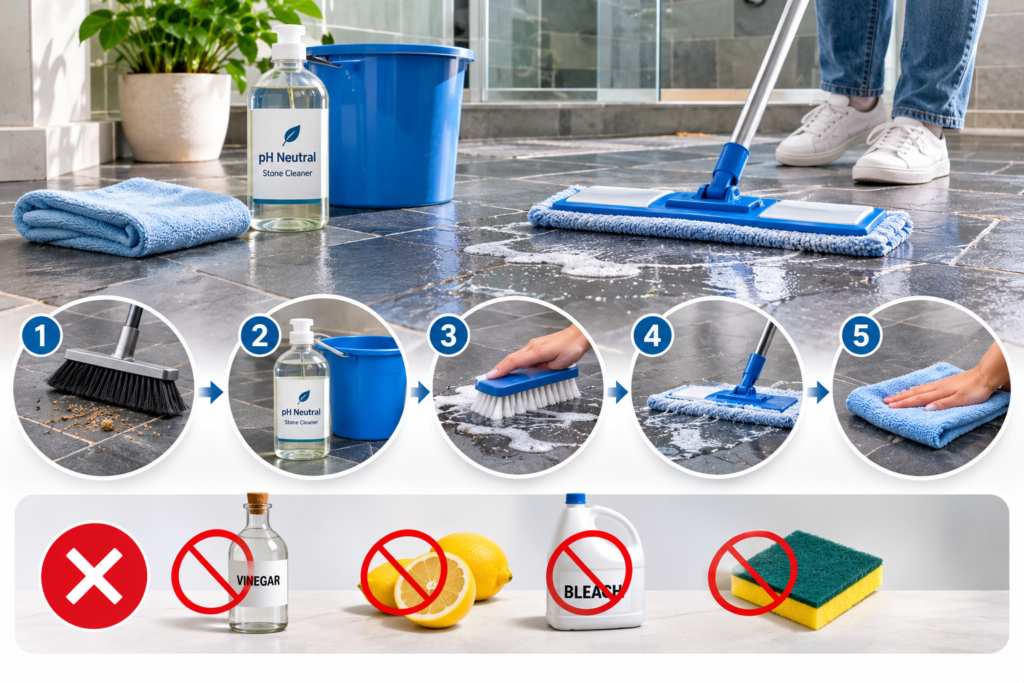

Slate tiles can give floors, walls, entryways, bathrooms, fireplaces, and other areas a distinctive natural appearance. Their textured surface also makes them different from smooth ceramic or porcelain tiles. Cleaning slate properly requires a gentler approach because slate is a natural stone and some cleaning products can damage the stone, grout, or protective sealer.
The safest general method is to remove loose dirt first, use a cleaner designed for natural stone, clean with a soft tool, remove the dirty solution, and allow the surface to dry properly. The Natural Stone Institute recommends neutral cleaners, stone soap, or mild dishwashing detergent with warm water for routine natural-stone care.
Quick Slate Cleaning Table
| Slate problem | Safer starting approach |
| Dust and grit | Soft broom or dust mop |
| Routine dirt | Neutral stone cleaner and gentle cleaning |
| Soap scum | Non-acidic stone-safe soap-scum remover |
| Mildew | Stone-compatible mold/mildew treatment |
| Oil stain | Identify the stain and use an appropriate stain treatment |
| Deep stain | Consider a poultice or professional treatment |
| Water marks | Use a compatible stone-care method |
| Scratches | Avoid aggressive DIY abrasion; assess the damage |
| Dull finish | Check for etching or coating damage before recoating |
| Recurring moisture | Address the source rather than repeatedly cleaning |
The correct treatment depends on the type of slate, finish, stain, and existing protective coating, so this table should be treated as a starting point rather than a universal prescription.
Understand Your Slate
Before cleaning slate tiles, consider where they are installed and whether they have a sealer or other finish.
Slate is a natural stone with a layered structure, and its surface can range from relatively smooth to naturally cleft and textured. The Natural Stone Institute notes that slate is a softer dimension-stone material and is not particularly resistant to abrasion or scratching.
This is why the cleaning process should avoid unnecessary abrasion. A product or tool that works well on a hard manufactured tile may not be appropriate for every slate surface.
Remove Loose Dirt
Start by removing dust, sand, hair, grit, and other loose debris.
For floors, use a soft dust mop, soft-bristle broom, or suitable vacuum attachment. Be careful with vacuum wheels and attachments because worn or hard components can scratch some natural-stone surfaces. The Natural Stone Institute recommends frequent dust mopping because sand, dirt, and grit can act as abrasives against natural stone.
Choose the Right Cleaner
For routine slate cleaning, choose a pH-neutral cleaner specifically intended for natural stone, or use another mild cleaning solution recommended by the slate manufacturer.
LATICRETE’s current STONETECH guidance recommends gentle products formulated for stone, tile, and grout maintenance. Its slate care instructions warn that highly alkaline, acidic, ammonia-based, abrasive, or bleach-containing cleaners can damage some stone, grout, or existing sealers.
Always read the product label before applying a cleaner to the entire surface.
Avoid Vinegar
Vinegar is frequently recommended online as a natural household cleaner, but it should not be your default choice for slate.
The Natural Stone Institute advises against acidic cleaning products because acids can damage certain natural stones. It specifically warns that products containing lemon, vinegar, or other acids can dull or etch acid-sensitive stone.
A stone-safe, neutral cleaner is a more appropriate starting point when you do not want to risk damaging the surface.
Test the Cleaner First
Before cleaning the entire slate installation, test the product in a small, hidden area.
This is particularly important when the slate has an existing sealer, color-enhancing treatment, wax, topical coating, or an unknown finish. LATICRETE recommends testing its slate-care products in an inconspicuous area and observing the result before proceeding.
If the test area changes color, becomes dull, develops residue, or reacts unexpectedly, stop and identify the existing finish before continuing.
Clean Small Sections
Do not flood the entire slate floor with cleaning solution at once.
Instead, divide the surface into small, manageable sections. Apply the appropriate cleaner and work gently across the slate so you can control the amount of moisture and cleaning solution.
This approach is particularly helpful with textured slate because dirt can collect in small depressions and along the natural surface pattern.
Use a Soft Brush
Natural-cleft slate can trap dirt more easily than a smooth tile.
A soft or non-abrasive nylon brush can help reach textured areas without relying on excessive pressure. LATICRETE’s slate maintenance guidance allows non-abrasive scrubbing for heavily soiled areas and recommends appropriate stone-care products.
Avoid steel wool, aggressive abrasive pads, and hard tools unless a stone-care professional specifically recommends them for the particular surface.
Do Not Let Dirty Water Sit
As you clean, remove the dirty solution instead of allowing it to remain on the slate.
For larger floors, this may mean changing mop water regularly. The Natural Stone Institute recommends changing rinse water frequently and thoroughly rinsing natural stone after washing.
Leaving dirty water on the surface can simply redistribute the material you were trying to remove.
Rinse the Surface
After cleaning, follow the cleaner’s instructions regarding rinsing.
For many natural-stone cleaning procedures, clean water is used to remove remaining cleaning solution and loosened soil. The Natural Stone Institute recommends thorough rinsing after washing and drying the surface with a soft cloth.
LATICRETE’s slate guidance also includes wiping or rinsing cleaned areas depending on the cleaning product being used.
Dry the Slate
Allow the slate to dry completely after cleaning.
For a floor, excess water can be removed with a clean mop or suitable towel. For smaller surfaces, a soft microfiber cloth can help remove remaining moisture.
Do not judge the final appearance while the slate is still wet. Natural stone can look considerably darker when damp, so wait until it has completely dried before deciding whether additional cleaning is necessary.
Remove Soap Scum
Slate used in showers and bathrooms can develop soap scum just like other tile surfaces.
For this type of buildup, use a non-acidic soap-scum remover designed for natural stone. LATICRETE’s current slate-care instructions include a dedicated soap-scum cleaning procedure involving application, wiping or gentle scrubbing, rinsing, and drying.
Avoid automatically reaching for an acidic bathroom cleaner because slate is still a natural stone surface.
Clean Slate Shower Tiles
Slate shower tiles need additional attention because they are exposed to constant water, soap, body oils, and humidity.
A squeegee can be useful after showering because removing excess water reduces the amount of moisture and residue left on the surface. The Natural Stone Institute recommends squeegeeing wet-area stone surfaces to help minimize soap-scum buildup.
Good ventilation also helps the shower dry between uses.
Treat Mold and Mildew
Mold and mildew may develop in damp slate installations, especially around grout lines and poorly ventilated areas.
Use a product specifically labeled as suitable for natural stone and follow its instructions. Current LATICRETE slate-care guidance includes a mold-and-mildew treatment using a dedicated product, followed by rinsing and repeat treatment when necessary.
Never mix cleaning chemicals together. The Natural Stone Institute specifically warns that mixing bleach and ammonia can create a toxic and potentially lethal gas.
Remove Hard Water Deposits
White or cloudy marks on slate can sometimes be caused by mineral deposits from hard water.
Do not immediately assume that an acidic descaler is appropriate. The safest approach is to identify the stone and use a compatible stone-care product.
If the deposit is severe or the surface has already become etched, a professional stone-care specialist may be needed rather than repeated household cleaning.
Deal With Grease and Oil
Slate can develop darker areas when oil-based substances penetrate the stone.
The Natural Stone Institute recommends identifying the type of stain before choosing a treatment. Oil-based stains can include grease, cooking oil, cosmetics, and similar substances.
A surface stain may respond to an appropriate cleaner, while a deeper stain may require a poultice treatment or professional restoration.
Remove Organic Stains
Food, leaves, plant material, and other organic substances can leave discoloration on natural stone.
The correct treatment depends on the type and depth of the stain. The Natural Stone Institute recommends identifying the stain first and provides different approaches for organic, oil-based, metallic, biological, and other stains.
Do not keep applying random cleaners when the cause of the discoloration is unknown.
What Is a Poultice?
A poultice is a material used to draw certain stains out of porous stone.
It is generally reserved for stubborn or deep stains that normal surface cleaning cannot remove. The Natural Stone Institute explains that the appropriate poultice depends on the type of stain and that difficult stains may require several applications or professional assistance.
Because poultice treatments can involve stronger chemicals and longer contact times, they should be approached carefully.
Seal Slate Tiles
Sealing can be useful for some slate installations, but it does not make the stone completely stain-proof.
The Natural Stone Institute explains that impregnating sealers primarily make natural stone more resistant to staining, rather than permanently preventing stains. It recommends discussing the appropriate sealer and application frequency with the stone supplier or sealer manufacturer.
LATICRETE’s current slate guidance similarly states that slate can be susceptible to both oil- and water-based staining and that sealing can help protect its appearance.
Check If Slate Needs Sealing
Not every slate surface should automatically receive the same sealing schedule.
Slate’s porosity varies, so a simple water test can provide useful information. LATICRETE’s guidance explains that if slate darkens after water is applied and allowed to sit for several minutes, the stone is absorbing moisture and may benefit from sealing in certain applications.
For an existing installation, however, the stone’s current condition and any previous coatings should be considered before applying a new product.
Clean Before Sealing
Never use a sealer as a substitute for cleaning.
The slate should be clean and free from unwanted coatings, dirt, and residues before sealing. Otherwise, you can trap an undesirable appearance beneath the new protective treatment.
LATICRETE’s current sealer instructions emphasize preparing the surface properly and testing the product before full application.
Protect the Grout
Slate installations often include cement-based grout, which can also absorb staining material.
Maintaining the grout separately helps preserve the appearance of the complete installation. Depending on the grout type and installation, an appropriate penetrating sealer may provide additional stain resistance.
Do not assume that the grout and slate require exactly the same product. Both materials should be compatible with the selected cleaner and sealer.
Cleaning Slate Floors
Slate floors benefit from regular dry maintenance because grit can act like an abrasive under foot traffic.
Sweep or dust mop frequently, particularly in entrances and high-traffic areas. Then use a suitable damp-cleaning method when necessary.
The Natural Stone Institute recommends mats or rugs near entrances to reduce the amount of sand and grit reaching natural-stone floors.
Cleaning Slate Walls
Slate wall tiles generally require less mechanical cleaning than floors because they are not exposed to shoe traffic.
Dust the surface first, then use a damp soft cloth or appropriate stone cleaner when needed. In bathrooms, focus on soap residue and moisture management rather than aggressive scrubbing.
For decorative or heavily textured slate, a soft brush can help reach recessed areas without unnecessary abrasion.
Cleaning Outdoor Slate
Outdoor slate can collect dirt, organic debris, algae, and moss more quickly than indoor installations.
Routine sweeping and water rinsing can remove ordinary debris. For biological growth, use a stone-compatible treatment and follow its instructions.
The Natural Stone Institute provides specific guidance for outdoor natural-stone surfaces and recommends suitable cleaning methods for algae and moss.
Common Mistakes to Avoid
One of the biggest mistakes is treating slate like ordinary ceramic tile.
Acidic cleaners, abrasive powders, harsh scrubbing, excessive cleaner concentration, and incompatible bleach or ammonia products can cause problems. Some cleaners can also affect an existing sealer.
Another mistake is ignoring the cause of recurring stains. If water, oil, or biological growth continues to reach the slate, repeated cleaning may only provide a temporary improvement.
How Often Should Slate Be Cleaned?
There is no single schedule that works for every slate installation.
A busy kitchen floor may need frequent dust removal, while a decorative wall may only require occasional cleaning. A shower can need more frequent maintenance because soap and moisture are continuously introduced.
Regular light cleaning is usually preferable to allowing heavy soil to accumulate. LATICRETE recommends routine sweeping and light damp mopping as part of natural slate maintenance.
When to Call a Professional
Professional help may be appropriate when slate has deep stains, widespread discoloration, severe scratching, etching, damaged grout, failing coatings, or an unknown finish.
The Natural Stone Institute recommends contacting a stone supplier, installer, or restoration specialist when a problem is too difficult to handle with ordinary cleaning.
Trying increasingly aggressive household chemicals can turn a manageable cleaning problem into a restoration project.
Final Wordings
Cleaning slate tiles does not have to be difficult, but it does require the right products and a gentle approach. Start by removing loose grit, then use a natural-stone-safe cleaner and suitable soft tools. Rinse or wipe according to the cleaner’s instructions and allow the surface to dry completely.
The most important rule is to avoid treating slate like an ordinary manufactured tile. Acidic products, abrasive cleaners, and unsuitable chemicals can damage natural stone or its protective treatment. The Natural Stone Institute recommends neutral cleaning products for routine stone care, while current LATICRETE guidance provides slate-specific maintenance and sealing recommendations. For long-term maintenance, regular dust removal, prompt cleanup of spills, sensible moisture control, and appropriate sealing where needed can help preserve the appearance of slate. If a stain is deep or the surface has been damaged, professional stone restoration is safer than repeatedly experimenting with stronger household cleaners.
FAQs
What is the best cleaner for slate tiles?
A pH-neutral cleaner made for natural stone is a safe starting point for routine slate maintenance. Follow the product label and test it on a small hidden area first.
Can you clean slate tiles with vinegar?
It is better to avoid vinegar as a general slate-cleaning solution. Natural Stone Institute guidance recommends avoiding acidic products for natural stone because they can cause surface damage on acid-sensitive materials.
How do you clean dirty slate floors?
Remove loose grit first, then use a suitable stone cleaner with a soft mop or cloth. Avoid abrasive tools and change dirty rinse water regularly so removed soil is not spread back over the floor.
Should slate tiles be sealed?
Some slate installations benefit from sealing, particularly where staining is a concern. However, sealing increases stain resistance rather than making slate completely stain-proof, and the correct product depends on the stone and installation.
How do you remove stains from slate?
First identify what caused the stain. Surface stains may respond to appropriate cleaning, while deeper oil, rust, organic, or biological stains can require specialized treatment or a poultice. Severe staining may need professional restoration.
Continue Exploring Our Latest Article: How to Clean Shower Tiles: Easy Steps for Tile, Grout and Soap Scum