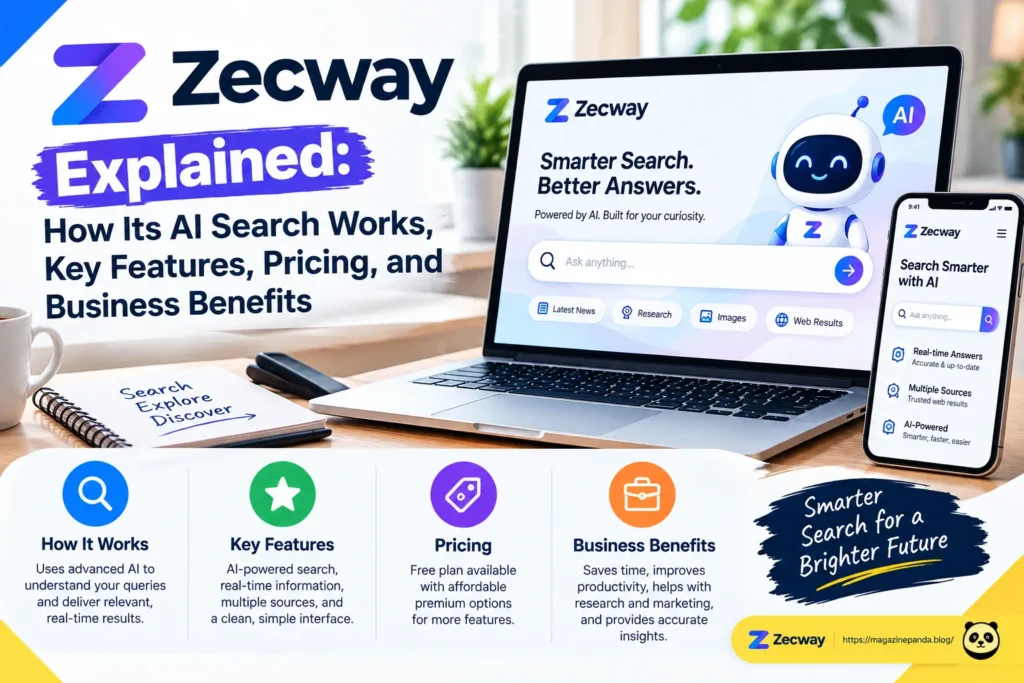

Zecway is an emerging workplace AI platform designed to help businesses find information scattered across company documents, messaging tools, and other work applications. Instead of searching several systems individually, employees can use a unified search interface to locate internal knowledge and receive AI-generated answers linked to their original sources.
As of October 2026, Zecway is promoting an early-access program rather than presenting itself as a fully established, generally available enterprise product. Its vision combines workplace search, an AI assistant, and agents that can perform selected tasks with human approval. The platform aims to make company information easier to find, understand, and use in everyday business activities.
For businesses considering Zecway, the most important questions concern its features, integrations, privacy practices, availability, and potential value. Understanding these areas can help organizations decide whether an emerging AI search platform fits their existing workflow.
Quick Facts About Zecway
| Detail | Information |
| Name | Zecway |
| Official website | zecway.com |
| Product category | Workplace AI and knowledge management |
| Primary purpose | Search and use internal company information |
| Main advertised layers | Search, AI assistant, AI agents |
| Named workplace tools | Google Drive, Slack, Notion, email |
| Source citations | Advertised feature |
| Permission-aware access | Advertised design approach |
| Availability in October 2026 | Early access advertised |
| Public standard pricing | Not confirmed |
| Security certifications | Not independently confirmed |
| Intended audience | Business teams and organizations |
What Is Zecway?
Zecway is a business software platform focused on workplace knowledge management and artificial intelligence. Its goal is to make company information easier to discover and use when employees need answers for everyday tasks.
Businesses frequently store important information across cloud drives, email, messaging applications, and project documents. When these systems are disconnected, employees may spend time locating the latest file, finding a previous decision, or checking which version of a policy is correct.
Zecway aims to bring that information into a single search experience. Its broader product concept also includes an AI assistant for creating summaries and drafts, alongside agents designed to handle selected workflows.
The platform is intended to complement existing workplace applications rather than require businesses to replace every tool they already use.
How Does Zecway Work?
Zecway’s product concept has three main components: search, an AI assistant, and AI agents. Each component addresses a different stage of workplace productivity, from finding information to preparing work and carrying out selected actions.
The idea is to reduce the effort required to move between separate applications. Rather than opening multiple tools to reconstruct a conversation or locate a document, employees can ask a question in everyday language and use the results to continue their work.
The actual experience depends on available integrations, configuration, permissions, and the maturity of the features offered to each early-access customer.
Key Features of Zecway
Unified Workplace Search
One of Zecway’s main advertised features is a single search interface for company information. The platform identifies Google Drive, Slack, Notion, and email among the workplace tools it aims to connect.
This approach can help employees locate documents, discussions, and previous decisions without remembering precisely where the information was stored. Natural-language queries may also make searches easier for people who do not know the exact file name or keywords.
The value of unified search depends on how well the platform indexes connected sources and retrieves relevant material. Businesses should test it with realistic questions and verify that results remain current as documents change.
AI-Powered Answers
Zecway describes an assistant that generates answers using company knowledge rather than relying exclusively on general-purpose AI information.
For example, an employee might need to locate a current pricing document or prepare a summary of an internal policy. The assistant is intended to retrieve relevant information and present an answer that can be checked against its sources.
Source-backed answers are particularly important in business environments, where an incorrect statement can affect customer communications, financial decisions, or internal procedures. Nevertheless, citations do not guarantee accuracy; employees should check the original material before relying on important conclusions.
Document Citations
The company emphasizes linking AI-generated answers to the documents or conversations used to support them. This feature is intended to make verification easier and help employees understand where a response originated.
Citations can help distinguish documented company policy from an AI-generated interpretation. When several files contain conflicting information, users still need to determine which document is authoritative and whether it has been updated.
Businesses evaluating Zecway should test whether citations consistently lead to relevant sources and whether retrieved documents reflect the latest approved information.
Permission-Aware Access
Zecway says its system checks access permissions before information reaches the AI layer. Its stated objective is to ensure that employees only receive information they are authorized to view.
This is an important consideration for organizations with separate departments and confidential records. For example, a company’s finance documents should not automatically become accessible to every employee simply because the company connects its document storage to an AI tool.
However, the company’s statements are not a substitute for an independent security assessment. Before connecting sensitive accounts, organizations should request documentation about permission synchronization, access logging, data retention, and the handling of revoked permissions.
AI Agents and Automation
Zecway’s broader product vision includes agents that can research information, plan tasks, and carry out selected actions. Its website illustrates recurring research and workflows in which a human reviews an action before it is completed.
This concept extends workplace AI beyond answering questions. An agent could potentially gather information, prepare a draft, and submit it for approval instead of requiring an employee to complete every preliminary step manually.
The distinction between a demonstration and a production-ready feature matters. Businesses should confirm which agent functions are currently available, which integrations they support, and which actions require approval before treating automation as an established capability.
Who Can Benefit From Zecway?
Small and Medium-Sized Companies
Smaller businesses often operate with limited administrative resources while using several cloud applications. A unified search system could help employees locate company information without repeatedly asking colleagues to resend documents or explain previous decisions.
The strongest use cases are those in which information is frequently misplaced or duplicated. Before adopting another platform, a business should identify the specific search problems it wants to solve and measure whether Zecway improves them.
Operations Teams
Operations teams regularly work with procedures, internal instructions, project updates, and records of previous decisions. Finding the correct version of a document can be important when employees need to follow established processes.
A searchable knowledge layer could help teams retrieve relevant information more quickly. However, organizations should maintain clear document ownership and version control rather than relying on search technology alone to resolve outdated or contradictory records.
Sales and Marketing Teams
Sales professionals often need information from proposals, product documents, customer conversations, and pricing materials. An AI assistant that retrieves approved company information could help prepare initial drafts and summaries.
Marketing teams may also use internal knowledge to develop briefs or collect background information for campaigns. Human review remains necessary, especially when material will be published externally or contains confidential customer information.
Growing Organizations
As companies add employees and applications, important knowledge can become harder to locate. A centralized search experience may become more valuable when teams no longer share the same immediate context.
However, the benefits depend on the quality of the underlying data and the platform’s ability to respect access restrictions. A company should not assume that connecting more applications automatically produces better answers.
Zecway Integrations
Zecway’s public materials name Google Drive, Slack, Notion, and email as examples of workplace information sources. These integrations are intended to help users search across different tools through one interface.
The exact integration list, supported account types, synchronization behavior, and availability of individual connectors should be confirmed directly with the company. A platform may advertise a planned integration without making every feature available to all early-access users.
Before signing up, businesses should check whether their existing software versions are supported, how frequently information is synchronized, and whether deleted or restricted files are handled correctly.
Zecway Pricing in 2026
As of October 2026, Zecway promotes limited early access through its website and states that a credit card is not required to request access. Its public materials do not establish a standard subscription price or a complete list of paid plans.
It would therefore be misleading to assign Zecway a monthly fee without confirmation from the provider. Pricing may depend on the size of the organization, the number of users, available integrations, usage limits, and the commercial terms offered after early access.
Companies should ask about implementation costs, storage or usage limits, support arrangements, and the pricing that will apply when the early-access period ends. They should also clarify whether trial data can be exported or deleted if they decide not to continue.
Is Zecway Safe for Business Use?
Zecway emphasizes permission-aware access to company information. That is a useful stated objective, but it does not independently establish that every aspect of the service has been audited or certified.
Businesses should review the privacy policy, terms of service, data-processing agreement, and security documentation before connecting internal accounts. Important questions include where data is stored, whether information is used for model training, how long records are retained, and what happens when an employee’s access is revoked.
Organizations handling financial, legal, health, or other sensitive information may need additional reviews before approving an AI platform. A controlled pilot with non-sensitive documents can help assess functionality without exposing critical business data unnecessarily.
Zecway and Data Privacy
Workplace AI tools can process information that was originally created for a particular team or purpose. Connecting that information to a search platform makes it especially important to understand the scope of data access.
Zecway’s stated permission-aware approach is intended to preserve existing access boundaries. However, businesses should verify how this works in practice, particularly when permissions change or documents contain information from several departments.
Employees should also understand what data they are permitted to enter into AI prompts. Clear internal policies can help prevent accidental disclosure of confidential information and ensure that AI-generated content is reviewed appropriately.
Zecway vs. Traditional Workplace Search
Traditional workplace search generally helps users find files, messages, and records by matching queries with available information. Zecway aims to add an AI layer that can turn retrieved material into answers, summaries, and draft content.
This may be useful when an employee needs a consolidated explanation rather than a list of documents. For instance, locating a previous decision and summarizing its context can require less manual work if the system retrieves the relevant sources accurately.
The comparison should be based on real tasks rather than marketing language. Businesses should evaluate search relevance, response accuracy, source citations, access controls, speed, and ease of use before deciding whether the platform offers an improvement over their current tools.
Zecway vs. General-Purpose AI Assistants
General-purpose AI assistants can help with writing, brainstorming, research, and many other tasks. Their access to private company knowledge depends on the product, its connected applications, and the permissions configured by the user or organization.
Zecway positions itself around company-specific knowledge and workplace search. Its intended distinction is that answers should be grounded in internal business information and linked to their sources.
The two categories are not necessarily competitors in every situation. A company may use a general-purpose assistant for broad tasks and a workplace search product for internal information. The right choice depends on integration requirements, security controls, costs, and the reliability of the answers produced.
Limitations to Consider
Zecway is being promoted through an early-access program, so prospective users should not assume that every advertised capability is fully available or suitable for production use.
A knowledge platform can also inherit problems from the information it retrieves. Outdated documents, contradictory policies, incomplete records, and unclear file ownership can all affect answer quality.
Integration setup and permission management may require administrative work, especially in organizations with complex access rules. Teams should evaluate these requirements alongside the expected productivity gains instead of judging the product only by its feature list.
How to Evaluate Zecway Before Adopting It
A structured pilot can help a business determine whether Zecway solves a real problem.
First, identify several common tasks that currently require employees to search across different applications. These might include locating a policy, finding the latest approved pricing document, or reconstructing the background of a project decision.
Next, compare the platform’s results with the answers employees would obtain using existing tools. Check whether citations lead to the right sources, whether restricted information remains inaccessible, and how the system handles missing or contradictory information.
Finally, review the commercial and security requirements. Confirm the supported integrations, pricing, retention policies, support arrangements, and options for removing company data if the organization stops using the service.
Frequently Asked Questions
What is Zecway used for?
Zecway is designed to help employees find internal company information and use AI to generate answers, summaries, and drafts based on workplace knowledge.
Is Zecway free?
The company advertises early access without requiring a credit card to request access. That does not establish that all features will remain free or that a permanent free plan exists.
Which applications does Zecway support?
Its public materials name Google Drive, Slack, Notion, and email. Businesses should confirm the currently available connectors and any limitations before signing up.
Is Zecway safe to use?
The company advertises permission-aware access controls, but businesses should review its security documentation and privacy terms before connecting confidential data.
Does Zecway provide AI agents?
AI agents are part of its advertised product vision. The availability and scope of specific automation functions should be confirmed directly with the company.
Who should consider Zecway?
Organizations that store knowledge across multiple applications may find its unified search approach worth evaluating, particularly when employees frequently struggle to locate current information.
How much does Zecway cost in 2026?
A verified standard subscription price was not established from the publicly available information reviewed. Prospective customers should request current pricing directly from the company.
Final Thoughts
Zecway is an emerging workplace AI platform built around the idea that company information should be easier to find, verify, and use. Its advertised combination of unified search, source-backed answers, permission-aware access, and AI agents aims to reduce the friction involved in everyday business tasks.
Its potential value depends on how well these features work with a company’s actual applications and information. Early-access status, unconfirmed public pricing, and limited independently verified technical details mean that organizations should evaluate the product carefully before relying on it for important workflows.
The most sensible approach is to test Zecway against real workplace tasks, verify its security and integration capabilities, and compare the results with existing tools. This allows businesses to judge its practical value using evidence rather than assumptions about what AI automation can achieve.
Continue Exploring Our Latest Article: SkipTheGames.com: Features, Safety, Legality, and What Users Should Know in 2026


Pingback: UploadWords.com USA: Everything to Know About Its Purpose, Features, User Experience, and Safety - magazinepanda.blog